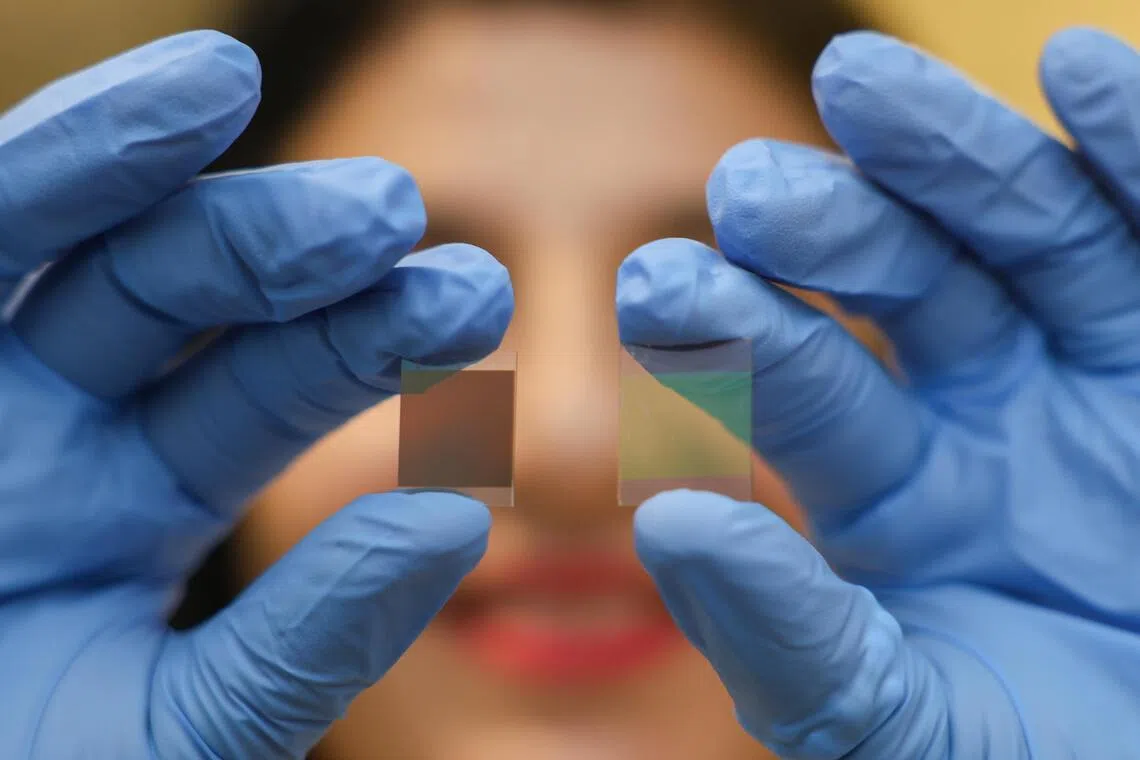
In a breakthrough for urban renewable energy, scientists at Nanyang Technological University (NTU) Singapore have developed ultra-thin, semi-transparent solar cells that can transform ordinary building windows and glass facades into active electricity generators.
Published in the scientific journal ACS Energy Letters, the development introduces perovskite-based solar films with an absorption layer shaved down to just 10 nanometers (nm)—roughly 10,000 times thinner than a strand of human hair and 50 times thinner than conventional perovskite configurations.
Disrupting Urban Solar: The Vertical Real Estate Play
In land-scarce, high-density urban environments like Singapore, vertical surface area on skyscrapers vastly outnumbers usable rooftop space. While traditional, opaque silicon solar panels cannot be mounted over windows without blocking natural light, this new technology presents a viable path toward Building-Integrated Photovoltaics (BIPV).
Because the newly engineered cells are intrinsically semi-transparent and color-neutral, they can be laminated directly onto skyscraper glazing, glass atriums, and vehicle sunroofs without significantly altering architectural aesthetics or blocking interior daylight.
Efficiency vs. Thickness Metrics
The NTU team, led by Associate Professor Annalisa Bruno at the Energy Research Institute @ NTU (ERI@N), successfully fabricated and benchmarked various thicknesses to chart the trade-off between light transmission and power conversion:
- 10 nm Opaque Prototype: Achieved an impressive 7% power conversion efficiency, marking one of the highest recorded yields for an ultra-thin photovoltaic architecture.
- 30 nm Opaque Prototype: Stepped up performance to 11% efficiency.
- 60 nm Semi-Transparent Variant: Maintained a 7.6% conversion efficiency while allowing 41% of visible light to pass directly through the material.
Crucially, unlike conventional rigid silicon panels, these ultra-thin perovskite configurations remain highly efficient at capturing energy from indirect, ambient, and diffuse light—making them ideally suited for vertical facades that experience shifting shade and reflection in dense city centers.
Scalable Manufacturing: Fully Vacuum-Processed
Historically, fabricating ultra-thin perovskite layers at scale has been bottlenecked by the reliance on liquid chemical solutions and toxic solvents, which introduce micro-defects and uneven crystallization.
The NTU Singapore team bypassed this hurdle by utilizing thermal evaporation—an industrially compatible, completely vacuum-based process. By heating the raw materials inside a vacuum chamber until they vaporize, the molecules settle uniformly across target substrates, allowing atomic-level control over the layer thickness. This marks the first time ultra-thin perovskite cells have been manufactured entirely via a dry, vacuum-driven production framework, smoothing the path toward high-volume commercial scaling.
Potential Urban Impact
According to preliminary modeling by the researchers, deploying these 60nm semi-transparent layers across a typical glass-clad office tower in Singapore’s Marina Bay or Raffles Place financial districts could theoretically generate several hundred megawatt-hours of clean electricity annually. This output roughly equals the annual grid consumption of 100 four-room HDB apartments.
Commercial Roadblocks and Next Steps
While the laboratory performance sets a new benchmark for ultra-thin photovoltaics, scaling the technology requires clearing standard commercial hurdles. Perovskite structures are traditionally sensitive to moisture, oxygen, and ultraviolet degradation over extended lifespans.
The university’s innovation enterprise, NTUitive, has officially filed a patent for the unique structural framework. The research group is currently entering discussions with manufacturing corporations and glass fabricators to standardize the thermal evaporation baseline, with immediate next-phase testing pivoting toward long-term weather durability and scaling the cells over multi-meter commercial window panes.
Get the day’s top stories in your inbox
One concise email. No spam, unsubscribe anytime.