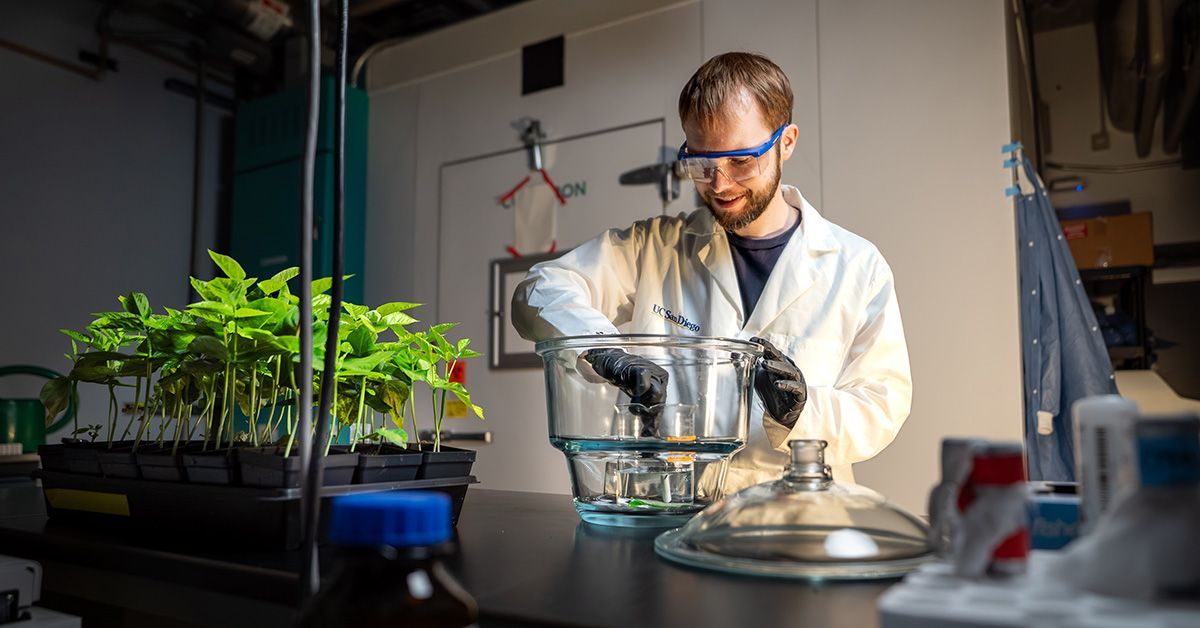
In a major breakthrough for deep-space exploration and astropharmacy, engineers at the University of California San Diego (UCSD) have developed a technique that allows astronauts to grow and repeatedly harvest pharmaceuticals from plants under space-like conditions.
The discovery solves a critical bottleneck for future multi-year missions, such as a round-trip to Mars. Currently, more than half of the medications stocked on the International Space Station (ISS) expire within three years, and standard pharmaceuticals rapidly degrade when exposed to space radiation.
The Innovation: Moving Past the “Smoothie” Problem
Traditionally, extracting custom therapeutic compounds or proteins engineered inside plants (a process called “molecular farming”) is incredibly destructive and wasteful. Scientists typically have to harvest the leaves and grind them down in a high-speed blender.
“You end up with something that looks like a smoothie, and you can imagine getting your product out of that smoothie is challenging,” noted Dr. Patrick Opdensteinen, the study’s first author.
To make pharmaceutical production viable inside a cramped spacecraft greenhouse, the UCSD team took inspiration from cellular biology and shifted to product secretion.
Instead of blending the plant, they realized they could draw out target medical particles from the apoplast—the network of interconnected spaces inside the leaves but outside the cell membranes—while keeping the living plant completely intact.
How It Works: The Vacuum and Spin Method
The researchers proved this non-destructive extraction pipeline using Nicotiana benthamiana (a close relative of the tobacco plant) and black-eyed pea plants engineered to produce cowpea mosaic virus (CPMV)—a stable plant virus that Senior Author Dr. Nicole Steinmetz has spent over a decade developing as an experimental immunotherapeutic cancer drug and vaccine delivery vehicle.
1.Submersion & Vacuum Flood:Under 15 mins.
Intact leaves from the living plants are gently submerged in a specialized liquid buffer solution inside a sealed container. A vacuum is applied, drawing air out of the tissue and forcing the medicinal buffer fluid directly into the apoplast spaces.
2.Centrifugal Extraction:Low-speed spin.
The fluid-saturated leaves are removed from the buffer and placed into test tubes. They are spun at a gentle speed inside a centrifuge, which acts like a spin-dryer, coaxing the liquid—now carrying the pure medicine particles—right back out of the leaf tissue.
3.Filtration & Purification:Immediate yield.
The harvested liquid is passed through a micro-filter. The filter isolates the large therapeutic CPMV particles while letting small, unwanted plant waste pass through, yielding a clean, concentrated pharmaceutical baseline.
Because the structural cell walls of the leaves are never ruptured, the plants remain perfectly healthy. They can be placed straight back into their growing pods to heal, continue growing, and be harvested repeatedly for subsequent batches of medicine. Using this pipeline, the team successfully harvested and purified therapeutic compounds from over 50 plants in less than two hours.
Thriving on “Space Stress”
To prove the system would survive beyond Earth’s atmosphere, the engineers collaborated with aerospace researchers to build a chaotic random positioning machine. The device continuously rotates growing plants to cancel out the directional pull of gravity, mimicking a microgravity environment. Concurrently, the plants were hit with temperature spikes and oxidative stressors to simulate ambient space radiation.
Surprisingly, the extreme “space stress” actually boosted the overall medicine yields.
Because stressed plants naturally experience a slightly weakened immune response, they became much more receptive to the underlying viral framework, causing the plant tissue to aggressively ramp up its production of the targeted medicinal particles.
The Roadmap for Astropharmacy
While the laboratory trials have successfully proven the viability of zero-waste, continuous harvesting on Earth, the research team is currently expanding the workflow to treat whole, rooted living systems rather than just detached leaves.
The next phase of the project involves working directly with rocket propulsion laboratories to test how intense launch vibrations affect the structural integrity of engineered seeds, paving the way for the first live biomanufacturing trials aboard the International Space Station later this decade.