Reserve Bank of India’s (RBI) Monetary Policy Committee (MPC) has unanimously voted to keep the policy repo rate unchanged at 5.25%. This marks the third consecutive meeting where the central bank has maintained a status quo on borrowing costs.
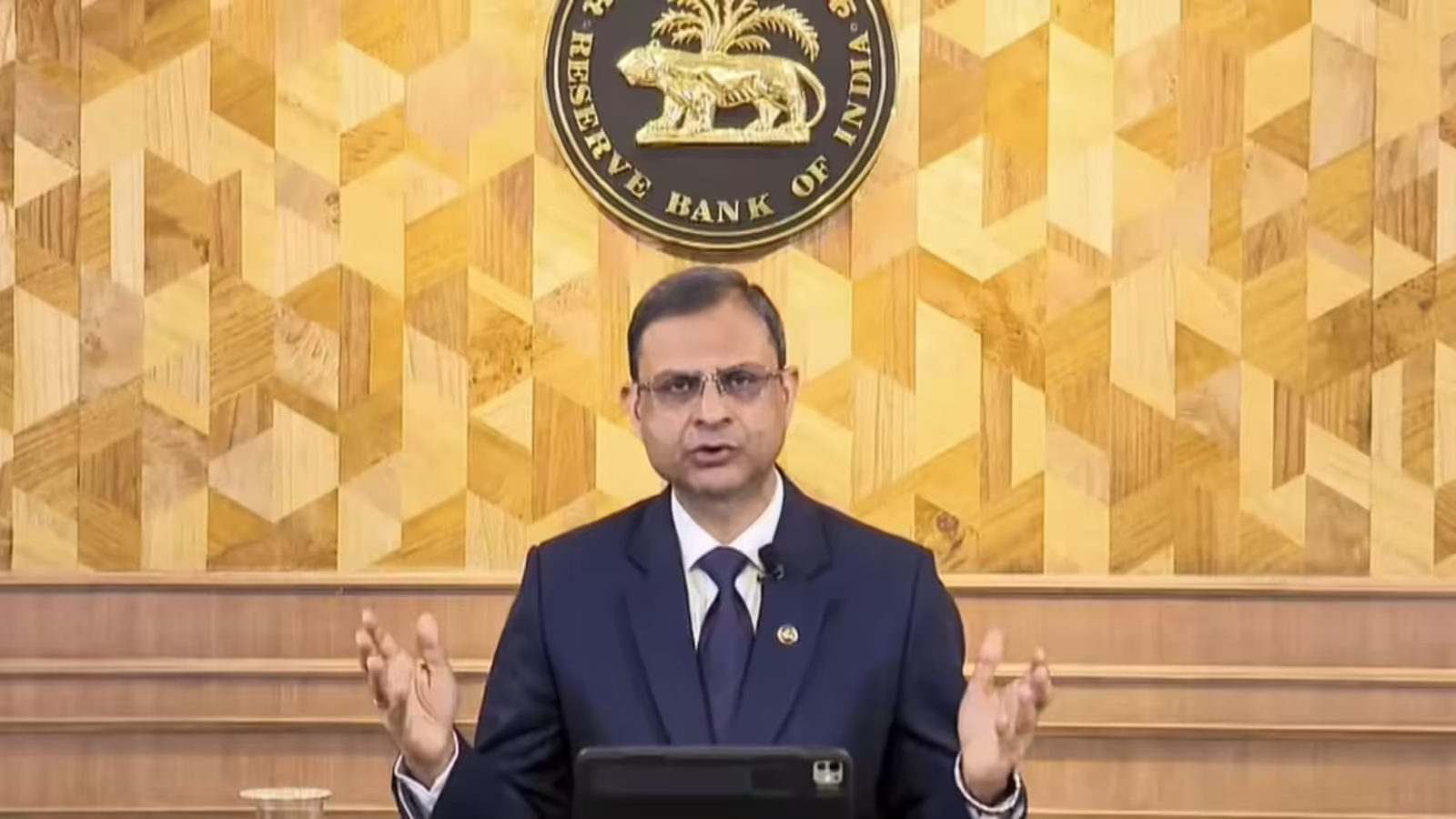
Announcing the decision at the conclusion of the three-day review meeting, RBI Governor Sanjay Malhotra stated that the committee also resolved to retain its “neutral” policy stance. This position gives the central bank maximum flexibility to respond to fluid domestic and global macroeconomic indicators.
Why the RBI Pressed the Pause Button
The central bank’s decision highlights a difficult balancing act. While India’s domestic economic momentum remains structurally sound, a deteriorating global environment has forced a highly cautious approach.
The primary catalysts keeping the repo rate on hold include:
1. The West Asia Spillover and Oil Shocks
A continuing geopolitical impasse in West Asia has emerged as a primary threat to global macroeconomic stability. The conflict has heavily disrupted key trade routes and supply chains, driving up international energy prices. Policymakers are keeping a close watch to ensure these elevated input costs do not filter down into widespread domestic inflation.
2. Upward Revision of Inflation Projections
Though domestic consumer price index (CPI) inflation sat comfortably below target at 3.48% in April, wholesale inflation accelerated sharply to 8.3%. Facing rising commodity costs and a weak rupee, the RBI raised its FY27 inflation forecast to 5.1% (up from the 4.6% projected in April). Headline inflation is anticipated to drift upward toward the central bank’s upper tolerance band during the third quarter of the fiscal year.
3. Uncertain Monsoon Signals
Adding to the supply-side risks, Governor Malhotra flagged concerns regarding domestic food inflation. Forecasters have flagged the potential return of El Niño conditions and subnormal southwest monsoon distributions, which could exert sudden upward pressure on seasonal food baskets.
Downgrade to GDP Growth Forecasts
Reflecting these compounded external headwinds, the RBI lowered its real GDP growth projection for FY27 to 6.6%, down from the 6.9% forecast issued during April’s policy meeting.
| Financial Period (FY27) | Projected GDP Growth Rate | Projected Inflation (CPI) |
| Quarter 1 (Q1) | 6.6% | 4.2% |
| Quarter 2 (Q2) | 6.3% | 5.1% |
| Quarter 3 (Q3) | 6.5% | 5.9% |
| Quarter 4 (Q4) | 6.8% | 5.9% |
| Full Year Average | 6.6% | 5.1% |
Technical Benchmarks & Policy Rates
Alongside the flat repo rate, all secondary peg benchmarks under the Liquidity Adjustment Facility (LAF) remain frozen at their previous metrics:
- Standing Deposit Facility (SDF) Rate: Held steady at 5.00%.
- Marginal Standing Facility (MSF) Rate: Maintained at 5.50%.
- Bank Rate: Kept unchanged at 5.50%.
Impact on Retail Borrowers and Fixed Deposit Investors
Because the benchmark repo rate hasn’t changed, banks are unlikely to make immediate, drastic updates to their loan or deposit rate structures.
- Home, Auto, and Personal Loan EMIs: Borrowers on floating-rate loans will see their EMIs hold steady for the time being. The era of consecutive interest rate cuts seen throughout 2025 has officially paused as the RBI prioritizes currency stability and inflation defense.
- Fixed Deposit (FD) Yields: For savers looking for higher fixed-income returns, the rate freeze limits room for commercial banks to aggressively increase FD interest payouts. However, with some market segments anticipating a potential rate hike later in the year if global oil shocks persist, long-term yields may face marginal upward adjustments.
Get the day’s top stories in your inbox
One concise email. No spam, unsubscribe anytime.