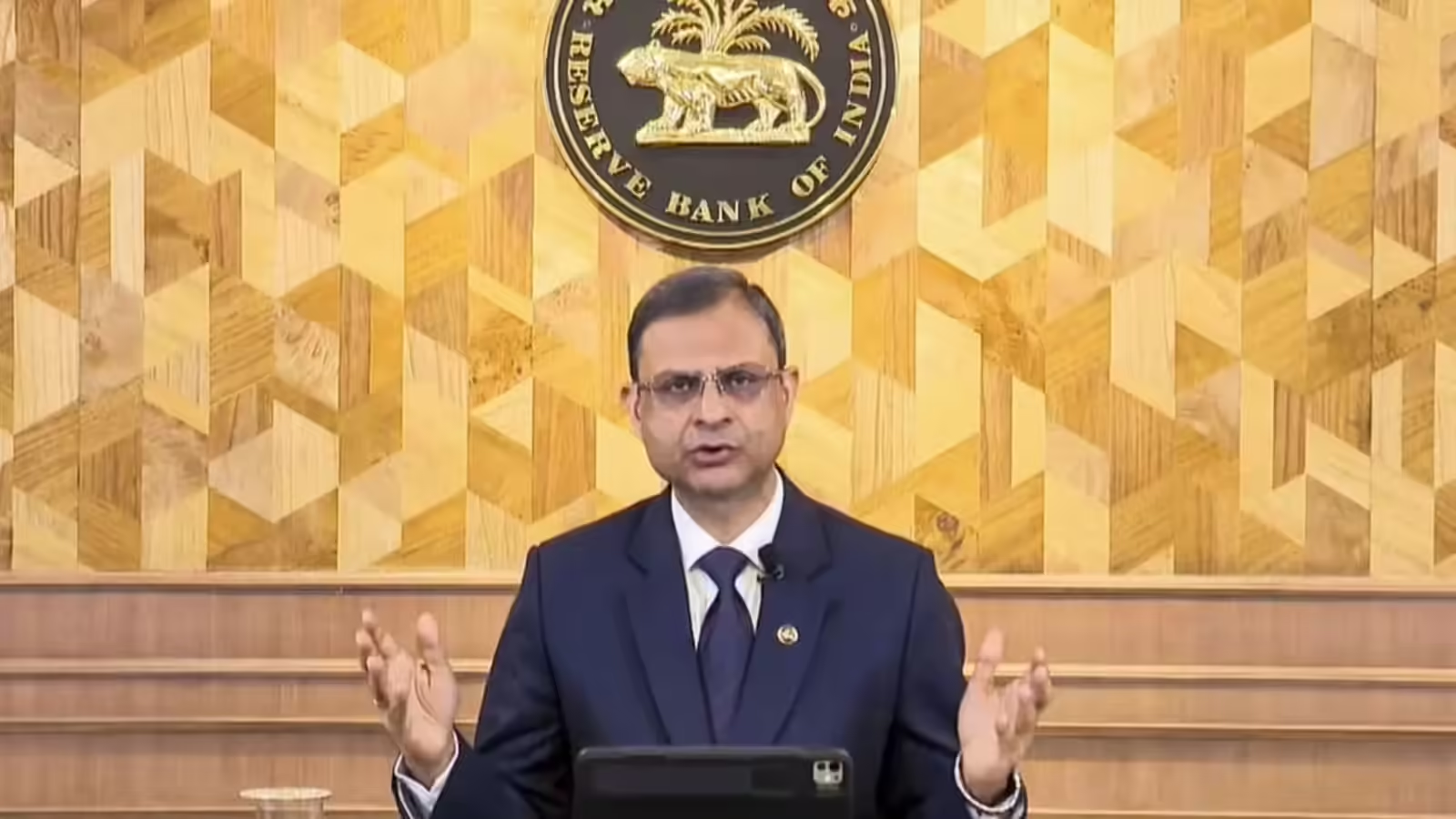
In a major move to attract foreign capital and deepen retail participation from the Indian diaspora, the Reserve Bank of India (RBI) has relaxed investment rules for Non-Resident Indians (NRIs) and Overseas Citizens of India (OCIs).
Announced by RBI Governor Shaktikanta Das during the June 2026 monetary policy review, the central bank has significantly increased the limits for investing directly in the Indian stock market under the Portfolio Investment Scheme (PIS) without requiring formal SEBI registration.
Furthermore, the RBI has extended this exact simplified investment facility to all individual Persons Resident Outside India (PROIs), bringing them completely on par with NRIs and OCIs.
Key Changes: Doubling the Investment Thresholds
The operational guidelines released by the central bank execute a policy transition that effectively removes historical investment caps on listed equities:
- Individual Investment Limit Raised: The maximum equity stake an individual NRI, OCI, or PROI can hold in a single listed Indian company has been doubled from 5% to 10% of its paid-up capital.
- Aggregate Ceiling Lifted: The combined, company-wide holding cap for all non-resident retail investors has been increased from 10% to 24% by default. Previously, surpassing a 10% aggregate stake required the company to pass a special shareholder resolution; it is now an open baseline.
Why is the RBI Easing These Rules Now?
The decision to streamline overseas capital comes at a crucial strategic junction for India’s financial landscape:
1. Capital Accumulation vs. Equity Volatility
While foreign institutional portfolio investors have been net sellers in the domestic equity market during the first half of 2026, the global Indian diaspora has been remitting cash at historic levels. According to data released by the RBI, personal remittances into India scaled to a record $135.46 billion in FY25. By easing direct investment bottlenecks, the regulator aims to channel these massive inflows directly into the capital markets.
2. Elimination of Regulatory Red Tape
By raising the limit thresholds before an investor is mandated to register as a Foreign Portfolio Investor (FPI), the RBI is slashing administrative friction. Investors can now deploy substantial capital through a basic non-resident bank account tied to a domestic broker without facing cumbersome SEBI compliance audits.
“This simplifies access to Indian equities… It broadens investment flexibility for overseas Indians who want exposure to India’s growth story but may not wish to navigate complex pooled fund structures or register as FPIs.”
— Adhil Shetty, CEO of BankBazaar, commenting on the operational shift.
Summary of the New Equity Investment Rules
| Metric | Old Framework | New Framework (Effective June 2026) |
| Individual NRI/OCI Cap | 5% of paid-up equity per company | 10% of paid-up equity per company |
| Aggregate NRI/OCI Cap | 10% baseline (24% only via special resolution) | 24% by default across listed entities |
| Foreign Individual (PROI) Access | Heavily restricted / FPI route only | Fully at par with NRIs via the PIS route |
| Registration Requirements | Mandatory SEBI registration for larger volumes | Exempt up to the new 10% / 24% caps |
Streamlining Onboarding: Fully Digital PIS Route
To support this change, the RBI announced the rollout of a simplified digital onboarding mechanism for Portfolio Investment Scheme (PIS) accounts, set to go live later this month.
To take advantage of the relaxed limits, NRIs must utilize an RBI-designated banking channel. Capital coming from foreign earnings must be routed through a Non-Resident External (NRE) account to retain full repatriability rights, while domestic Indian earnings (such as rent or dividends) will utilize Non-Resident Ordinary (NRO) channels. The new framework allows diaspora investors to build meaningful, high-conviction positions in mid-cap and small-cap Indian enterprises without being forced to artificially diversify due to regulatory ceilings.
Get the day’s top stories in your inbox
One concise email. No spam, unsubscribe anytime.