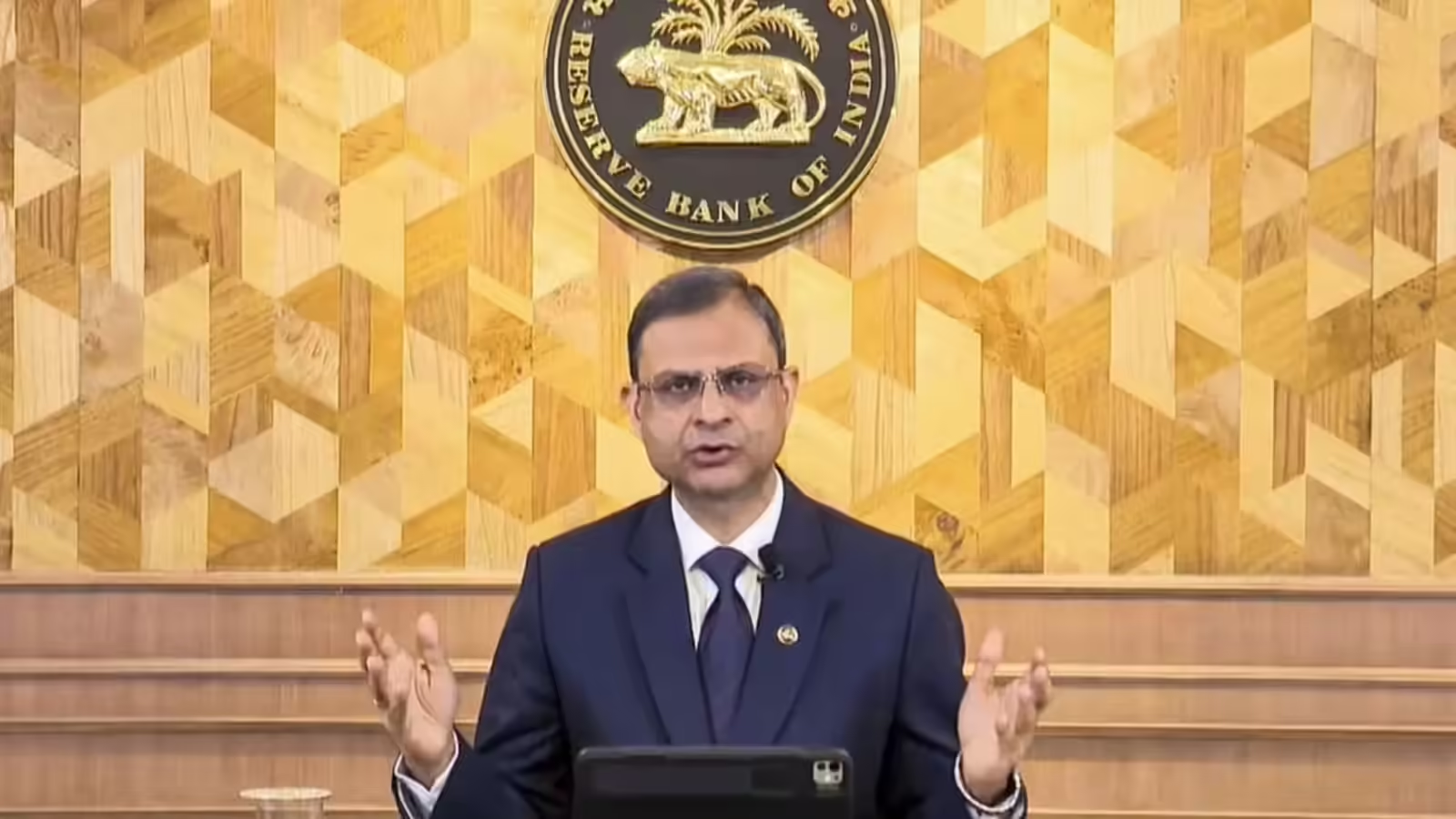
In a historic paradigm shift that fundamentally rewrites corporate dealmaking in India, the Reserve Bank of India’s (RBI) sweeping M&A Financing Framework has formally come into effect as of July 1, 2026.
The revised Commercial Banks – Credit Facilities Amendment Directions marks a momentous departure from decades of conservative, stability-first rules. For the first time, the central bank is allowing domestic commercial banks to finance up to 75% of a corporate takeover or acquisition value, drastically lowering the equity burden on Indian companies looking to scale up.
Previously, Indian banks were heavily restricted from funding share acquisitions to limit speculative bubbles. This forced domestic companies to rely almost entirely on expensive private credit, promoter funds, or offshore alternative lenders to execute buyouts.
1. The Financial Guardrails & Limits
While the new playbook introduces controlled permissions for Leveraged Buy-Outs (LBOs), the RBI has embedded a strict risk-management matrix to prevent runaway financial system leverage:
- The 75:25 Cap: Banks can now bankroll up to 75% of an independently assessed acquisition value. The acquiring company must bring the remaining 25% purely as skin-in-the-game equity from internal accruals or fresh equity issues.
- The Debt-to-Equity Ceiling: Post-acquisition, the consolidated debt-to-equity ratio of the combined entity (Acquirer + Target company) cannot exceed 3:1 on a continuous basis. Analysts note that if a target company already carries high legacy debt, this 3:1 cap may naturally reduce the maximum funding a bank can legally disburse.
- The Bridge Finance Cushion: Listed acquirers are allowed to avail of short-term “bridge finance” from banks for up to 12 months to satisfy their 25% equity contribution, provided they have a firm, board-approved plan to extinguish it via asset sales or equity raises.
2. Who is Eligible to Borrow?
The RBI has dismantled the barrier that restricted acquisition finance strictly to a handful of large, listed conglomerates, expanding the playing field while maintaining an elite eligibility filter:
                  [ TAKE-OVER FINANCING ELIGIBILITY WINDOW ]

  [ Minimum Corporate Scale ] ──► Acquirer must possess a Net Worth > ₹500 Crore
                                             │
  [ Historical Track Record ] ──► Must demonstrate stable Net Profit after Tax (PAT)
                                  for each of the preceding 3 financial years
                                             │
  [ Unlisted Corporate Filter ] ──► Unlisted acquirers must additionally secure an
                                    investment-grade rating (BBB- or above) before payout
The Structural Delivery: The credit facility can be extended directly to the parent non-financial acquiring company, an existing non-financial subsidiary, or a newly formed step-down Special Purpose Vehicle (SPV) established specifically to orchestrate the takeover.
3. Scope of Takeovers & Prohibitions
To ensure bank funds drive real corporate synergy and long-term consolidation rather than accounting tricks, the framework defines strict operational boundaries:
- The “Control” Mandate: The loan will only be approved if the transaction results in the acquirer obtaining outright corporate management control under the Companies Act.
- Crossing Thresholds: If the acquirer already holds a controlling stake, fresh bank finance can only be deployed if the additional purchase pushes the acquirer across critical voting-right thresholds—specifically 26%, 51%, 75%, or 90%—each unlocking enhanced legal or statutory governance control.
- No Related-Party Funding: To completely prevent promoters from using public bank deposits for circular equity routing, acquisition financing for related-party transactions is strictly prohibited. The acquirer and target cannot share common management, promoters, or cross-holding parent groups.
| Metric | Pre-2026 Framework | The New July 1, 2026 Reality |
| Max Bank Funding Limit | Structurally barred / Cap at 70% for limited exceptions | Up to 75% of the independent transaction valuation. |
| Acquirer Equity Share | 30% minimum equity contribution | Reduced to 25% minimum allocation. |
| Market Target Scope | Confined almost exclusively to listed plays | Seamlessly open to both listed and unlisted targets. |
| Prudential Bank Ceiling | 10% of a bank’s Tier-1 capital base | Raised to 20% of a bank’s eligible capital base for aggregate M&A exposure. |
The Collateral Backing
Under the security protocols, any acquisition loan must be fully secured. The primary security will comprise a first unencumbered pledge over the equity shares or compulsorily convertible debentures (CCDs) of the target company acquired.
Furthermore, to protect the banking sector beyond the volatile market value of pledged shares, the RBI has made a corporate guarantee from the acquiring parent company or its group holding entity mandatory in all transactions.
By shifting from a rigid “risk-avoidance” stance to an equilibrium of “risk-management,” the new rules allow India’s deepest localized balance sheets—its commercial banking sector—to directly anchor the country’s accelerating multi-billion-dollar corporate consolidation boom.