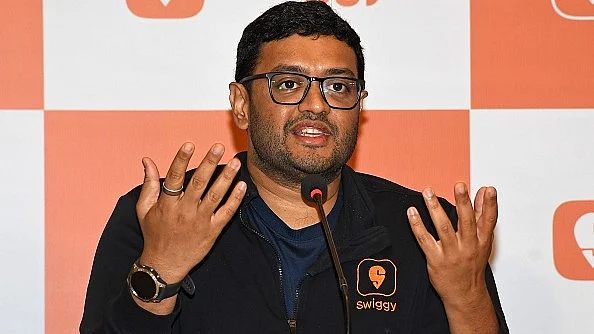
Signaling a looming consolidation wave across India’s hyper-competitive delivery landscape, Swiggy Group CEO Sriharsha Majety stated that the quick-commerce industry is highly unlikely to sustain its current volume of independent players over the medium term.
The commentary arrives amid an intense capital-fueled spending war, as deep-pocketed retail giants like Walmart-owned Flipkart (Flipkart Minutes), Amazon, and Mukesh Ambani’s Reliance Retail aggressively deploy subsidies to shrink delivery times down to 10 minutes.
In a deliberate strategic counter-move, the newly public food and grocery delivery pioneer has chosen to pull back on aggressive promotional spending and cede short-term market share to insulate its unit economics and prioritize long-term profitability.
The Telecom Playbook: Drawing Parallel to Airtel vs. Jio
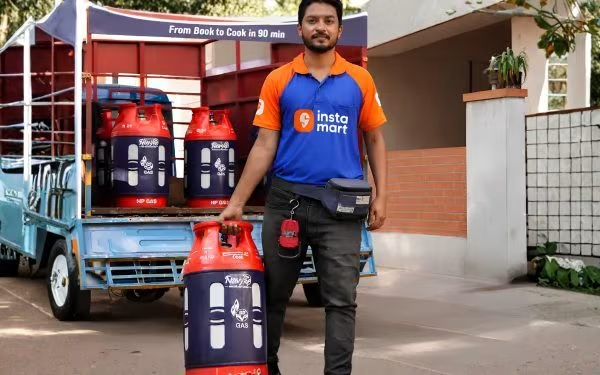
Defending Swiggy Instamart’s decision to limit rapid dark store expansion—adding only seven new locations in the fourth quarter of FY26 to hover just above 1,143 stores—Majety invoked the historical playbook of the Indian telecom sector.
He highlighted Bharti Airtel’s measured response during Reliance Jio’s disruptive 2016 market entry, noting that Airtel intentionally shed low-value subscribers to preserve its capital health during the price war, eventually emerging stronger as smaller, over-leveraged players were forced to exit or merge.
“Investors are giving us the feedback that they remain unconvinced until you show that clear bridge to growth and profitability at Instamart,” Majety told Bloomberg. “Joining the spending only postpones the problem. If I join the short-term market share fight through just buying orders, I worry deeply about my long-term market share.”
Shifting Focus to High-Retention Private Labels
Rather than competing on purely incentive-backed delivery speeds, Swiggy is attempting to drive customer retention through a highly differentiated, exclusive supply inventory.
The company is heavily funding its new premium, ultra-fresh private-label grocery portfolio. By offering hard-to-replicate daily items—such as specialized Indian cottage cheese (paneer) with a shelf life of only a few days and fresh clotted cream that bypasses traditional organized retail distribution channels—Instamart has logged significantly higher repeat purchase cohorts and customer retention metrics.
Majety compared this approach to the segmentation seen in the mature US retail market, where brands like Whole Foods, Costco, and traditional bodegas co-exist by targeting entirely separate consumer demographics rather than engaging in a race to the bottom on price.
Financial Health: A Resilient Capital Cushion
The tactical shift away from customer acquisition subsidies has already yielded noticeable improvements on Swiggy’s financial ledgers:
- Unit Economics: Instamart improved its baseline contribution margin and unit economics by 5 to 6 percentage points over the past four quarters.
- Core Business Acceleration: Swiggy’s core Food Delivery business posted its strongest acceleration loop in nearly four years during the March quarter, crossing an adjusted annual EBITDA milestone of ₹1,000 crore.
- Consolidated Reductions: Swiggy’s overall consolidated net loss narrowed significantly to ₹800 crore for the quarter ended March 2026, down from a ₹1,081 crore deficit in the prior-year period.
Dismissing a recent JM Financial research note suggesting that Swiggy’s best long-term outcome might involve an outright sale to a larger conglomerate, Majety emphasized that the company’s defensive stance is born out of deliberate governance logic rather than a lack of financial ammunition. Supported by a massive post-IPO funding round that left the firm with roughly 150 billion rupees (₹15,000 crore) in liquid bank cash reserves, Swiggy is betting that pure logistics density and hyper-local execution will outlast temporary, venture-backed discount bubbles.
Get the day’s top stories in your inbox
One concise email. No spam, unsubscribe anytime.