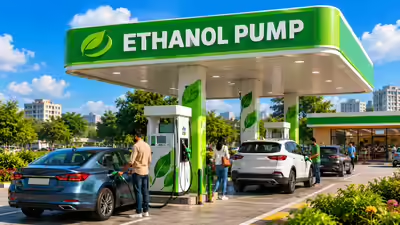
The Ministry of Petroleum and Natural Gas (MoPNG) has issued a formal clarification completely dismissing reports that Bhutan rejected importing India’s E20 (20% ethanol-blended) petrol.
The Centre clarified that Indian Oil Marketing Companies (OMCs) never extended an offer to export E20 petrol to Bhutan, and no such export proposal exists. Therefore, the question of a rejection does not arise.
1. The Genesis of the Controversy
The confusion stemmed from a report by a local newspaper, The Bhutanese, which stated that the Bhutanese government had requested Indian public sector fuel suppliers to continue sending conventional, unblended petrol instead of the newly rolled-out E20 blend.
The report cited technical concerns raised during bilateral meetings by Bhutan’s Department of Trade:
- Hygroscopic Concerns: Ethanol readily absorbs moisture from the air. In mountainous, high-altitude terrain, there were concerns that moisture intrusion in storage facilities could lead to phase separation, lowering fuel quality.
- Infrastructure Legacy: Bhutan’s existing underground dealer tanks are older and not yet optimized to handle highly corrosive or moisture-sensitive ethanol blends.
- Performance on Steep Gradients: Early worries circulated regarding whether ethanol-blended fuel would impact consistent vehicle torque on heavy mountain climbs.
This report was quickly picked up by opposition political parties and amplified across social media in India to criticize the government’s flagship domestic biofuel mandates.
2. The Government’s Response & Fact-Check
In an official statement on social media, the Ministry stated:
“Claims that Bhutan declined an offer to import E20 petrol from India are incorrect. No such offer has been made by the Oil Marketing Companies (OMCs), and there is no proposal for export of E20 petrol to Bhutan. Please rely only on official information from MoPNG and the Oil Marketing Companies.”
Journalists close to the discussions clarified that while Bhutanese technical teams did proactively ask Indian suppliers to continue providing standard Motor Spirit (MS) as long as it remains available in the Indian domestic production pipeline, this was a routine operational alignment—not a diplomatic snub or a rejection of a formal trade package.
3. Defense of the E20 Ecosystem
The diplomatic controversy occurred alongside a broader public debate within India over E20 petrol, following complaints from some domestic motorists regarding fuel efficiency and legacy engine compatibility.
In tandem with the fact-check, the Ministry of Information and Broadcasting strongly defended the safety of the nationwide rollout:
- Extensive Verification: The government emphasized that E20 was launched only after rigorous laboratory, vehicle, and long-horizon field testing by major technical institutions, including the Automotive Research Association of India (ARAI), the Indian Institute of Petroleum (IIP), and Indian Oil R&D.
- Warranty Alignment: The Centre reiterated that vehicle manufacturers have fully aligned their newer model assembly lines with international ethanol blending benchmarks, and using approved E20 fuel does not automatically void a manufacturer’s warranty.
- Widespread Performance: Officials highlighted that millions of domestic vehicles have been running smoothly on the blend since its comprehensive market rollout, with zero statistically significant engine failures traced back to the fuel architecture.
Get the day’s top stories in your inbox
One concise email. No spam, unsubscribe anytime.