In a landmark shift for the personal computing landscape, Nvidia and Microsoft have officially unveiled the “NVIDIA RTX Spark™,” a new superchip that positions Nvidia chips as the main processor for Windows PCs for the first time.
The joint architecture represents a major strategic move to transition personal computers from simple digital tools into autonomous, local AI teammates. Unveiled right ahead of the Computex trade show in Taipei and Microsoft’s Build developer conference, the partnership combines Nvidia’s graphic and AI ecosystems with an Arm-based CPU architecture. The silicon is designed to run complex frontier AI models and local agents natively without needing to round-trip data to cloud servers.
1. Under the Hood: The Specs of the RTX Spark
The RTX Spark breaks away from conventional x86 architecture used by Intel and AMD, opting instead for a highly efficient “superchip” framework developed in collaboration with MediaTek. The hardware integrates consumer graphics power with intensive system computing:
- The Processor Core: Features a high-performance 20-core NVIDIA Grace™ CPU built on Arm architecture.
- The AI & Graphics Engine: Integrates an NVIDIA Blackwell RTX GPU packed with 6,144 CUDA cores and fifth-generation Tensor Cores utilizing ultra-efficient FP4 precision.
- High-Speed Interconnect: The CPU and GPU components are bridged natively via the NVIDIA NVLink®-C2C chip-to-chip interconnect.
- Memory & Performance: Accommodates up to 128GB of unified memory, pushing out 1 petaflop of local AI performance while maintaining all-day battery life for thin-and-light laptops.
According to Nvidia CEO Jensen Huang, the chip allows users to run massive 120-billion-parameter Large Language Models (LLMs) with up to 1 million tokens of context directly on a local laptop.
2. Windows Integration and the Hunt for “Local Agents”
The arrival of Nvidia-powered processors gives Microsoft’s AI PC ambitions a crucial second chance after early hitches with its Copilot+ PC rollout. To support the new hardware, Microsoft is introducing specialized Windows security and containment primitives tailored for autonomous operations.
Central to this launch is the rollout of NVIDIA OpenShell on Windows, a framework designed to let software platforms securely execute local AI tasks. Popular third-party applications are already adapting to the hardware; Adobe is rearchitecting its flagship applications, including Photoshop and Premiere, from the ground up to achieve a 2x performance jump natively on the RTX Spark.
Concurrently, leaks suggest Microsoft is deploying an agentic software layer called “Autopilot” alongside a dedicated agent app called “Scout”. This tool is designed to act as a local assistant capable of automatically triaging user inboxes, managing calendars, and drafting contextual replies based on local data without data leakage risks.
3. Disrupting the Market and Challenging Apple
Nvidia’s foray into mainstream PC processors directly threatens Intel and AMD’s historic dominance over the Windows ecosystem. It also intensifies competition with Qualcomm, which has been Microsoft’s primary provider for Arm-based Windows devices. However, market analysts suggest that Nvidia’s entry will validate and expand the overall market size for Arm-on-Windows hardware, which could inadvertently benefit alternative Arm developers.
Furthermore, the launch provides Microsoft with a direct counterweight to its primary rival, Apple, which updated its MacBook lineup with proprietary M5-series chips. By offering high-efficiency silicon paired with an un-throttled CUDA and TensorRT ecosystem, Microsoft is aggressively pitching these machines to developers and creators who require heavy-duty computational horsepower on the go.
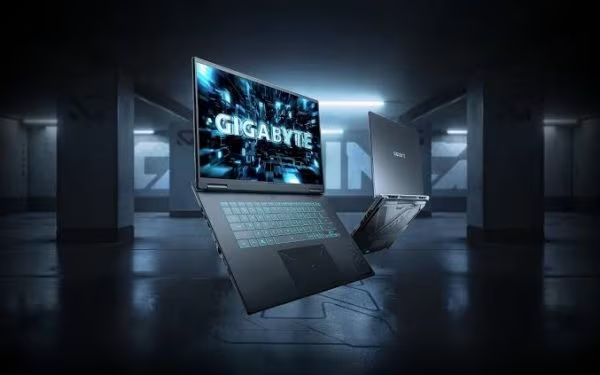
The first wave of RTX Spark-powered consumer laptops and compact desktops will hit the market this fall. Hardware configurations have been confirmed from prominent manufacturers including ASUS, Dell, HP, Lenovo, and MSI, with specialized entries from Microsoft’s own Surface brand leading the portfolio.
Get the day’s top stories in your inbox
One concise email. No spam, unsubscribe anytime.