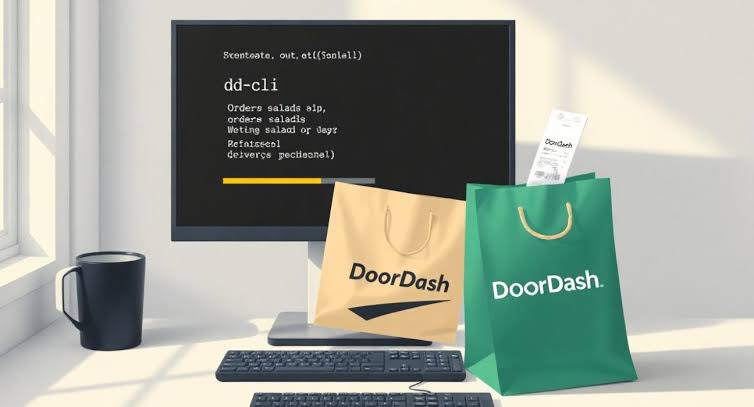
DoorDash has introduced a new command-line interface (CLI) tool that enables AI agents to place food delivery orders directly through its platform. The launch marks another step toward integrating autonomous AI assistants with real-world services, allowing software agents to order meals programmatically on behalf of users while following predefined permissions and workflows.
The CLI tool is aimed at developers building AI agents capable of performing practical tasks beyond generating text. By enabling AI systems to interact directly with DoorDash’s ordering infrastructure, the company is expanding the role of generative AI from information retrieval to real-world commerce and task automation.
DoorDash Launches CLI Tool for AI Agents
The new developer tool simplifies integration between AI assistants and DoorDash’s delivery platform.
| Key Highlights | Details |
|---|---|
| Company | DoorDash |
| Product | Command-Line Interface (CLI) tool |
| Purpose | Enable AI agents to order food directly |
| Target users | Developers and AI application builders |
| Use case | Programmatic food ordering and delivery automation |
| Industry | AI, food delivery, developer tools |
The launch reflects the growing trend of equipping AI agents with the ability to perform real-world actions rather than simply provide recommendations.
How the CLI Tool Works
The CLI enables developers to connect AI agents with DoorDash’s ordering services through programmable commands and APIs.
Potential capabilities include:
- Searching restaurants and menus.
- Selecting food items.
- Customizing orders.
- Managing delivery addresses.
- Submitting orders automatically.
- Tracking delivery status.
Developers can integrate these capabilities into autonomous AI workflows while maintaining user authorization and application-level controls.
Why It Matters
The launch signals the next phase of AI-powered digital assistants.
Key benefits include:
- Automating routine food orders.
- Streamlining developer integrations.
- Expanding AI agent capabilities.
- Reducing manual interactions.
- Enabling conversational commerce.
- Supporting enterprise automation use cases.
Instead of simply suggesting restaurants, AI agents can now execute the entire ordering process on behalf of users when authorized.
Potential Applications
| Application | Benefit |
|---|---|
| Personal AI assistants | Automatically order meals based on user preferences |
| Workplace productivity | Schedule team lunches and recurring orders |
| Smart home ecosystems | Voice-triggered food ordering |
| Enterprise software | Automate meal delivery for employees or events |
| Healthcare | Assist patients with meal ordering |
| Accessibility | Help users with limited mobility place food orders |
These use cases demonstrate how AI agents are evolving into digital assistants capable of completing real-world transactions.
AI Agents and Commerce
The DoorDash CLI aligns with a broader industry movement toward agentic AI, where AI systems can perform tasks independently within predefined boundaries.
Emerging trends include:
- AI-powered shopping assistants.
- Automated travel bookings.
- Calendar and email management.
- Financial task automation.
- Restaurant reservations.
- E-commerce purchasing.
Food delivery represents a natural extension of this trend, offering a practical and frequently used real-world application.
Challenges Ahead
Despite its potential, several challenges remain.
These include:
- Ensuring secure user authorization.
- Preventing accidental or unauthorized orders.
- Protecting payment information.
- Managing order errors and cancellations.
- Maintaining developer security standards.
- Building user trust in autonomous AI actions.
Robust permission systems and transparent controls will be essential as AI agents gain greater autonomy.
Outlook
DoorDash’s CLI tool represents an important milestone in the evolution of AI-powered commerce, enabling autonomous software agents to move beyond conversation and perform tangible tasks. As businesses increasingly adopt agentic AI, developer tools that connect AI systems with real-world services are expected to become a critical part of the technology ecosystem.
Future enhancements could expand AI agent capabilities to include more personalized recommendations, recurring order automation, multi-step workflows, and integration with broader productivity platforms. The launch also positions DoorDash to participate in the growing ecosystem of AI-native applications that interact directly with digital services.
What It Means for the AI and Delivery Industry
DoorDash’s move illustrates how food delivery platforms are adapting to the rise of autonomous AI agents. Rather than serving only human users through mobile apps and websites, companies are beginning to build infrastructure that allows trusted AI systems to act on behalf of customers.
For the AI industry, the CLI highlights the growing importance of developer-friendly tools that enable AI agents to interact with external services securely. As agentic AI continues to mature, similar integrations are likely to emerge across e-commerce, transportation, finance, healthcare, and other sectors, accelerating the shift from AI assistants that answer questions to AI agents that complete real-world tasks.
Get the day’s top stories in your inbox
One concise email. No spam, unsubscribe anytime.