
Chinese food-delivery and lifestyle giant Meituan has officially open-sourced LongCat-2.0, a massive 1.6-trillion-parameter Mixture-of-Experts (MoE) large language model.
The launch represents a major structural milestone for the global AI landscape: it is the first trillion-parameter model of its scale to complete its entire pre-training and inference pipeline natively on domestic Chinese AI ASIC chip clusters (specifically a 50,000-card superpod deployment), bypassing any reliance on Nvidia silicon.
Before its official identity was revealed, the model had been quietly dominating global API usage charts on OpenRouter under the anonymous codename “Owl Alpha,” processing over 10 trillion tokens per month.
1. Architectural Blueprint & Sparsity Mechanics
While the model carries a headline figure of 1.6 trillion total parameters, its underlying MoE architecture makes it surprisingly lightweight during active execution:
- Dynamic Token Activation: The architecture dynamically activates between 33 billion and 56 billion parameters per token, averaging a highly efficient 48B active footprint.
- Zero-Computation Experts: To eliminate unnecessary compute overhead, routine tasks (like punctuation or basic syntax routing) bypass heavy parameters entirely via “Zero-Compute” subnetworks, reserving complex sub-expert pathways exclusively for dense reasoning workloads.
- The N-gram Embedding Boost: Meituan expanded the model’s core embedding space 100-fold by appending 135 billion parameters dedicated strictly to a 5-gram token combination framework, accelerating memory I/O and handling massive batch inference smoothly.
2. Breaking the Long-Context Memory Wall
Unlike traditional attention mechanisms that suffer from severe memory fragmentation and exponential computing penalties when processing dense codebases, LongCat-2.0 features a native 1-million-token context window powered by LongCat Sparse Attention (LSA):
Plaintext
[ THE LONGCAT SPARSE ATTENTION (LSA) ENGINE ]

├── Streaming-aware Indexing (SI) ──► Reorganizes token data into predictable contiguous reads
├── Cross-Layer Indexing (CLI)    ──► Reuses attention paths across adjacent layers via distillation
└── Hierarchical Indexing (HI)     ──► Runs rapid coarse-to-fine block filtering for fast retrieval
This structural shift transforms traditional quadratic attention costs into linear complexity, letting autonomous agents read, evaluate, and modify an entire software codebase in a single prompt.
3. MOPD: Triple-Expert Fusion
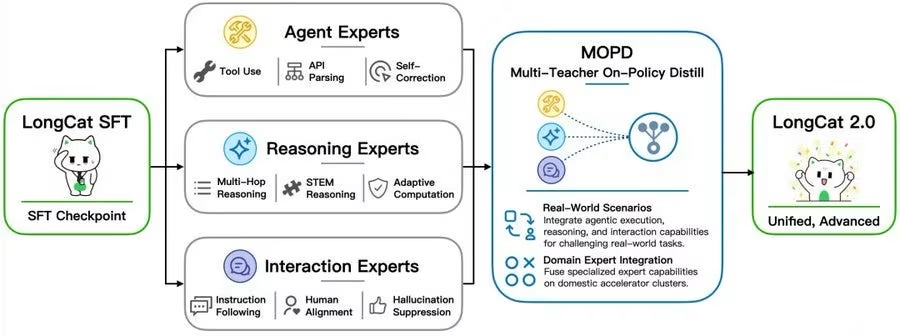
To achieve near-frontier performance in autonomous software engineering, Meituan avoided building a monolithic generalist. Instead, they utilized a training pipeline called Multi-Teacher On-Policy Distillation (MOPD).
The pipeline trained three distinct specialist “teacher” groups from a foundational Supervised Fine-Tuning (SFT) checkpoint before fusing their capabilities back into a single student model:
| Specialized Expert Group | Primary Functional Focus |
| Agent Experts | Advanced tool invocation, complex API schema parsing, and autonomous self-correction. |
| Reasoning Experts | Multi-hop problem solving, STEM logic pathways, and adaptive token computing. |
| Interaction Experts | Exact instruction-following, human alignment, and strict hallucination suppression. |
4. Benchmark Performance metrics
Evaluated against heavy developer benchmarks, LongCat-2.0 shows near-frontier capabilities in autonomous coding and web navigation:
- SWE-bench Multilingual: Scores 77.3, establishing a highly competitive open-source footprint for resolving end-to-end repository issues.
- Terminal-Bench: Registers 70.8, highlighting high stability and real-world error recovery when running active shell commands in native terminal environments.
- BrowseComp & RW-Search: Scores 79.9 and 78.8 respectively, outperforming many proprietary models in complex multi-step web browsing and information retrieval.
Availability & Deployment
Meituan has released the model weights to the public under a commercially viable, enterprise-grade MIT license. The model is available via Hugging Face in multiple precision formats (BF16, FP8, and INT8), alongside customized inference optimizations tailored for alternative global hardware architectures. Global developers can also access the model directly via the LongCat API platform and OpenRouter.
Get the day’s top stories in your inbox
One concise email. No spam, unsubscribe anytime.