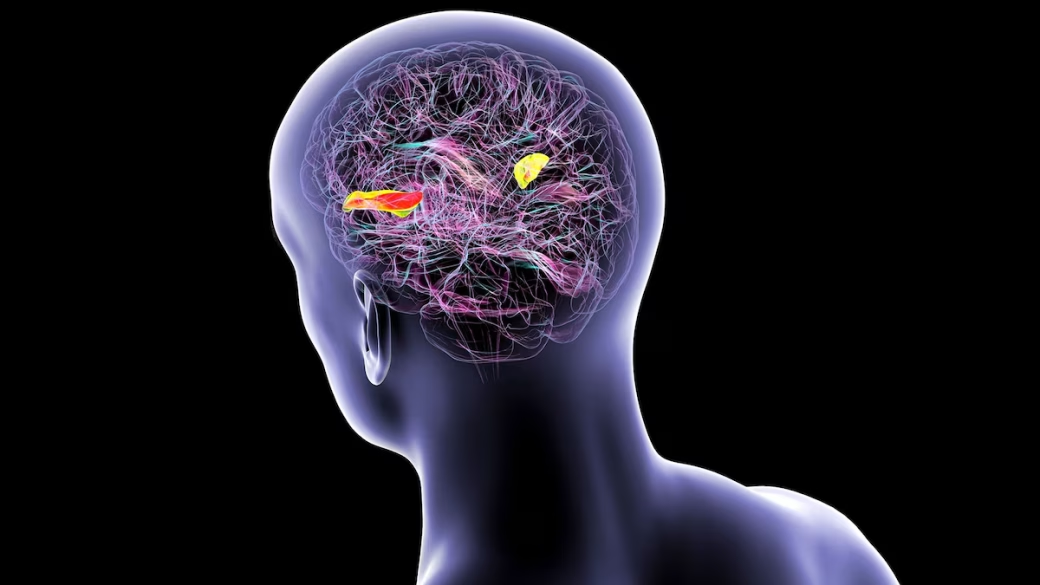
Science is backing this up more clearly than ever. Fresh research presented at the Federation of European Neuroscience Societies (FENS) Forum highlighted just how profoundly multilingualism acts as a shield against neurological decay.
The study, led by researchers at the Basque Center on Cognition, Brain and Language, utilized advanced brain activity scans and artificial intelligence to map out a definitive “gradient of youthfulness” directly tied to how many languages an individual handles.
1. The Multi-Language Gradient
By comparing a participant’s actual chronological age with their biological “brain age” baseline, scientists discovered a striking correlation between language count and structural brain preservation:
- Bilinguals (2 Languages): Possessed brains that appeared an average of 6 years younger than monolinguals.
- Trilinguals (3 Languages): Their brains appeared roughly 7 years younger than normal baselines.
- Quadrilinguals (4 Languages): Showed the most dramatic impact, with brain activity profiles looking an astonishing 13 years younger than their actual age.
2. Why it Works: The Brain’s Workout Plan
The underlying mechanism comes down to cognitive reserve—the brain’s ability to improvise, find alternative neural pathways, and stay resilient when faced with damage or natural aging.
Plaintext
[ THE BILINGUAL COGNITIVE ENGINE ]

      Active Language A                  Inactive Language B
┌────────────────────────────┐     ┌────────────────────────────┐
│   Currently Processing     │     │   Temporarily Suppressed   │
│ (Grammar, Vocab, Phonics)  │     │  (via Cognitive Inhibition)│
└────────────────────────────┘     └────────────────────────────┘
               ▲                                  ▲
               └─────────────────┬────────────────┘
                                 │
                     [ EXECUTIVE CONTROL MESH ]
              Constant monitoring, switching, and filtering
              turns the brain into an expert problem solver.
When you speak more than one language, both systems are constantly active in your subconscious. To prevent them from colliding, your brain relies heavily on a process called cognitive inhibition (muffling the language you don’t need) and conflict monitoring. This mental gymnastics routine strengthens the gray matter volume in regions linked to attention, memory, and executive function.
3. The Fluency and Timing Caveat
While loading up a language app later in life is an exceptional way to spark neuroplasticity through “effortful learning,” the researchers emphasize that it isn’t a simple binary switch.
The protective anti-aging effect functions as a spectrum. The absolute highest levels of brain preservation are tied to depth and duration of experience—meaning earlier acquisition in childhood and achieving high proficiency provide the sturdiest neurological armor. However, experts maintain that forcing your brain to tackle a difficult new grammar system at any age remains a phenomenal way to build a cognitive buffer against neurodegenerative conditions like Alzheimer’s.
Get the day’s top stories in your inbox
One concise email. No spam, unsubscribe anytime.