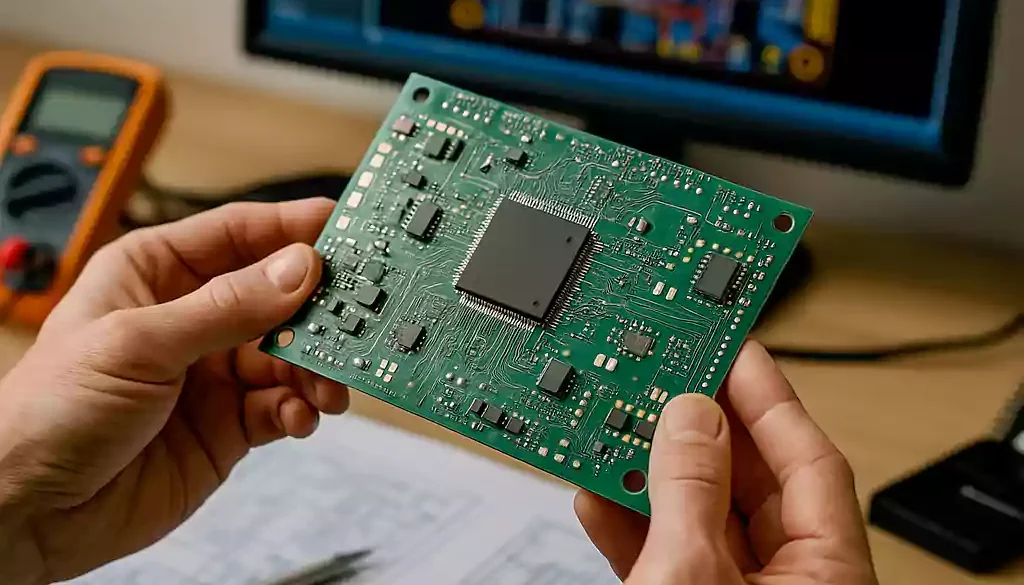
In a historic shift in global electronics supply chains, India’s exports of printed circuit boards (PCBs) to China surged over 40-fold to hit $1.5 billion in FY26.
The sudden surge marks a dramatic pivot for a product category that traditionally moved in the opposite direction. Historically, India has been a heavy importer of Chinese electronic components; this data shows Indian manufacturers successfully reversing the flow in a crucial, high-volume segment.
1. The Numbers Behind the Global Shift
Data from the commerce ministry and industry tracking groups shows the sheer speed of this localized manufacturing boom. What was a minor, quiet trade corridor just twelve months ago has rapidly evolved into a primary export pillar:
- The 40x Growth Curve: India’s PCB shipments to China sat at roughly $36 million in FY25. Propelled by sudden scaling across domestic manufacturing hubs, that number leaped to $1.5 billion in FY26.
- China as the Primary Buyer: India’s total global PCB exports reached roughly $1.9 billion in FY26. China single-handedly absorbed nearly 80% of that entire volume, turning itself into the definitive anchor market for Indian-made boards.
- The Macro Component Wave: The PCB spike is driving a wider transformation. Total electronic component exports from India to China reached a record $4.2 billion (₹35,000 crore) in FY26, multiplying 4.5 times year-on-year.
 [ INDIA TO CHINA PCB EXPORTS VISUALIZED ]

  FY25 Baseline: █ $36 Million

  FY26 Surge:    ████████████████████████████████████████ $1.5 Billion (40x Jump)
                 │
                 └──► Accounts for ~80% of India's total $1.9B global PCB export pie
2. Supply Chain Dynamics: What Is Fueling the Surge?
The trade reversal is driven by a mix of shifting international assembly dynamics and heavy localized policy intervention:
- The “China Plus One” Ecosystem Realized: Global tech giants—most notably Apple and its primary tier-one contract manufacturing partners—have spent the last few years aggressively expanding factory lines in India to assemble finished devices like iPhones and Apple Watches. As these sub-assembly ecosystems mature, their global component networks are dynamically scattering. Simpler, lower-value multi-layer electronic boards are increasingly being mass-produced in India and shipped straight to Chinese assembly loops to optimize logistics.
- The PLI and Capital Infrastructure Catalyst: The rapid capacity scaling rests heavily on government capital pushes, including the Production Linked Incentive (PLI) Scheme and the Electronics Component Manufacturing Scheme (ECMS). According to IT Ministry data, approximately 75 dedicated electronic component factories are currently under construction across the country, with another 250 facilities mapped to open over the next three years.
3. The Future: Moving Toward “Deep Manufacturing”
While the $1.5 billion milestone is a major export victory, economic analysts and industry groups like the India Printed Circuit Association (IPCA) caution that the next phase of growth will require climbing higher up the value chain:
| Current Export Layer (FY26 Success) | The Next Frontier (Deep Manufacturing Target) |
| Focus on high-volume production of simpler, lower-value electronic assemblies and standard multi-layer boards. | Transitioning to advanced 20-to-22 layer multi-layer PCBs and high-density interconnect (HDI) semiconductor substrates. |
| High concentration risk with 80% of volume dependent on a single destination market (China). | Diversifying the global client footprint into western automotive, aerospace, and defense electronics. |
| Vulnerable to raw material import crunches (copper-clad laminates, glass fiber) due to international shipping bottlenecks. | Building full raw material self-reliance to unlock an estimated ₹40,000 crore in annual forex savings via complete domestic integration. |
To accelerate this transition into high-tier technology, the government recently finalized major industrial projects, including a ₹3,250 crore joint venture between Amber Enterprises and Korea Circuit near Noida. By establishing facilities dedicated to advanced flexible PCBs and high-density semiconductor substrates, India is trying to ensure that its manufacturing base doesn’t remain a supplier of basic electronics hardware, but evolves into a globally competitive, deeply integrated component superpower.