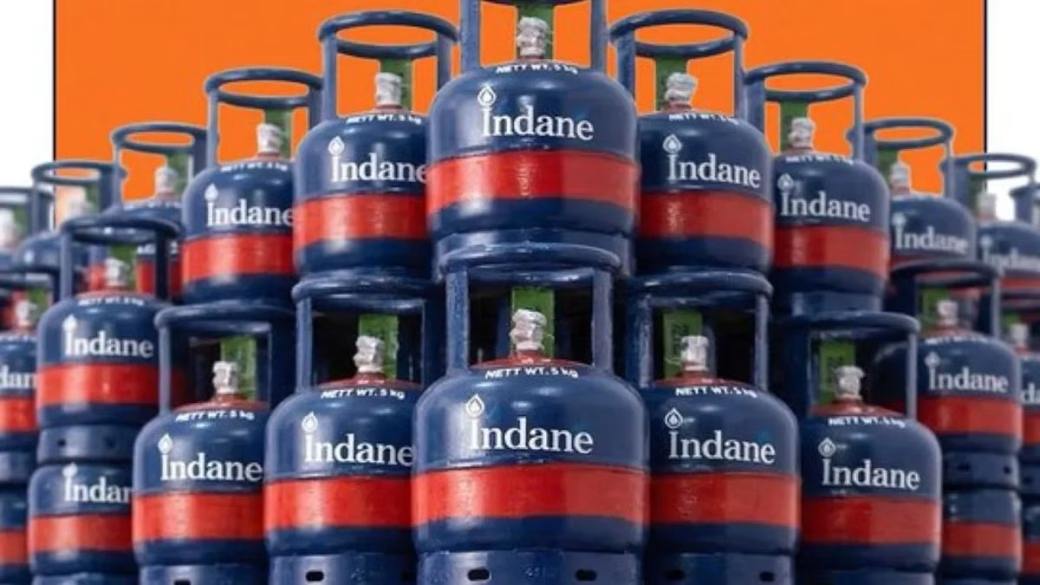
Following months of compounding price hikes triggered by the West Asia energy crisis, demand for 5kg Free Trade LPG (FTL) cylinders has plunged by an estimated 80% across several urban and semi-urban migration pockets.
The dramatic drop highlights deep financial distress among India’s informal workforce, particularly migrant laborers, street vendors, and students. Because 5kg FTL cylinders are sold at market rates without domestic subsidies or address-proof requirements, they bear the full brunt of global energy volatility.
1. The Anatomy of the Price Surge
The severe erosion in demand follows a punishing series of price hikes initiated after shipping routes like the Strait of Hormuz faced prolonged blockades earlier in the year:
- The Price Peak: Driven by raw material under-recoveries and global supply crunches, the retail cost of a 5kg FTL cylinder in metro areas climbed sharply, peaking at an all-time high of ₹821.50 in June 2026.
- The Recent Correction: Following a partial easing of geopolitical tensions and a rollback of emergency state restrictions on bulk LPG feedstocks, Oil Marketing Companies (OMCs) issued their first price cut of the year on July 1, 2026, trimming the 5kg cylinder price by ₹13 to settle at ₹808.50 in Delhi.
Despite the minor July reduction, the aggregate price remains prohibitively high for low-income daily wage earners compared to the subsidized 14.2kg domestic household cylinders, which sit insulated at ₹942.
 [ JAN - MAY 2026 CRUNCH ] ──► West Asia conflict triggers severe global C3-C4 feedstock shortages
                                            │
                                            ▼
 [ JUNE 2026 PEAK        ] ──► 5kg FTL cylinder hits record ₹821.50 ──► Demand plummets by ~80%
                                            │
                                            ▼
 [ THE INFORMAL RESORT   ] ──► Migrants resort to dangerous alternatives: Electric coils or illegal refills
                                            │
                                            ▼
 [ JULY 1 PRICE REVISION ] ──► OMCs cut price by ₹13 to ₹808.50 ──► Relief minor; affordability gap remains
2. Why Migrants Are Stepping Away
The 80% collapse in regular retail refills does not mean these households have stopped cooking; rather, it indicates an emergency migration to alternative, often unsafe, energy options:
- The Illegal Refilling Hazard: With a single legal 5kg refill crossing the ₹800 mark, thousands of consumers have shifted toward the parallel black market. Underground vendors illegally bleed gas from subsidized 14.2kg domestic cylinders into empty 5kg bottles, selling the hazardous refills at a steep discount.
- The Pivot to Electric Coils: In dense urban clusters where electricity bills are shared or unmetered in low-income housing units, workers have completely abandoned gas. They are turning to cheap, low-efficiency electric heating coils and induction plates to bypass the fuel loop entirely.
- Commercial Vendor Squeeze: Small-scale roadside food vendors (dhabas, tea stalls, and fast-food carts) operating on razor-thin margins have been forced to cut their usage. Many have absorbed the losses by reducing operational hours or reverting to charcoal and commercial firewood where local municipal rules permit.
3. The Current Fuel Pricing Framework (Effective July 2026)
While the government has stepped up localized over-the-counter supplies to assure the public that there is no structural physical shortage of LPG, the commercial price matrix remains highly strained:
| LPG Cylinder Type | Current Retail Price (Delhi) | Recent Policy Actions & Trajectory |
| 5-kg Free Trade LPG (FTL) | ₹808.50 | Slashed by ₹13 on July 1; market-linked pricing leaves it highly vulnerable to import shocks. |
| 14-2-kg Subsidized Domestic | ₹942.00 | Kept unchanged in July after a ₹29 hike in June; heavily insulated by state under-recovery buffers. |
| 19-kg Commercial Cylinder | ₹2,930.00 | Reduced by a significant ₹183.50 on July 1; brings substantial input relief to formal hotels and restaurants. |
⚠️ Enforcement Watch: To counter the massive demand migration toward the black market, the Ministry of Petroleum and Natural Gas has aggressively tightened monitoring under the Essential Commodities Act. Local authorities have conducted daily inspection sweeps across multiple states, seizing over 50,000 illegally diverted domestic cylinders and suspending dozens of distribution points. However, industry experts caution that until market-linked FTL prices drop back down to historical baselines below ₹600, checking the informal diversion will remain an uphill task.