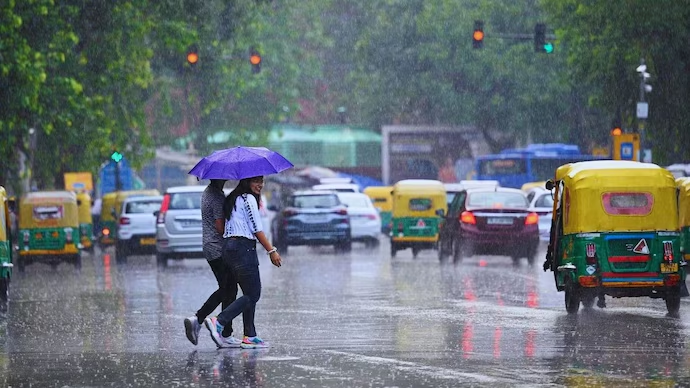
In a development that has triggered immediate anxieties across India’s agricultural and economic planning sectors, the India Meteorological Department (IMD) has sharply downgraded its forecast for the upcoming 2026 Southwest monsoon.
During its second-stage Long Range Forecast briefing on Friday, Ministry of Earth Sciences Secretary Dr. M. Ravichandran and IMD officials revealed that seasonal rainfall between June and September is now expected to touch just 90% of the Long Period Average (LPA). This marks a worrying drop from the already conservative 92% baseline the weather office projected in its initial April 13 release.
The revised figure sits at the absolute bottom margin of what meteorologists classify as a “below-normal” monsoon. Alarmingly, the IMD indicated a significant 60% probability that total rainfall could break even lower, dropping past the 90% floor into a full-scale macro “deficient” cycle—marking this as the lowest pre-season forecast ever officially registered by the modern agency.
The Culprit: The Sudden Influx of a “Super” El Niño
The primary driver behind the vanishing rainclouds is a rapid and highly aggressive thermal transition in the Pacific Ocean.
While early 2026 began under neutral conditions, sea-surface temperatures across the Equatorial Pacific have begun spiking at an unprecedented pace. The World Meteorological Organization (WMO) issued a parallel global alert warning that a full-scale “Super El Niño” event is solidifying with high confidence.
The localized timeline for this oceanic phenomenon will directly choke off incoming monsoon intensity:
- June: El Niño conditions will establish weak but noticeable structural footholds, slowing down the monsoon’s initial velocity.
- July & August: The thermal anomalies will intensify into a moderate category, disrupting standard rain distribution during peak sowing weeks.
- September: The phenomenon is projected to peak into a Moderate-to-Strong category, cutting the late-season withdrawal rains short.
Compounding this gridlock, the monsoon’s official landward arrival over Kerala—historically anchored to June 1—has faced localized atmospheric delays. While monsoon fronts have technically reached India’s southern maritime territories, the IMD estimates that actual landward progression will be delayed by roughly a week, pushing the real kickoff into the first week of June.
Regional Impact Breakdown: A Stark Geographical Divide
The 2026 monsoon is tracking a highly skewed, uneven geographical distribution profile, splitting the subcontinent into distinct moisture zones:
- The Northeast Buffer (Normal): The northeastern states and adjoining eastern sub-Himalayan pockets are the only regions projected to escape the dry patch, with models pointing toward normal, stable seasonal totals.
- The Rest of India (Below Normal): The remaining vast majority of the country—specifically the Northwest, Central India, and the South Peninsula—is blinking red for below-normal precipitation.
- The Core Monsoon Zone: Crucially, IMD Director General Mrutyunjay Mohapatra explicitly highlighted that the “monsoon core zone”—the vital geographical sweep containing India’s primary non-irrigated, rain-fed agricultural heartlands—is highly likely to bear the brunt of the deficient rain deficit.
Severe Heatwaves and the Macro-Economic Strain
Adding physical strain to the moisture deficit, the IMD confirmed that the intense heatwave to severe heatwave conditions cooking Central and Northwest India will refuse to abate easily, holding a tight grip over the interior for the foreseeable future. Both daytime and night temperatures are modeled to sit persistently on the higher side of historical baselines.
The combination of an intense summer heatwave and a 90% deficient monsoon injects considerable volatility into India’s macroeconomics. Because over half of India’s agricultural workforce relies strictly on the Southwest monsoon to feed fields growing critical staples like paddy, pulses, sugarcane, and oilseeds, a delayed and weak water cycle directly threatens crop yields.
Should Kharif crop volumes plummet, the government will likely face a sharp resurgence in stubborn food inflation, completely tying the hands of the Reserve Bank of India (RBI) regarding interest rate cuts and dampening rural consumer spending power heading into the late-2026 festive commercial season.
Get the day’s top stories in your inbox
One concise email. No spam, unsubscribe anytime.