
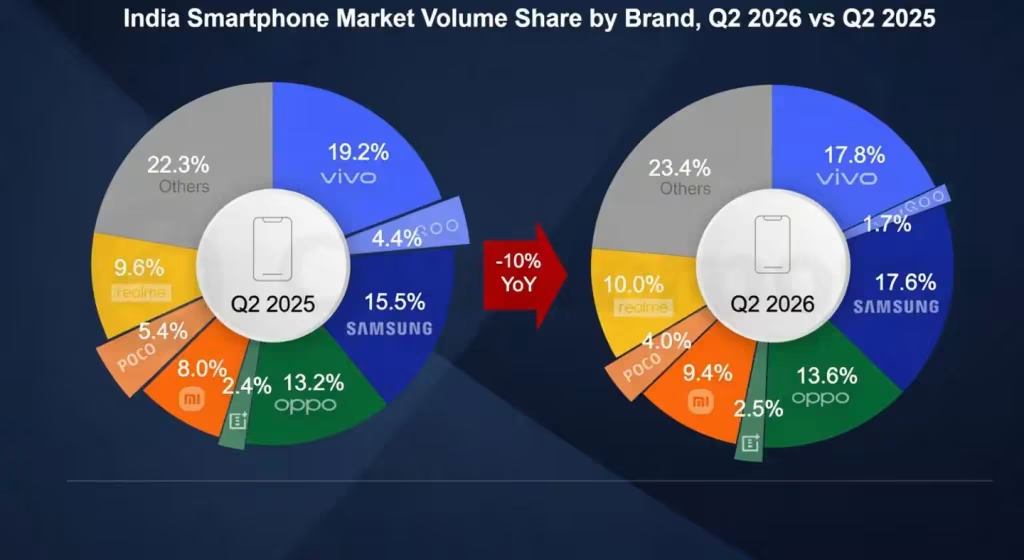
India’s smartphone shipments declined by 10% year-over-year, even as the average selling price (ASP) of smartphones increased by 15%, highlighting a significant shift in consumer buying behavior toward premium devices. The slowdown in unit shipments reflects weaker replacement demand, while rising prices indicate that consumers purchasing new smartphones are increasingly opting for higher-end models with advanced features.
The trend underscores the evolving dynamics of India’s smartphone market, where premiumization continues despite softer overall demand. Manufacturers are focusing on AI-powered features, improved cameras, and premium designs to drive higher revenues even as shipment volumes moderate.
India’s Smartphone Market Sees Volume Decline
The latest market data points to slower unit sales but higher revenue potential.
| Key Highlights | Details |
|---|---|
| Shipment change | Down 10% year-over-year |
| Average selling price | Up 15% |
| Market trend | Premiumization despite weaker demand |
| Key drivers | AI features, flagship devices, premium upgrades |
| Consumer behavior | Fewer purchases but higher spending per device |
| Industry | Smartphones and consumer electronics |
The contrasting trends suggest that value growth is outpacing volume growth in India’s smartphone industry.
Why Smartphone Shipments Declined
Several factors contributed to the slowdown in device shipments.
Key reasons include:
- Longer smartphone replacement cycles.
- Soft consumer spending in entry-level segments.
- Fewer first-time smartphone buyers.
- Economic uncertainty affecting discretionary purchases.
- Inventory normalization after previous demand cycles.
- Increased competition among brands.
Consumers are holding onto their devices for longer periods as smartphone hardware improvements become more incremental.
Why Prices Are Rising
Despite lower shipments, smartphone makers continue to move customers toward premium devices.
Factors driving higher average selling prices include:
- AI-powered smartphone features.
- Better cameras and processors.
- Premium materials and displays.
- Higher storage configurations.
- 5G adoption.
- Increased sales of flagship and upper mid-range models.
Manufacturers are prioritizing profitability by expanding their premium product portfolios.
Market Snapshot
| Metric | Trend |
|---|---|
| Smartphone shipments | ↓ 10% |
| Average selling price | ↑ 15% |
| Premium segment | Growing |
| Entry-level segment | Under pressure |
| Consumer focus | Value and AI-enabled features |
The premium segment continues to outperform the broader smartphone market despite weaker overall demand.
Industry Trends
Several developments are reshaping India’s smartphone market.
These include:
- AI becoming a key purchase differentiator.
- Expansion of premium smartphone portfolios.
- Growing demand for foldable devices.
- Wider adoption of 5G smartphones.
- Improved financing and trade-in programs.
- Greater focus on ecosystem products such as smartwatches and earbuds.
Brands are increasingly relying on premium devices to offset slower shipment growth.
Challenges Ahead
The smartphone industry continues to face multiple headwinds.
These include:
- Weak demand in budget smartphone categories.
- Rising component and manufacturing costs.
- Longer replacement cycles.
- Intense competition among global and domestic brands.
- Pricing pressure in the mid-range segment.
- Balancing affordability with premium innovation.
Manufacturers will need to carefully manage pricing strategies while maintaining consumer demand.
Outlook
India remains one of the world’s largest smartphone markets, but the latest shipment decline suggests that the industry is entering a more mature phase where revenue growth is increasingly driven by premiumization rather than rapid unit expansion. As consumers upgrade less frequently, smartphone brands are focusing on AI capabilities, improved hardware, and differentiated software experiences to justify higher prices.
Looking ahead, continued rollout of AI-powered smartphones, broader 5G adoption, and festive season demand are expected to support market recovery. However, sustained shipment growth may depend on stronger consumer spending and renewed demand in the affordable smartphone segment.
What It Means for the Smartphone Industry
The divergence between declining shipments and rising average selling prices highlights a structural shift in India’s smartphone market. Manufacturers are moving away from competing primarily on volume and instead emphasizing higher-value products that improve profitability.
For consumers, this means access to more advanced devices with AI-driven features and premium experiences, albeit at higher price points. For smartphone brands, success will increasingly depend on balancing innovation, affordability, and ecosystem integration in an increasingly competitive and mature market.
Get the day’s top stories in your inbox
One concise email. No spam, unsubscribe anytime.