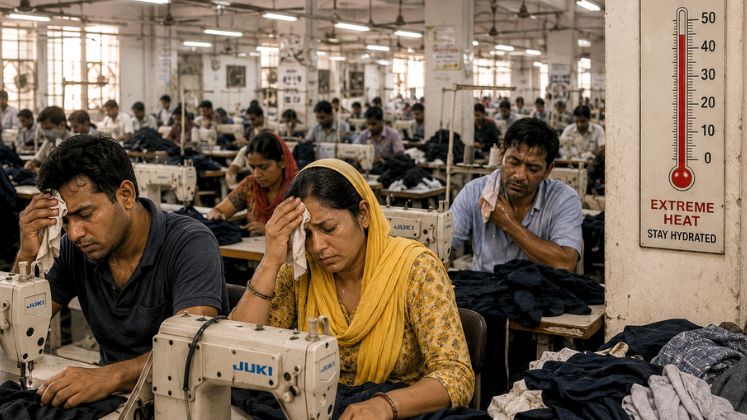
A newly released global supply chain report confirms that extreme summer heatwaves are no longer just an environmental talking point—they are actively altering the unit economics of global fashion.
According to a study titled “Too Hot to Ignore: Extreme Heat in Garment Supply Chains,” published on June 9, 2026, by the NYU Stern Center for Business and Human Rights, rising indoor temperatures and humidity have triggered productivity losses of up to 10% at major textile and apparel manufacturing facilities.
The field research, which monitored ten major manufacturing clusters across India (spanning Tamil Nadu, Haryana, Odisha, Maharashtra, and Karnataka), highlights a direct threat to the resilience of a $39 billion export industry that employs 45 million people globally.
The Four-Pronged Heat Drain
The study outlines how excessive heat breaks down standard assembly-line efficiency through four main operational vectors:
1. Sweat Stains and Material Contamination
Textile production relies heavily on flawless raw material handling. On scorching shop floors, worker sweat directly stains delicate fabrics. Combined with dust contamination exacerbated by dry heat, factories are seeing a steep rise in stitching defects and rejected garments, forcing lines to stop entirely to clean and redo batches.
2. Spiking Worker Absenteeism
During peak summer months, employee absenteeism jumps by 2% to 5%. Without adequate cooling infrastructure, workers face severe dehydration, dizziness, heat rashes, and urinary tract infections. This physical toll forces them to take unpaid sick days, leaving assembly lines understaffed.
3. The Dangerous “Indoor Amplification” Effect
The report revealed a startling infrastructure failure: inside the dyeing, washing, and processing units of several factories, indoor temperatures reached 43°C to 45°C (113°F). Because of heavy machinery heat and trapping asbestos or metal roofs, the internal working environment frequently registered up to 5°C hotter than the already dangerous outdoor air.
4. Direct Financial Erosion for Laborers
The crisis hits the lowest-earning segments of the supply chain hardest. Heat-related health complications are costing individual workers between ₹500 and ₹1,000 per month in extra medical bills and bottled water. For an industry where average monthly wages hover between ₹11,500 and ₹18,000, this climate penalty eats up a significant portion of household take-home income.
Macro Impact on Global Fast Fashion
The operational slowdown is sending ripples all the way to international retail shelves. The affected factories serve as primary suppliers for dominant global apparel giants, including Uniqlo (Fast Retailing), Marks & Spencer, Tesco, Target, Primark, Tommy Hilfiger, and NEXT.
[45°C Indoor Factory Heat] ──► 10% Productivity Drop + Higher Absenteeism
                                        │
                                        ▼
                           [The Sourcing Tipping Point]
            Missed Production Deadlines ──► Delays on Western Retail Shelves
Factory managers note that they are “just about keeping their heads above water” using makeshift, temporary adjustments to keep lines moving. However, supply chain experts warn that the true breaking point arrives when a missed production deadline prevents a factory from insulating its international corporate buyers from the delay, potentially leading to order cancellations and heavy contractual penalties.
A Governance Failure: “Data Blindness”
The NYU Stern report heavily criticizes international fashion brands for a major disconnect in how they manage their carbon footprints versus their actual labor environments.
While 94.1% of surveyed global apparel and footwear brands openly acknowledge that extreme heat poses a moderate-to-severe risk to their production pipelines, their tracking is practically non-existent:
- Only 35.3% of brands require their regional suppliers to actively measure or report internal factory temperatures.
- 0% of the surveyed brands collect temperature or humidity data continuously.
- 50% of brands admitted they have never even asked their manufacturers if extreme heat waves have disrupted their seasonal output.
The Path Forward: Shared Adaptation Costs
Historically, international brands have pushed the financial burden of factory compliance entirely onto local suppliers. However, given that the World Bank estimates that heat-related lost working hours could put up to 4.5% of India’s total GDP at risk by 2030 ($150 billion to $250 billion), researchers argue that voluntary guidelines are no longer sufficient.
The report concludes that global clothing brands must pivot toward a model of shared responsibility. To build resilient supply chains capable of surviving shifting climate baselines, Western buyers will need to actively co-finance structural factory upgrades—such as installing commercial HVLS (High-Volume Low-Speed) ventilation fans, upgrading to heat-reflective roofing, and relaxing rigid, zero-flexibility delivery timelines during extreme weather events.