In an aggressive push to strengthen India’s digital public infrastructure (DPI) and bridge the last-mile connectivity gap, the Department of Telecommunications (DoT) has announced sweeping citizen-friendly reforms to the PM-WANI (Prime Minister’s Wi-Fi Access Network Interface) framework.
The regulatory updates, issued via DoT Circulars on May 22, target the friction points that have historically throttled the adoption of public hotspots. Under the new mandates, the government is completely eliminating repetitive SMS-OTP delays for laptops, introducing low-cost “sachet-style” connectivity windows, and enforcing uniform network branding to protect users from cybersecurity phishing threats.
All ecosystem stakeholders—including Public Data Offices (PDOs) and App Providers—have been handed a strict eight-week compliance window, making the upgraded features standard across India by July 2026.
1. QR-Based Authentication for Secondary Devices
Connecting secondary devices that lack active cellular SIM cards—such as laptops and tablets—to public networks has traditionally required manual webpage redirects, telephone prompts, and slow SMS-based One-Time Passwords (OTPs).
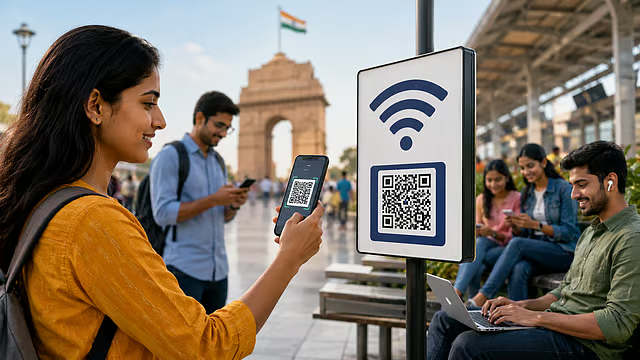
The revised 2026 guidelines solve this via QR-code-based cross-device authentication.
- The Process: When a user attempts to connect a laptop to a PM-WANI hotspot, the landing page will display a dynamic QR code.
- The Execution: The user scans this code using any pre-authenticated PM-WANI mobile application on their smartphone.
- The Result: The secure credential handshake immediately tethers the laptop to the high-speed network, bypassing carrier SMS pipelines entirely.
2. Micro-Connectivity “Sachet” Internet Packs
To democratize access for transiting commuters, students, and low-income individuals who do not need expensive, full-day or monthly internet packages, the DoT has advised hotspot operators to roll out micro-transaction models.
Modelled after “sachet-style” retail packaging, Public Data Offices are now directed to offer three distinct, ultra-short-duration validities:
- 15-Minute Bursts: Ideal for commuters pulling into a transit hub needing to instantly download a dynamic boarding pass or ticket QR.
- 30-Minute Windows: Tailored for quick email clearances and messaging check-ins.
- 60-Minute Sessions: Optimized for students or professionals working remotely out of marketplaces and bus terminals.
These temporary packs automatically expire once their time window closes, optimizing bandwidth availability and raising asset utilization across dense public areas.
3. SSID Standardization to Defeat “Evil Twin” Phishing
Public Wi-Fi networks are frequent vectors for cybercriminals deploying spoofed or fake routers (“Evil Twin” networks) designed to capture sensitive personal data or financial credentials.
To create an immediate visual baseline of security, the DoT has mandated uniform Service Set Identifier (SSID) nomenclature across the country. All authorized hotspots must prominently incorporate standard “PMWANI” branding directly into their broadcasted Wi-Fi names. This uniform standard makes authentic portals immediately recognizable to everyday citizens while structurally isolating malicious, unverified proxy networks.
               [ NEW PM-WANI LOGIC CORRIDOR ]
                              │
       ┌──────────────────────┴──────────────────────┐
       ▼                                             ▼
 [ Access Layer ]                             [ Utility Layer ]
 • Standardized "PMWANI" SSID                  • 15 / 30 / 60 Min Data Sachets
 • One-Scan QR App Verification                • Dynamic Token Cost Architecture
 • Instant No-OTP Laptop Tether                • Broad Regional Deployment
Transforming Small Businesses into Decentralized Telcos
Launched originally under the National Digital India initiative, the overarching goal of PM-WANI is to decentralize the distribution of broadband internet. Instead of relying exclusively on massive telecommunication monopolies to lay physical lines into every micro-merchant store, PM-WANI allows local tea stalls, neighborhood grocery shops (Kiranas), and small scale retail establishments to establish their own local hotspots.
By eliminating complex licensing requirements and steep statutory fees, any small merchant can purchase a standard commercial internet line, plug in a WANI-compliant access point, and function as a mini-telecom operator (Public Data Office).
By slashing login friction down to a single QR scan and introducing pocket-friendly 15-minute sachet plans, the Ministry of Communications under Union Minister Jyotiraditya Scindia expects public adoption of these micro-networks to surge dramatically ahead of the late-2026 festive travel cycle.