Key takeaways
- Chinese EV pressure means carmakers from China are pushing hard into Europe with lower prices and more models.
- European brands face a squeeze because EV demand has slowed, costs are still high, and Chinese rivals move fast.
- The EU has discussed tariffs, which are import taxes, but action has been uneven and slow.
- Big names like Volkswagen, BMW, and Mercedes now need cheaper EVs and faster factory plans.
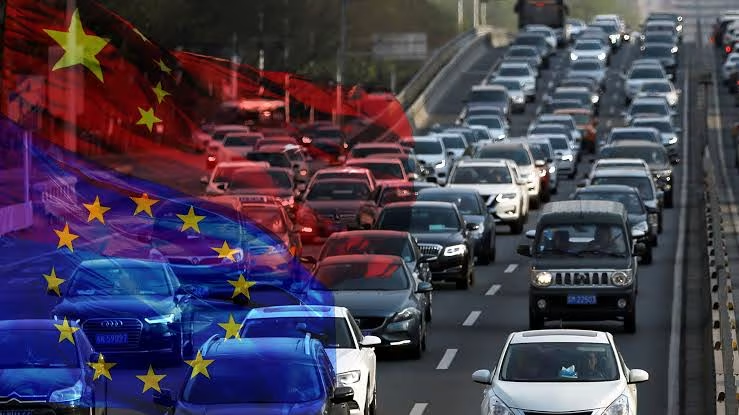
Chinese EV pressure is the growing challenge European carmakers face from Chinese electric vehicle brands. It means cheaper cars, fast product launches, and tighter profit margins. In Europe, that matters now because buyers want value, and many local brands are still catching up.
Why is Chinese EV pressure rising now?
The short answer is price. Chinese brands have learned how to build electric cars fast and often cheaper than rivals. That gives them room to cut prices, so shoppers notice.
Europe’s carmakers are in a tough spot because EV sales growth has cooled. Growth has not stopped, but it is slower than many bosses hoped two years ago. Meanwhile, fuel cars still bring in a lot of cash, so companies must manage two big businesses at once.
Chinese EV pressure also grows because many Chinese companies already dominate battery supply chains. A supply chain is the network that makes and moves parts. Batteries are the costliest part of most EVs, so control there matters a lot.
According to the International Energy Agency, global electric car sales topped 17 million in 2024. China made up the biggest share by far. That scale helps Chinese firms spread costs over millions of vehicles, which can lower prices in export markets like Europe.
What does this mean for European automakers?
For Europe’s big brands, the danger is simple. If rivals sell good EVs for less money, local firms may lose buyers. If they cut prices too, profits can shrink.
That is painful because building a new EV platform costs billions. A platform is the basic car structure under many models. Carmakers need high sales to earn that money back.
Volkswagen, Mercedes-Benz, BMW, Renault, and Stellantis all face this math. A company can sell more cars, but still make less profit per car. That can hit jobs, factory plans, and future research budgets.
In fact, some European brands are already rethinking timing. They are slowing some battery-only plans while also trying to release cheaper EVs sooner. That shows how fast Chinese EV pressure has changed the market.
Key numbers behind Chinese EV pressureGlobal EV sales17m+EU tariff top rate38.1%EU base import duty10%
Has the EU done enough about Chinese EV pressure?
The EU has tried to respond, but not everyone agrees on how hard to push. One tool is tariffs. Tariffs are taxes on imports from other places.
The European Commission has investigated Chinese EV support and proposed extra duties on some imports. Those extra rates came on top of the EU’s existing 10% car import tariff. In some cases, the added duty reached as high as 38.1% before later adjustments and talks, according to official EU documents.
But policy moves can be slow because Europe is not one country. Germany, France, Italy, and others do not always want the same thing. Some fear a trade fight with China, while others want stronger protection right now.
That hesitation matters because carmaking is huge in Europe. It supports factories, suppliers, and research centers across several countries. So Chinese EV pressure is not just a showroom story. It is also an industry and jobs story.
You can read the EU’s own case details at the European Commission. For broader market data, the International Energy Agency tracks global EV sales and battery trends.
Why can Chinese brands move so fast?
Chinese carmakers built speed into their business. Many launch new models quicker than older rivals. They also update software faster, which many younger buyers care about.
Software is the code that runs screens, maps, driver help, and battery settings. In modern EVs, software can shape the whole driving feel. That is one reason Chinese firms often look strong in smart features as well as price.
They also benefit from a giant home market. China sells millions of EVs each year, so companies can test ideas at scale. Then they bring proven cars to Europe.
This is similar to what happened in phones. A few years ago, Chinese brands used scale and price to grow fast. We saw a related trend in our report on the smartphone industry 2026: Why phones cost more now, where supply chains and pricing power changed the market.
What numbers show the scale of the challenge?
Three figures tell the story clearly. First, global EV sales passed 17 million in 2024, according to the IEA. Second, the EU’s base import tariff on cars is 10%. Third, proposed extra EU duties on some Chinese EVs reached up to 38.1%.
Those numbers show two things. The market is already huge, and Europe worries enough to consider high trade barriers. But even with barriers, Chinese EV pressure has not gone away.
| Measure | Figure | Why it matters |
|---|---|---|
| Global EV sales | 17 million+ | Bigger scale helps lower costs |
| EU base car import tariff | 10% | Existing cost on imported cars |
| Top extra duty discussed | 38.1% | Shows how worried Europe is |
| Main challenge | Lower-priced EVs | Puts pressure on local profits |
What should European carmakers do next?
They likely need three things at once. They need cheaper EVs, better software, and faster factories. Doing just one will not be enough.
They may also need partnerships for batteries and chips. Chips are tiny processors that run car systems. Without steady parts supply, even a good model can arrive late or cost too much.
Some of this lesson shows up in other industries too. For example, our piece on Alibaba AI stack takes on Nvidia with open-source tools explains how scale and lower-cost systems can put pressure on older leaders. Markets change fast when new rivals combine price with speed.
European brands still have strengths. They have famous names, dealer networks, and years of engineering know-how. But Chinese EV pressure means those old advantages are no longer enough by themselves.
Could buyers actually benefit?
Yes, at least in one clear way. More competition can mean lower prices and better features. That is good news for families thinking about buying an EV.
Buyers may also get longer range, faster charging, and better screens. Range is how far a car goes on one charge. If competition rises, companies often try harder to impress shoppers.
Still, governments also think about jobs and industrial power. If local factories lose too much ground, the long-term cost could be bigger than a short-term discount. So the debate is not simple.
That is why Chinese EV pressure has become such a hot issue. It touches trade, climate goals, factory jobs, and what cars cost at the dealership.
How does this fit with the bigger EV race?
The EV race is now global, not local. China leads in scale, the US pushes its own factory support, and Europe is trying to protect industry while staying open. That balance is hard.
Europe also has other big industrial goals, from batteries to clean energy. Our story on the DCM Shriram renewable energy plan lifts capacity to 176 MW shows how companies everywhere are investing for a cleaner economy. Cars are a huge part of that shift.
For now, the message is clear. Chinese EV pressure is rising faster than Europe’s response. If local carmakers do not cut costs and move faster, they could lose more ground.
Chinese EV pressure means European automakers now face a simple test: build good electric cars at prices ordinary buyers can afford, or risk losing market share to faster, cheaper rivals from China.
FAQs
What is Chinese EV pressure?
It is the rising competitive threat from Chinese electric car brands in Europe. They often offer lower prices, new tech, and fast launches.
Why are European carmakers worried?
They fear losing buyers and profits. EVs cost a lot to develop, so price cuts can hurt earnings quickly.
How is the EU responding?
The EU has investigated Chinese subsidies and discussed extra import duties. But member countries differ, so action has been slower than some companies want.
Who benefits if competition grows?
Car buyers may benefit first because prices can fall and features can improve. But workers and factories could face more pressure if local brands lose sales.
Get the day’s top stories in your inbox
One concise email. No spam, unsubscribe anytime.