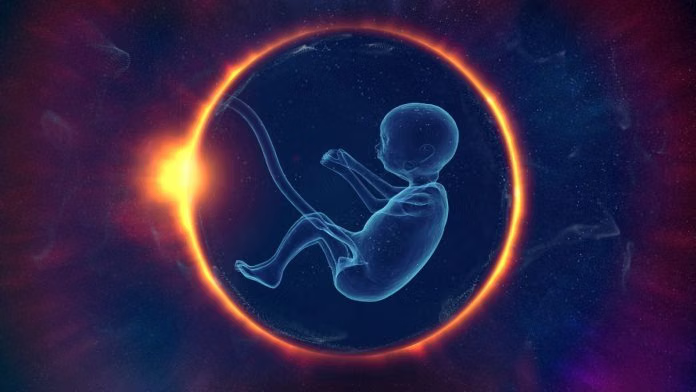
In a groundbreaking bid to determine whether the human species can successfully establish self-sustaining colonies beyond Earth, China has initiated the world’s first space-based experiment on human artificial embryo models.
The cargo was quietly launched on May 10 aboard a Long March 7 rocket during the Tianzhou-10 resupply mission from the Wenchang Space Launch Site. The payload arrived at the Tiangong space station in the early hours of May 11, where Chinese astronauts (taikonauts) successfully integrated the biological samples into the orbital laboratory’s experimental modules.
The experiment addresses a critical, unanswered question for long-duration spaceflight: can the earliest stages of human life actually form and develop normally without the presence of Earth’s gravity?
Unpacking the Science: What Are “Artificial Embryos”?
Project leader Yu Leqian, a prominent professor at the Chinese Academy of Sciences’ (CAS) Institute of Zoology, clarified that the materials sent into orbit are not real, fertilized human eggs.
Instead, they are sophisticated, stem-cell-grown structures known as blastoids. These synthetic models are biologically engineered to mimic the cellular architecture, signaling, and physical dimensions of a genuine human embryo. Crucially, they lack the capacity to properly form a fetus or develop into an individual.
Using these models allows researchers to circumvent severe ethical boundaries and international research regulations—such as the 14-day restriction on culturing live human embryos—while capturing translationally accurate data on human molecular development.
The Tiangong orbital laboratory is testing two distinct types of synthetic embryo models, specifically targeting the developmental window between 14 and 21 days after fertilization:
- The Peri-Implantation Model: This variant is cultured directly on top of uterine cells. It mimics the critical phase where an early embryo must properly orient itself and attach to the uterine wall.
- The Peri-Gastrulation Model: Housed inside an automated microfluidic chip, this model replicates gastrulation—the pivotal architectural event where a single layer of cells completely reorganizes into distinct, multi-layered structures that establish the body axis (determining head and tail layout) and form the building blocks for future organs.
The Microgravity Protocol: 5 Days in Orbit
To ensure the experiments run without human variance, the taikonauts rely on an advanced, pre-set automated life-support system built into the module. This architecture automatically flushes and replaces the nutrient culture medium surrounding the stem-cell blocks every 24 hours to keep the cells dividing.
The spacebound synthetic models were permitted to grow dynamically in real microgravity for exactly five days. Following the completion of this 120-hour development window, the automated system triggered a deep-freeze protocol, locking the samples “on ice” in orbit to halt further cellular processes.
Simultaneously, a completely identical control group of artificial embryos was grown, monitored, and frozen in a ground-based laboratory in China under identical timelines.
Once the frozen space samples are returned to Earth via a future descent capsule, genomic and structural specialists will conduct a side-by-side microscopic comparison with the ground control group. This will allow scientists to map out exactly how cellular division, tissue folding, and gene expressions are warped by cosmic radiation and a zero-gravity environment.
The Sovereign Stakes: Colonizing the Moon and Mars
While past space biology studies have successfully evaluated early embryonic development in mice—such as a Japanese experiment aboard the International Space Station that reported normal early cell progression—human cellular mechanics are vastly more complex and sensitive to environmental stressors. Microgravity is already known to accelerate stem-cell aging, alter fluid dynamics, and potentially disrupt the precise physical layout required for embryo cell migration.
The timing of China’s experiment highlights a broader geopolitical transition. As the modern space race shifts from temporary exploration milestones toward the deployment of permanent, long-term infrastructure—including NASA’s Artemis lunar base plans and China’s International Lunar Research Station (ILRS)—understanding the biological boundaries of reproduction is no longer a theoretical exercise.
If the data eventually reveals that human cellular structures cannot properly orient or differentiate without Earth-normal gravity ($1\text{G}$), future self-sustaining colonies on the Moon ($0.16\text{G}$) or Mars ($0.38\text{G}$) may require massive engineering interventions, such as artificial gravity rotating habitats, just to make human propagation possible.
Get the day’s top stories in your inbox
One concise email. No spam, unsubscribe anytime.