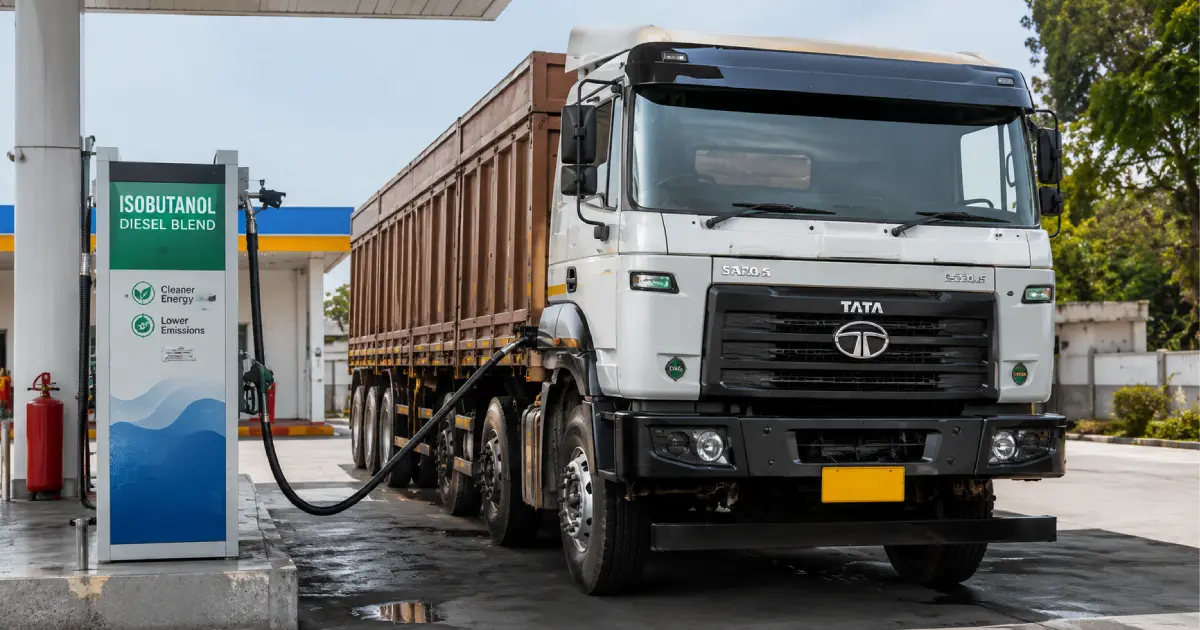
Following the highly successful nationwide rollout of E20 petrol, the Government of India is aggressively pivoting to its next major energy security frontier: blending up to 15% isobutanol with diesel.
Union Minister for Road Transport and Highways, Nitin Gadkari, confirmed that after extensive research and pilot trials, the government is framing a comprehensive roadmap to introduce isobutanol-blended diesel. Because India consumes nearly twice as much diesel as petrol, this initiative represents an even larger opportunity to slash imported crude dependencies and curb transport sector emissions.
1. Why Isobutanol Instead of Ethanol for Diesel?
While India has scaled its ethanol-blending program seamlessly in petrol engines, ethanol cannot be mixed directly into conventional diesel. Initial attempts to blend ethanol with diesel beyond a 5% threshold failed globally due to major structural limitations:
- The Cetane & Ignition Hurdle: Diesel engines rely on compression ignition and require fuel with a high cetane rating (typically 45–55). Ethanol sharply drops the cetane number, causing delayed ignition, severe engine knocking, and drastic power loss under heavy loads.
- The Volatility Danger: Ethanol has a low flashpoint, making it highly volatile and chemically unstable when stored alongside or mixed with heavy diesel fuel oil.
- The Solution: Rather than forcing ethanol into diesel setups, Indian researchers are chemically converting domestically produced sugarcane and agricultural biomass ethanol into isobutanol (a four-carbon alcohol). Isobutanol naturally yields high blend stability, lower volatility, and does not experience phase separation when stored.
2. Technical Edge: Superior Material Compatibility
Unlike ethanol, which is heavily hygroscopic (meaning it attracts and absorbs moisture from the air, causing long-term fuel tank corrosion), isobutanol offers specific properties that closely match conventional hydrocarbon fuels:
- High Energy Density: The energy profile per liter of isobutanol is significantly closer to raw diesel than ethanol is to petrol. As a result, industry experts project that a 15% blend will have a completely marginal, near-invisible impact on vehicle mileage.
- Cleaner Combustion: Real-world laboratory testing shows that isobutanol promotes a more complete burn within the engine cylinder. This naturally curbed the output of particulate matter and nitrogen oxides ($NO_x$)—the two most problematic emissions associated with commercial transport.
- No Hardware Changes Needed: At a 15% ratio, the fuel remains entirely compatible with existing internal combustion diesel engines, logistics pipelines, and commercial retail fuel pumps. Heavy commercial trucks will maintain standard power delivery and torque metrics without needing immediate mechanical overhauls.
3. Real-World Testing & Implementation Timeline
India is the first country globally to design a mandatory nationwide integration framework for isobutanol-diesel mixes. The foundational scientific work is already in an advanced stage:
- The Bengaluru Pilots: Comprehensive real-world road and lab testing is actively being spearheaded by Hindustan Petroleum Corporation Limited (HPCL) at its state-of-the-art R&D Center in Bengaluru.
- 100% Alternative Power Feat: Minister Gadkari highlighted that engineering teams have already successfully operated two stationary generator sets on 100% pure alternative fuels (a mix of pure ethanol and pure isobutanol), proving that internal combustion configurations can easily adapt to high-concentration alcohol bases.
- The Next Steps: According to the Ministry of Road Transport and Highways (MoRTH), full-scale regulatory approvals and the formal rollout of the initial blending mandate are expected to begin later this year.
Get the day’s top stories in your inbox
One concise email. No spam, unsubscribe anytime.