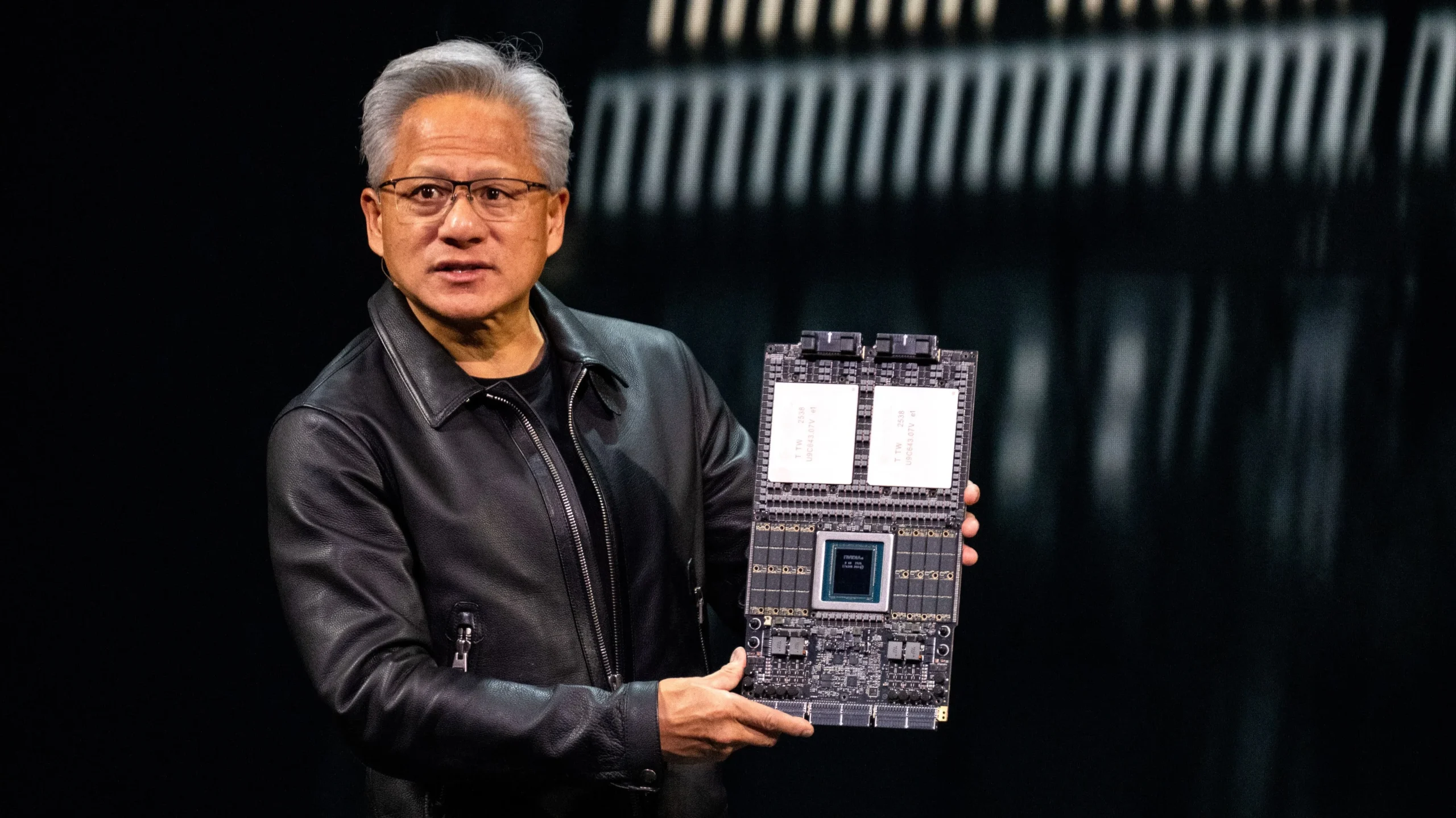
During Nvidia’s blockbuster Q1 FY27 earnings call on Thursday, May 21, 2026, CEO Jensen Huang announced that the company has unlocked a “brand new” $200 billion total addressable market (TAM).
Surprisingly, this massive new financial frontier isn’t coming from Nvidia’s core Graphics Processing Units (GPUs)—it is coming from Central Processing Units (CPUs) designed specifically for the next era of artificial intelligence.
1. The Catalyst: The “Vera” CPU & Agentic AI
The hardware driving this $200 billion projection is Nvidia’s new Vera CPU, which the company first unveiled in March 2026. While competitors like Intel and AMD have traditionally dominated the data center CPU space, Huang argues that classic x86 cloud architectures are completely unequipped for what is coming next.
- The Division of Labor: Huang explained that while GPUs handle the heavy “thinking” and reasoning layers of large language models, autonomous AI agents rely heavily on CPUs to execute tasks, call APIs, manipulate software tools, and process tokens rapidly.
- The World’s First “Agentic” CPU: Vera is an Arm-based processor engineered from the ground up to handle the continuous, 24/7 background workflows of billions of autonomous digital agents and physical robotic systems.
- Early Inflows: Standalone sales of the Vera CPU have already brought in $20 billion so far this year, proving that hyperscalers are rapidly shifting their infrastructure buy-in.
2. Retooling the Global Infrastructure
Huang noted that every major cloud hyperscaler and system manufacturer is currently partnering with Nvidia to deploy Vera alongside their Blackwell and upcoming Rubin GPU architectures.
“The world is fundamentally retooling its entire computing fabric. We are shifting away from general-purpose multitasking servers to highly accelerated, agent-first factories. Nvidia is now at the absolute center of both the GPU reasoning layer and the CPU execution layer.” — Jensen Huang, Nvidia CEO
3. Fending Off the Custom Silicon Threat
The strategic timing of this $200 billion announcement is highly deliberate. Wall Street has expressed growing anxiety over Big Tech firms like Amazon Web Services (AWS), Google, and Meta aggressively designing their own in-house, custom AI chips to reduce their dependence on Nvidia.
By defining and capturing an entirely separate, high-margin CPU market tailored uniquely for agentic task execution, Nvidia is building a secondary competitive moat. It changes the narrative from “Can Nvidia sell enough GPUs?” to “Can anyone else build the dual-processor ecosystem required to run millions of autonomous agents simultaneously?”
Get the day’s top stories in your inbox
One concise email. No spam, unsubscribe anytime.