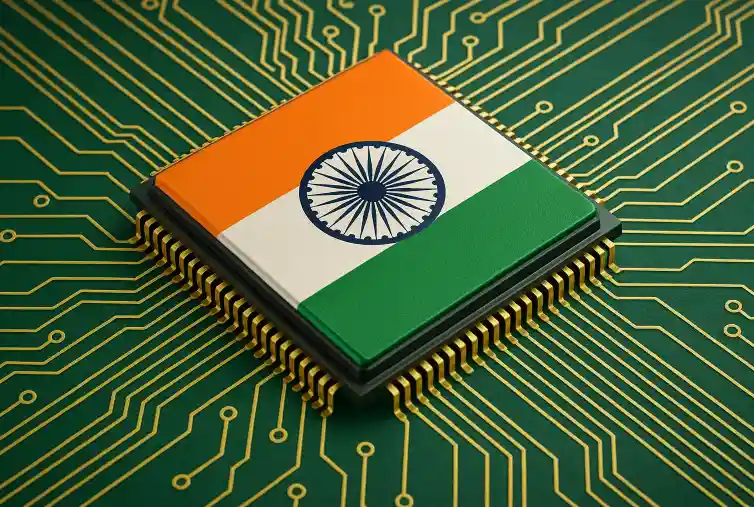
The Indian government is preparing to extend subsidized access to artificial intelligence (AI) chips to government departments, research institutions, and state-backed educational institutions under the IndiaAI Mission, expanding the programme beyond startups. The move is aimed at accelerating the development of indigenous AI models, strengthening public-sector AI applications, and giving government researchers access to the high-performance computing resources needed to build advanced AI systems.
Until now, the IndiaAI Mission has primarily focused on providing subsidized graphics processing units (GPUs) to startups building AI applications. Under the proposed expansion, ministries, research agencies, public universities, and government laboratories will also receive access to AI compute infrastructure through the Mission’s Compute-as-a-Service (CaaS) platform at significantly reduced costs.
IndiaAI Mission Expands GPU Subsidy Programme
The Ministry of Electronics and Information Technology (MeitY) has reportedly asked central ministries to estimate their future GPU requirements for AI projects.
According to internal government memorandums reviewed by Mint, ministries have been instructed to assess computing needs for upcoming AI initiatives and submit projections covering research, public services, and domain-specific AI applications. Government-backed organizations including C-DOT, BSNL, C-DAC, and the Council of Scientific and Industrial Research (CSIR) have also been asked to estimate their future AI compute requirements.
| Programme | Details |
|---|---|
| Initiative | IndiaAI Mission |
| Implementing Ministry | MeitY |
| New Beneficiaries | Government departments, research agencies, state-backed colleges |
| Support | Subsidized GPU access through Compute-as-a-Service (CaaS) |
Up to 40% Subsidy on AI Compute
According to the Department of Telecommunications (DoT) memorandum cited in the report, government entities will receive up to a 40% subsidy on AI computing costs through the IndiaAI Mission.
The subsidized infrastructure will enable organizations to develop:
- Indigenous AI models.
- Public-sector AI applications.
- Research projects.
- Academic AI initiatives.
- Domain-specific AI solutions.
The government believes reducing access costs will encourage wider adoption of AI across ministries and research institutions.
Building AI for Public Services
The expanded programme is intended to support AI projects across multiple sectors.
| Focus Area | Expected Applications |
|---|---|
| Healthcare | Medical AI and diagnostics |
| Agriculture | Crop intelligence and advisory systems |
| Education | AI-powered learning platforms |
| Telecommunications | Network optimization |
| Scientific research | Foundation models and AI tools |
| Governance | Citizen services and automation |
Officials say the initiative aligns with one of the IndiaAI Mission’s original objectives of creating AI applications that can improve public services at population scale.
Funding Already Allocated
The expansion will be financed under the existing IndiaAI Mission, which was approved in March 2024 with a total outlay of ₹10,372 crore over five years.
According to the report:
| Funding Status | Amount |
|---|---|
| Total IndiaAI Mission outlay | ₹10,372 crore |
| Allocation for FY27 | ₹1,000 crore |
| Committed so far | ₹2,194 crore |
| Actual spending | ₹973 crore |
Officials said the FY27 allocation will support subsidized GPU access for government departments and research institutions, with additional funding available if required.
Why GPUs Matter
Graphics Processing Units (GPUs) are the foundation of modern artificial intelligence.
They are used to:
- Train large language models (LLMs).
- Run AI inference.
- Process large datasets.
- Develop computer vision systems.
- Build generative AI applications.
Because GPU infrastructure is extremely expensive, compute costs often account for more than half of an AI company’s total expenditure. Shared government infrastructure can therefore significantly reduce barriers for AI developers and researchers.
Supporting India’s AI Ambitions
The IndiaAI Mission is designed to create a domestic AI ecosystem through shared compute infrastructure, datasets, talent development, startup financing, research, and responsible AI initiatives.
By expanding GPU subsidies beyond startups, the government aims to encourage greater collaboration between academia, public research institutions, and government agencies while accelerating the development of sovereign AI capabilities tailored to India’s needs.
What It Means for India’s AI Ecosystem
The proposed expansion of GPU subsidies marks the next phase of the IndiaAI Mission, shifting its focus from supporting early-stage startups to enabling AI development across the public sector. By giving government departments, universities, and research institutions affordable access to high-performance computing, the Centre hopes to accelerate innovation in healthcare, education, governance, scientific research, and other strategic sectors.
For India’s AI ecosystem, the initiative could strengthen indigenous model development while reducing dependence on costly commercial cloud infrastructure. If implemented at scale, it would also reinforce the government’s ambition of building a self-reliant AI ecosystem powered by shared computing resources, domestic innovation, and public-sector collaboration.
Get the day’s top stories in your inbox
One concise email. No spam, unsubscribe anytime.