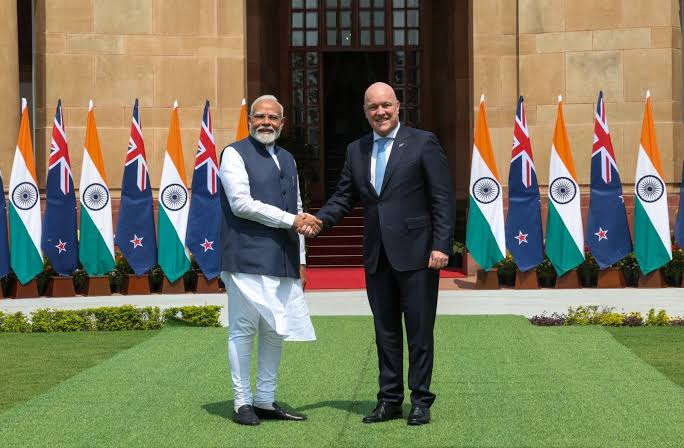
India and New Zealand have set an ambitious goal of doubling bilateral trade to ₹35,000 crore (around NZ$7 billion) by 2030, reflecting growing economic ties between the two countries as they deepen cooperation in trade, investment, technology, agriculture, education, and clean energy. The target was announced following high-level discussions between government officials and business leaders, who identified significant opportunities to expand commercial engagement over the next five years.
The announcement comes as both nations work toward strengthening economic relations through the proposed India-New Zealand Free Trade Agreement (FTA), which resumed negotiations earlier this year after being stalled for more than a decade.
Ambitious Trade Target for 2030
India and New Zealand currently share a growing but relatively modest trade relationship compared to their overall global trade volumes.
By targeting ₹35,000 crore in bilateral trade by 2030, both governments aim to significantly increase exports, imports, investment flows, and business partnerships across multiple sectors.
| Trade Goal | Details |
|---|---|
| Bilateral trade target | ₹35,000 crore |
| Target year | 2030 |
| Focus | Trade, investment and economic cooperation |
Officials believe stronger business collaboration and improved market access can help both countries achieve the target.
FTA Negotiations Gather Momentum
A major driver of the trade target is the ongoing negotiation of a Free Trade Agreement (FTA) between India and New Zealand.
The proposed agreement is expected to reduce tariffs, improve market access for businesses, simplify customs procedures, and encourage investment.
Key areas under discussion include:
- Agriculture.
- Dairy products.
- Pharmaceuticals.
- Information technology.
- Education.
- Services.
- Renewable energy.
- Digital trade.
A successful FTA could significantly boost trade volumes by lowering barriers for exporters and investors.
Sectors Expected to Drive Growth
Both countries see multiple industries with strong growth potential over the coming years.
| Sector | Opportunity |
|---|---|
| Agriculture | Food processing and agri-tech collaboration |
| Dairy | Market access and technology exchange |
| Information Technology | Digital services and software exports |
| Education | Student mobility and research partnerships |
| Renewable Energy | Clean energy investments |
| Tourism | Higher visitor exchanges |
| Healthcare | Pharmaceuticals and medical technology |
Businesses from both countries are expected to explore joint ventures and long-term investment opportunities.
India’s Growing Importance
India has emerged as one of the world’s fastest-growing major economies, making it an increasingly attractive market for New Zealand exporters.
Rapid growth in digital infrastructure, manufacturing, infrastructure development, and consumer demand has created new opportunities for international businesses.
For New Zealand, expanding access to India’s large and growing consumer market represents an important long-term economic opportunity.
Investment Cooperation
Beyond merchandise trade, both countries are seeking to strengthen investment partnerships.
Areas of collaboration include:
- Startup investments.
- Food technology.
- Agritech innovation.
- Artificial intelligence.
- Advanced manufacturing.
- Logistics.
- Sustainable infrastructure.
Greater investment flows could help businesses expand into new markets while supporting innovation and job creation.
Challenges Remain
Despite strong political commitment, several issues will need to be addressed before trade reaches the 2030 target.
| Challenge | Potential Impact |
|---|---|
| Tariff negotiations | Market access discussions |
| Dairy sector sensitivities | Key issue in FTA talks |
| Regulatory alignment | Compliance requirements |
| Logistics costs | Trade competitiveness |
| Market awareness | Business expansion opportunities |
Negotiators will need to balance domestic industry interests while creating commercially meaningful market access.
Outlook
Business groups from both countries remain optimistic that closer economic cooperation will generate long-term benefits.
The ongoing FTA negotiations, increasing business engagement, and growing demand across technology, education, food, and clean energy sectors are expected to provide additional momentum over the coming years.
If the proposed agreement is successfully concluded, bilateral trade could accelerate significantly before the end of the decade.
What It Means for India and New Zealand
The shared objective of reaching ₹35,000 crore in bilateral trade by 2030 signals a renewed commitment to strengthening economic ties between India and New Zealand. As both countries pursue deeper cooperation through the proposed Free Trade Agreement, businesses are likely to gain improved market access, lower trade barriers, and greater investment opportunities.
For India, the partnership offers expanded export opportunities and stronger engagement with the Asia-Pacific region. For New Zealand, it provides access to one of the world’s fastest-growing large economies. If negotiations progress successfully, the relationship could evolve into a broader strategic economic partnership spanning trade, technology, education, agriculture, and sustainable development.
Get the day’s top stories in your inbox
One concise email. No spam, unsubscribe anytime.