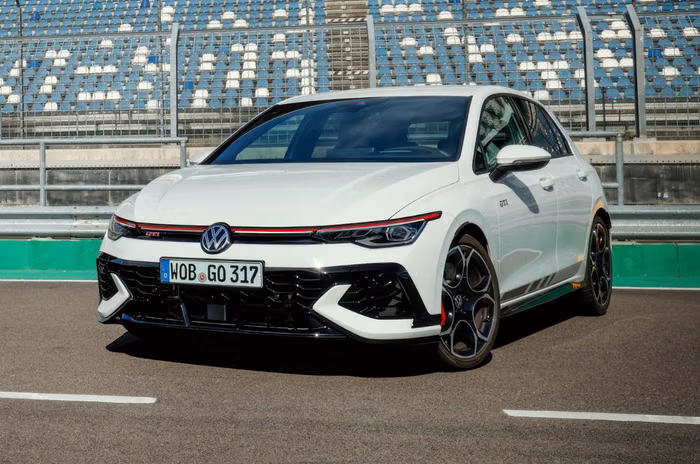
Volkswagen Group reported its largest quarterly decline in vehicle deliveries since 2022, as weakening demand in China overshadowed growth in Europe and North America. The German automaker delivered 2.077 million vehicles globally during the second quarter of 2026, down 8.6% year-over-year, highlighting the growing challenges traditional automakers face in the world’s largest automotive market.
The sharp decline comes despite Volkswagen’s continued investment in electric vehicles and localized product development in China, where domestic manufacturers such as BYD continue to gain market share through competitively priced, technology-focused EVs.
China Slump Weighs on Global Deliveries
China remained the biggest drag on Volkswagen’s performance during the quarter. Vehicle deliveries in the country plunged 36.6% from a year earlier, far exceeding declines seen in other major markets.
The downturn reflects a broader slowdown in China’s automotive market, where intense price competition, changing consumer preferences, and the rapid adoption of locally developed electric vehicles have put increasing pressure on foreign brands.
Volkswagen has long relied on China as one of its most important growth engines, but the market has become significantly more competitive over the past few years as domestic automakers continue to expand their product offerings and strengthen their technological capabilities.
Volkswagen’s Regional Performance
| Region | Q2 2026 Delivery Trend |
|---|---|
| China | -36.6% |
| North America | +7.7% |
| Western Europe | +1.8% |
| Central & Eastern Europe | +6.7% |
| Global Deliveries | -8.6% to 2.077 million vehicles |
While sales improved across several international markets, those gains were not enough to offset the sharp decline in China, which remains Volkswagen’s largest single market.
Local EV Makers Continue to Pressure Foreign Brands
Volkswagen’s struggles mirror the broader challenges facing German automakers in China. Companies including Mercedes-Benz, BMW, and Porsche have also reported weaker sales as consumers increasingly favor domestic EV manufacturers.
Chinese companies such as BYD have rapidly expanded their market share by offering vehicles equipped with advanced driver-assistance systems, connected-car technology, and competitive pricing. At the same time, aggressive discounting across the Chinese auto industry has intensified pressure on international brands.
Although Volkswagen briefly regained the position of China’s best-selling automaker earlier this year, the company’s latest results suggest sustaining that momentum has become increasingly difficult.
Volkswagen Bets on “In China, for China”
To regain competitiveness, Volkswagen has been accelerating its localization strategy under its “In China, for China” initiative.
The company has announced plans to launch more than 20 new energy vehicle (NEV) models tailored specifically for Chinese consumers. The strategy focuses on faster product development, locally designed software, and partnerships with Chinese technology companies to better compete with domestic rivals.
Volkswagen believes locally developed electric vehicles will help narrow the technology gap and better address the preferences of Chinese buyers, who increasingly prioritize smart cockpit features, advanced connectivity, and intelligent driving capabilities.
Broader Challenges Extend Beyond China
China is not the only challenge confronting Volkswagen. The automaker is also navigating rising U.S. tariffs, higher development costs associated with electrification, stricter emissions regulations, and growing geopolitical uncertainty.
These pressures have prompted CEO Oliver Blume to pursue a broad restructuring program aimed at reducing complexity, improving efficiency, and strengthening Volkswagen’s competitiveness. The proposed overhaul includes simplifying the company’s extensive model lineup and reducing costs across its global operations, although some restructuring efforts have faced resistance from labor representatives.
Impact Across Volkswagen Brands
The slowdown affected several of Volkswagen Group’s key brands.
| Brand | Reported Q2 Trend |
|---|---|
| Volkswagen Passenger Cars | Declined |
| Audi | Lower deliveries amid China weakness |
| Porsche | Lower deliveries |
| Škoda | Growth |
| Lamborghini | Growth |
| Commercial Vehicles | Growth |
While premium brands such as Audi and Porsche also experienced weaker demand, Škoda, Lamborghini, and Volkswagen’s commercial vehicle business delivered positive results during the quarter.
What It Means for the Global Auto Industry
Volkswagen’s latest delivery figures highlight the rapid transformation underway in the global automotive industry. China’s shift toward domestically developed electric vehicles is reshaping competitive dynamics, forcing established international automakers to rethink their product strategies and accelerate localization efforts.
For Volkswagen, recovering its position in China will be critical to restoring global sales momentum. The success of its next generation of locally developed electric vehicles could determine whether the company can regain market share in the world’s largest EV market while maintaining its leadership in the global automotive industry.
Get the day’s top stories in your inbox
One concise email. No spam, unsubscribe anytime.