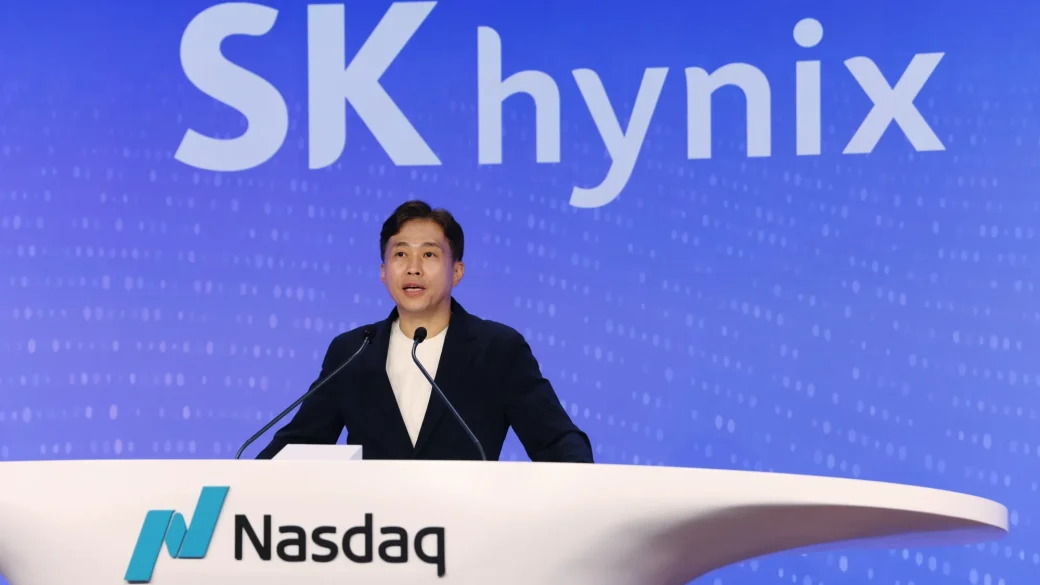
SK Hynix expects the global memory chip industry to face its most severe supply shortage in 2027, with demand projected to outpace production capacity well beyond the end of the decade. The warning, issued by CEO Kwak Noh-jung, highlights the growing strain that artificial intelligence is placing on the semiconductor supply chain as companies race to build AI infrastructure around the world.
The South Korean chipmaker, one of the world’s leading producers of DRAM and NAND memory, believes the industry’s current expansion plans will still be insufficient to meet the rapidly rising demand for advanced memory chips, particularly High Bandwidth Memory (HBM), which has become a critical component in AI accelerators used by companies such as Nvidia.
AI Boom Is Driving Unprecedented Memory Demand
Speaking about the outlook for the industry, Kwak said the global memory market is heading toward its worst-ever supply shortage in 2027. Despite significant investments in new fabrication plants and advanced packaging facilities, he expects demand to continue exceeding supply beyond 2030.
The rapid expansion of AI data centers is the primary driver behind the forecast. Large language models, generative AI applications, and cloud-based AI services require enormous amounts of high-performance memory to process massive datasets efficiently. As hyperscalers continue investing billions of dollars into AI infrastructure, memory manufacturers are struggling to expand production fast enough.
Why High Bandwidth Memory Is in Short Supply
Unlike conventional DRAM used in PCs and smartphones, High Bandwidth Memory is designed to deliver extremely high data transfer speeds while consuming less power. It is an essential component in AI GPUs developed by companies such as Nvidia and AMD.
Producing HBM is significantly more complex than manufacturing traditional memory chips. The process requires advanced chip stacking, sophisticated packaging technologies, and longer production cycles, making it difficult for manufacturers to rapidly increase output.
As a result, much of the industry’s manufacturing capacity is being redirected toward AI-focused products, leaving limited room for expanding production of other memory products.
Memory Demand vs Supply Outlook
| Timeline | Industry Outlook |
|---|---|
| 2026 | Strong AI-driven memory demand continues |
| 2027 | SK Hynix expects the industry’s worst-ever memory shortage |
| 2028–2030 | Demand projected to remain above production capacity |
| Beyond 2030 | Supply-demand imbalance expected to persist despite capacity expansion |
Massive Investments Continue Across the Industry
To prepare for long-term AI demand, SK Hynix is accelerating investments across its manufacturing network.
The company is building a $4 billion advanced chip packaging facility in Indiana and has announced plans to invest approximately $10 billion in AI-related development in the United States. It is also evaluating additional wafer fabrication facilities as global demand continues to grow.
These investments come alongside broader expansion efforts across the semiconductor industry, with competitors such as Samsung Electronics and Micron Technology also increasing spending to secure future production capacity.
SK Hynix Strengthens Its Position in the AI Supply Chain
The AI boom has transformed SK Hynix into one of the most important suppliers in the semiconductor industry. The company has established itself as a leading producer of HBM chips, supplying memory used in Nvidia’s AI accelerators that power many of today’s largest AI models and cloud computing platforms.
Strong demand has translated into record financial performance. SK Hynix recently reported record operating profits driven largely by sales of AI-focused memory products, while investor enthusiasm helped fuel a successful U.S. market debut.
What the Shortage Could Mean for the Industry
A prolonged imbalance between memory supply and demand could have far-reaching consequences for the technology sector.
| Potential Impact | Expected Outcome |
|---|---|
| AI infrastructure | Higher deployment costs for new data centers |
| Cloud providers | Increased spending on AI hardware |
| Chip manufacturers | Continued pricing power for advanced memory |
| Enterprise AI | Longer lead times for AI servers |
| Consumer electronics | Possible pressure on DRAM and NAND availability if production shifts toward AI products |
Industry analysts believe AI-related demand will remain the dominant growth driver for the memory market throughout the remainder of the decade, encouraging manufacturers to prioritize premium AI memory products over traditional consumer memory.
Can the Industry Catch Up?
Although memory manufacturers are expanding aggressively, building new semiconductor fabrication plants takes several years and requires billions of dollars in capital investment. Advanced packaging capacity has also become a major bottleneck as demand for AI chips continues to surge.
Even with new facilities coming online, SK Hynix believes production growth will not be sufficient to match the pace of AI infrastructure spending, resulting in continued shortages for several years.
What It Means for the AI Industry
SK Hynix’s forecast underscores how memory has become one of the most critical components of the AI revolution. While GPUs often receive the most attention, advanced memory technologies such as HBM are equally essential for training and running increasingly sophisticated AI models.
If demand continues to exceed supply through 2030, memory manufacturers could enjoy sustained pricing power and strong profitability, while technology companies may face higher hardware costs and longer procurement timelines. The warning also reinforces the strategic importance of expanding global semiconductor manufacturing capacity as AI adoption accelerates across industries.
Get the day’s top stories in your inbox
One concise email. No spam, unsubscribe anytime.