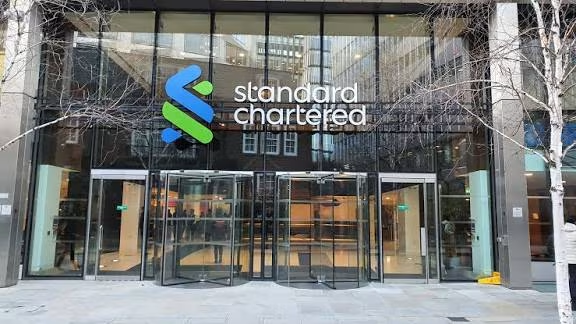
Standard Chartered Bank has significantly downscaled its physical footprint in India, cutting its branch network down to 80 from 100 over the past year.
Despite closing a fifth of its brick-and-mortar storefronts, the British banking giant has not surrendered its valuable banking licenses to the Reserve Bank of India (RBI). Instead, the lender is holding onto the surplus licenses and reviewing whether they can be strategically redeployed to alternative high-growth centers in the future.
1. The Strategy: Pivoting to Wealth and Affluent Banking
The contraction of Standard Chartered’s physical layout is part of a deliberate corporate transition away from mass retail and single-product relationships toward highly focused, multi-product wealth management.
- Consolidation Over Exit: Rather than abandoning markets entirely, the bank has rationalized its operations by merging branches that sit in close geographical proximity and closing down redundant single-city offices.
- Upgrading to Priority Banking: While total branches are down, Standard Chartered is investing heavily in premium infrastructure. The lender is actively expanding its high-format “Priority Centers” network inside existing branches, targeting an increase from 20 centers to roughly 30 by the end of 2026.
- A Network Still Elite: Even with 80 branches, Standard Chartered firmly retains its title as the largest branch network among all foreign banks operating in India that have chosen not to convert into a Wholly Owned Subsidiary (WOS).
2. Unwinding the Mass-Retail Footprint
The physical retail branch cuts follow a clear, multi-quarter corporate offloading of mass consumer credit and loan exposure in India:
Plaintext
[ THE MASS-RETAIL DIVESTMENT ROADMAP ]

├── Oct 2024: Sold its Personal Loan Book (~₹4,100 Cr in standard assets) to Kotak Mahindra Bank.
└── Apr 2026: Sold its entire pool of 450,000 Retail Credit Cards to Federal Bank.
By passing its personal loans and credit cards off to domestic banks, StanChart has cleared out lower-margin retail weight to free up relationship managers and digital pipelines specifically for small and medium-sized enterprises (SMEs) and affluent individual portfolios.
3. The Changing Landscape for Foreign Banks in India
Standard Chartered’s retreat from broad-scale physical retail highlights a widening operational truth: foreign institutions are finding it incredibly difficult to match the massive local distribution, ultra-cheap deposits, and aggressive digital reach of Indian private and public sector banking giants.
| Foreign Lender | Current India Retail Strategy |
| Standard Chartered | 80 Branches: Pivoting entirely to wealth advisory, high-net-worth individuals, and premium SME portfolios. |
| Citibank | Exited Retail: Completely finalized the multi-billion dollar sale of its Indian consumer banking division to Axis Bank in 2023. |
| Deutsche Bank | Exited Retail: Agreed to sell its local retail, private banking, and wealth operations to Kotak Mahindra Bank for ₹282 crore in June 2026. |
| HSBC | The Contrarian: Took a reverse stance by opening 20 new localized offices in cities like Navi Mumbai, Thiruvananthapuram, and Bhopal to capture regional wealth. |
By maintaining its baseline corporate and investment infrastructure out of its main hubs—including its massive Global Business Services campus in Chennai—Standard Chartered is betting that a leaner physical footprint with un-surrendered RBI licenses is the most efficient way to maximize returns on Indian soil.
Get the day’s top stories in your inbox
One concise email. No spam, unsubscribe anytime.