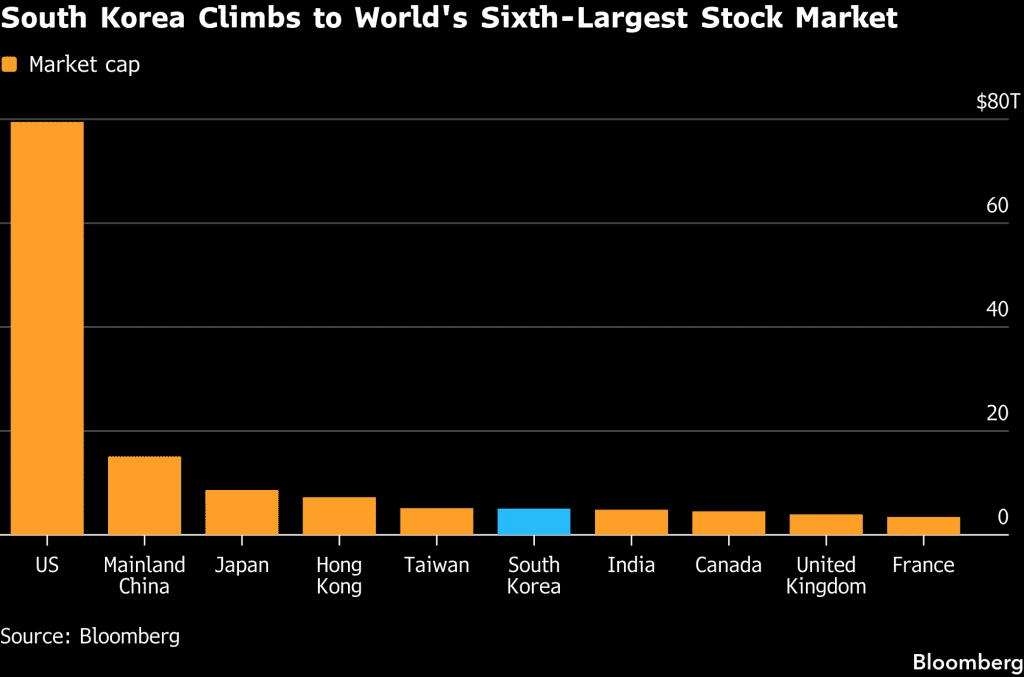
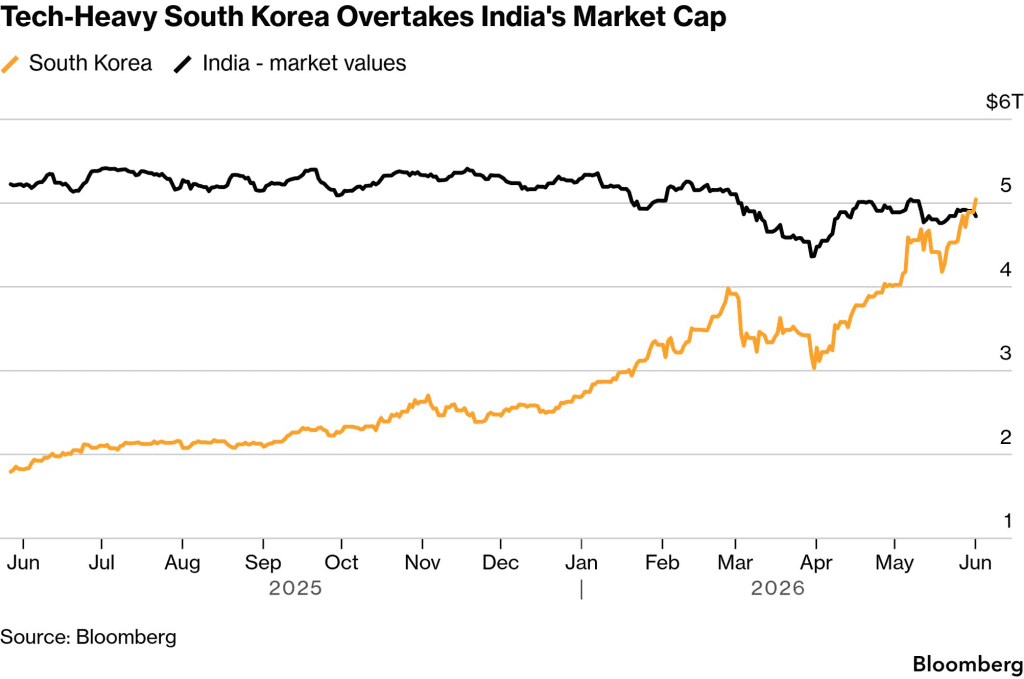
In a massive reshuffling of global equity hierarchies, South Korea’s stock market has officially overtaken India’s to become the sixth-largest in the world by market capitalization.
Driven by an extraordinary, breakneck rally in its technology and semiconductor sectors, the total market capitalization of South Korean listed companies crossed the $5 trillion mark during the Asian trading session. Concurrently, the Indian stock market—weighed down by persistent foreign capital outflows and currency pressures—saw its total market value ease slightly to $4.8 trillion, sliding India down to the seventh spot globally.
1. The Core Engine: The $1 Trillion AI Valuation Club
The primary catalyst behind South Korea’s equity surge is the global artificial intelligence hardware buildout. International investors looking to capitalize on AI infrastructure have heavily concentrated their capital into South Korea’s premier memory chip manufacturers:
- SK Hynix Inc.: Serving as the primary supplier of High Bandwidth Memory (HBM) chips to Nvidia with a 57% global revenue share, the company’s stock has soared over 1,000% over the past year. Its market capitalization historically crossed the $1 trillion threshold, backed by a first-quarter net profit surge of 398% and a record-breaking 72% operating margin.
- Samsung Electronics Co.: Samsung’s market capitalization expanded significantly, with its stock price gaining 196% over the last 12 months. The company’s Q1 operating profit jumped more than eightfold, easily eclipsing full-year earnings expectations.
Leaning on the explosive momentum of these tech titans, South Korea’s benchmark KOSPI index has surged more than 100% year-to-date in 2026. This blistering performance has allowed South Korea to leapfrog major global equity hubs over the last few months, including Canada, Germany, France, and the United Kingdom, before ultimately surpassing India.
2. Why the Indian Market Faces Near-Term Pressure
Financial analysts emphasize that India’s drop to the seventh position is a reflection of shifting global capital flows rather than structural weakness in its broader domestic economy. Instead, several market-specific headwinds have temporarily cooled off Indian equities:
- FII Outflows: Global institutional funds have been actively rebalancing their portfolios, pulling record amounts of foreign capital out of Indian indexes to chase high-yielding AI infrastructure plays in East Asian semiconductor corridors.
- Macro Environment: A weaker Indian Rupee against a surging US Dollar has eroded foreign investor returns, creating near-term caution across local bourses.
- The “AI Pure-Play” Deficit: Unlike South Korea or Taiwan, India’s stock indexes lack large, listed, pure-play AI hardware or chip design manufacturing giants that can directly absorb the massive influx of speculative global AI liquidity.
3. Market Cap vs. Economic Scale
While equity markets track investor enthusiasm for forward-looking tech cycles, macroeconomic fundamentals present a completely different picture of scale. Market data from the International Monetary Fund (IMF) highlights that India’s real economy continues to drastically outsize South Korea’s:
| Country | Stock Market Capitalization (June 2026) | Gross Domestic Product (GDP Scale) |
| South Korea | $5.0 Trillion | $1.93 Trillion |
| India | $4.8 Trillion | $4.15 Trillion |
Though South Korea’s outsized influence over the global hardware supply chain has allowed its stock market value to trade at an ultra-premium multiple relative to its GDP, asset managers caution about potential overheating. Because this global equity re-rating is heavily cyclical and tied almost en
Get the day’s top stories in your inbox
One concise email. No spam, unsubscribe anytime.