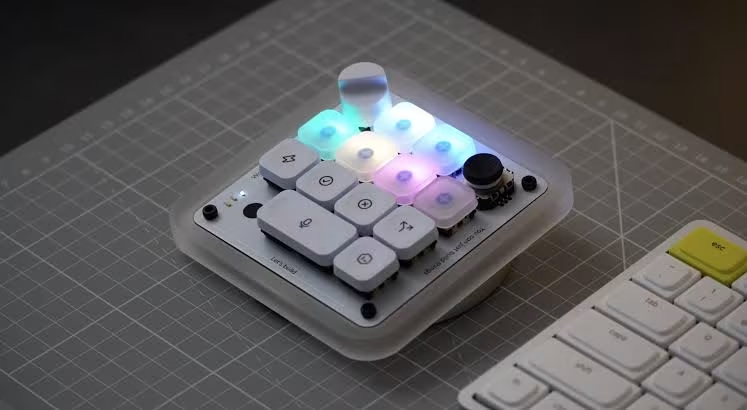
OpenAI has officially entered the hardware market with the launch of the Codex Micro, a $230 (around ₹20,000) mechanical macro keyboard developed in partnership with boutique keyboard manufacturer Work Louder. Designed specifically for developers using Codex, OpenAI’s AI coding assistant, the compact device serves as a physical control panel for managing AI coding agents and workflows.
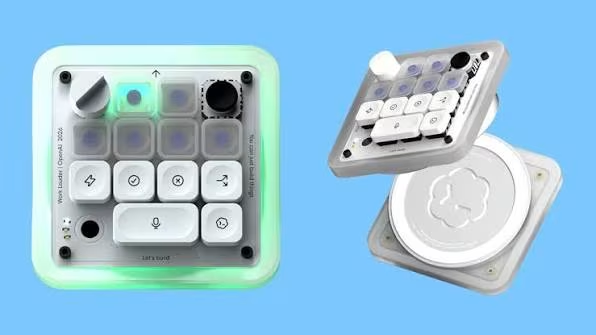
Unlike a traditional keyboard, the Codex Micro is a limited-edition programmable controller featuring illuminated “Agent Keys,” customizable shortcut buttons, a rotary dial for adjusting AI reasoning levels, and a joystick for navigating workflows. The device integrates with the ChatGPT desktop app, allowing users to configure controls and monitor AI agent activity in real time. OpenAI says the product is intended for power users who regularly work with multiple AI coding agents rather than the broader consumer market.
OpenAI Launches Its First Hardware Product
The Codex Micro marks the company’s first commercial hardware release.
| Key Highlights | Details |
|---|---|
| Company | OpenAI |
| Product | Codex Micro |
| Partner | Work Louder |
| Price | $230 |
| Target users | Developers and AI power users |
| Availability | Limited-run product |
The launch represents OpenAI’s first step into dedicated hardware while larger AI device projects remain in development.
What Is the Codex Micro?
The Codex Micro is not a full-size keyboard but a compact programmable controller built for AI-assisted software development.
Key features include:
- Illuminated Agent Keys showing live AI agent status.
- Customizable shortcut keys for Codex commands.
- Rotary dial to adjust AI reasoning levels.
- Joystick for switching workflows.
- Mechanical switches with clicky or silent options.
- Integration with the ChatGPT desktop application.
Designed for AI Coding Workflows
The device acts as a physical command center for developers managing multiple AI coding agents.
Potential uses include:
- Monitoring active coding agents.
- Approving or rejecting AI-generated code.
- Switching between coding sessions.
- Launching common development workflows.
- Sending voice prompts.
- Adjusting AI reasoning intensity for different tasks.
Hardware Specifications
| Feature | Description |
|---|---|
| Mechanical keys | Programmable switches |
| RGB lighting | Live agent status indicators |
| Rotary dial | Controls AI reasoning level |
| Joystick | Workflow navigation |
| Connectivity | Configured through ChatGPT desktop app |
The Codex Micro is designed to complement—not replace—a standard keyboard.
Why OpenAI Built It
The company is betting that AI-assisted software development will increasingly involve managing multiple autonomous coding agents.
The hardware aims to provide:
- Faster workflow control.
- Reduced reliance on mouse navigation.
- Instant access to common AI actions.
- Better visibility into agent activity.
- A more tactile development experience.
A Limited-Edition Collaboration
OpenAI says the Codex Micro is a limited-run collaboration with Work Louder rather than a mass-market product.
This suggests the device is intended to:
- Test demand for AI-focused hardware.
- Serve early adopters and developers.
- Explore new interaction models for AI systems.
- Complement OpenAI’s broader hardware ambitions.
Reports indicate the company is also developing a separate, screenless AI device with former Apple designer Jony Ive’s team, though that product has not yet been announced.
Challenges Ahead
Several factors could influence adoption.
These include:
- Niche appeal beyond developers.
- Competition from programmable macro pads.
- Dependence on the Codex ecosystem.
- Premium pricing.
- Long-term software support.
Its success will largely depend on how widely AI coding agents are adopted in professional software development.
Outlook
The launch of the Codex Micro marks OpenAI’s first commercial hardware product and signals the company’s growing interest in creating dedicated interfaces for AI-powered workflows. Rather than introducing a consumer AI gadget, OpenAI has chosen to focus on developers—one of its most active user communities—with a device tailored to managing multiple AI coding agents.
While the Codex Micro is positioned as a limited-edition accessory, it offers an early glimpse into how AI-native hardware may evolve beyond traditional keyboards and mice. As AI agents become more capable of handling complex programming tasks, physical controls designed specifically for supervising, coordinating, and interacting with those agents could become increasingly common in professional software development.
What It Means for AI Hardware
The Codex Micro reflects a broader shift toward purpose-built hardware for AI workflows. Instead of treating AI as another software feature, companies are beginning to explore physical interfaces that make interacting with autonomous AI systems faster and more intuitive.
For developers, the device represents a new way to manage AI-assisted coding. For the industry, it signals that future AI hardware may extend beyond smartphones and smart speakers to include specialized tools optimized for productivity, software engineering, and other professional use cases. As AI agents become more deeply integrated into daily work, dedicated hardware could emerge as an important part of the next generation of human-computer interaction.
Get the day’s top stories in your inbox
One concise email. No spam, unsubscribe anytime.