OpenAI CEO Sam Altman has expressed a more optimistic view on the long-term impact of artificial intelligence on employment, saying AI could ultimately create more jobs than it eliminates. The remarks mark a shift from his earlier warnings that AI would significantly disrupt the labor market, with Altman now arguing that while many existing roles will change or disappear, entirely new industries and occupations are likely to emerge as AI becomes more capable.
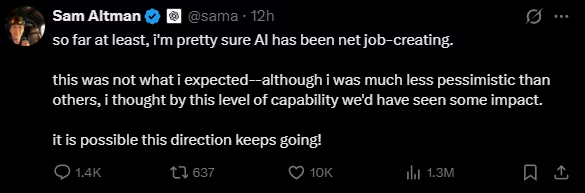
Altman’s comments come amid an ongoing global debate over AI’s impact on employment. Businesses are rapidly adopting generative AI to automate repetitive tasks, while governments, economists, and technology leaders continue to assess how the technology will reshape the workforce over the coming decades.
Sam Altman Sees Net Job Growth From AI
Altman believes that although AI will automate many existing tasks, history suggests technological revolutions tend to generate new forms of employment over time.
According to him, AI is expected to:
- Increase worker productivity.
- Create entirely new professions.
- Accelerate innovation.
- Expand entrepreneurship.
- Enable new industries.
Rather than focusing solely on job displacement, Altman emphasized the economy’s ability to adapt to technological change.
| AI Employment Outlook | Expected Impact |
|---|---|
| Routine tasks | Increased automation |
| Worker productivity | Significant improvement |
| New occupations | Expected to emerge |
| Long-term employment | Potential net job growth |
A Shift From Earlier Warnings
In previous interviews, Altman had cautioned that AI could replace many existing jobs and disrupt labor markets.
His latest comments suggest a more balanced perspective:
- Some jobs will disappear.
- Many existing roles will evolve.
- New categories of work will emerge.
- Human creativity will remain valuable.
- Economic opportunities could expand.
He argued that every major technological transformation has initially raised similar concerns before creating entirely new industries.
AI Will Change Work Rather Than Eliminate It
Many experts believe AI is more likely to automate specific tasks than replace entire professions.
Areas expected to see significant AI assistance include:
- Software development.
- Customer support.
- Marketing.
- Finance.
- Healthcare administration.
- Research.
In many cases, AI is expected to augment human workers rather than replace them completely.
Productivity Could Drive Economic Growth
Altman suggested that AI’s biggest economic contribution may come from dramatically increasing productivity.
Potential benefits include:
- Faster software development.
- Improved scientific research.
- More efficient businesses.
- Lower operating costs.
- Higher innovation.
Higher productivity could enable companies to expand into new markets and create additional employment opportunities.
New Industries May Emerge
Historically, technological revolutions have created jobs that previously did not exist.
Possible AI-driven careers include:
- AI system trainers.
- AI safety specialists.
- Prompt engineers.
- AI workflow designers.
- Human-AI collaboration experts.
- Autonomous systems managers.
As AI capabilities continue improving, additional professions are expected to emerge that are difficult to predict today.
Challenges Remain
Despite the optimistic outlook, Altman acknowledged that the transition may be difficult.
Key concerns include:
- Worker reskilling.
- Income inequality.
- Short-term job displacement.
- Education reform.
- Workforce adaptation.
Many economists argue that governments and businesses will need to invest heavily in training programs to help workers transition into new roles.
AI Adoption Continues to Accelerate
Businesses across industries are rapidly deploying AI to improve efficiency.
Major areas of adoption include:
- Enterprise software.
- Coding assistants.
- Customer service.
- Manufacturing.
- Scientific research.
- Education.
The pace of AI deployment continues to increase as models become more capable and accessible.
Outlook
The long-term impact of AI on employment remains uncertain, with experts offering differing projections. While some studies forecast significant automation of routine tasks, others suggest that productivity gains and new business creation could offset many job losses.
Altman’s latest comments reflect growing optimism among some technology leaders that AI will transform the labor market rather than permanently reduce overall employment, provided societies invest in education, workforce adaptation, and responsible AI deployment.
What It Means for the Future of Work
Sam Altman’s view that AI could create more jobs than it eliminates signals a broader shift in how technology leaders are framing artificial intelligence. Rather than viewing AI solely as a replacement for human labor, the discussion is increasingly centered on how it can enhance productivity, unlock new industries, and create occupations that do not yet exist.
For workers, the message is that adaptability and continuous learning will become increasingly important as AI changes the nature of many professions. For businesses and policymakers, the challenge will be ensuring that education, reskilling initiatives, and labor market policies evolve quickly enough to help people benefit from the opportunities created by the AI economy.
Get the day’s top stories in your inbox
One concise email. No spam, unsubscribe anytime.