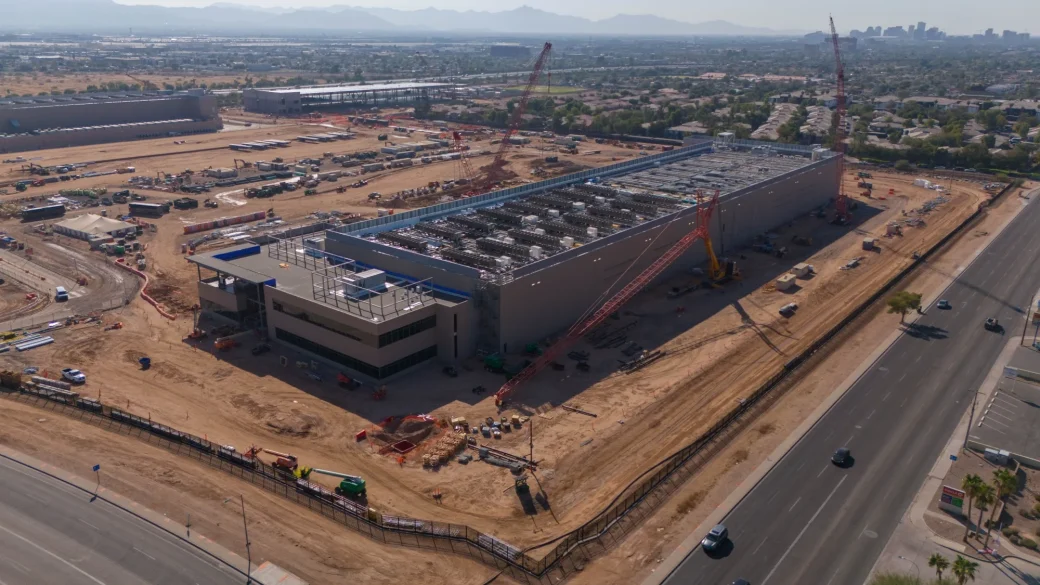
The rapid global expansion of artificial intelligence (AI) is expected to push data center construction delays well into 2027, as shortages of power infrastructure, electrical equipment, cooling systems, and skilled labor continue to constrain new projects. According to industry analysts, demand for AI-ready data centers is significantly outpacing the industry’s ability to build new capacity, creating bottlenecks that are delaying deployments across North America, Europe, and parts of Asia.
The surge in demand is being driven by massive investments from hyperscale cloud providers such as Microsoft, Amazon Web Services (AWS), Google, Meta, and OpenAI, which are rapidly expanding AI infrastructure to support large language models, cloud computing, and enterprise AI services. However, limited access to electricity, transformers, and specialized components is slowing the pace of new construction.
Data Center Delays Could Extend Through 2027
Industry experts warn that construction timelines are continuing to lengthen as supply struggles to keep pace with unprecedented demand.
| Industry Outlook | Details |
|---|---|
| Expected bottleneck | Through 2027 |
| Main driver | AI infrastructure boom |
| Most affected projects | Hyperscale AI data centers |
| Key issue | Supply chain and power constraints |
Developers report that projects that previously took 18–24 months to complete are now frequently requiring substantially longer timelines due to equipment shortages and permitting delays.
AI Is Fueling Record Infrastructure Demand
The rapid adoption of generative AI is dramatically increasing demand for computing infrastructure.
Major demand drivers include:
- Large language models (LLMs).
- AI inference services.
- AI training clusters.
- Cloud computing.
- Enterprise AI applications.
- Autonomous systems.
These workloads require significantly more computing power, memory, networking, and electricity than traditional cloud services.
Power Availability Has Become the Biggest Constraint
Access to reliable electricity is now one of the primary challenges facing data center developers.
Critical constraints include:
- Grid capacity limitations.
- Delays in utility connections.
- Transformer shortages.
- High-voltage equipment availability.
- Transmission infrastructure upgrades.
| Infrastructure Challenge | Impact |
|---|---|
| Grid connection delays | Slower project completion |
| Transformer shortages | Construction bottlenecks |
| Rising electricity demand | Capacity constraints |
| Utility approvals | Longer development timelines |
In several regions, utilities are unable to provide sufficient power for large AI campuses without major grid investments.
Equipment Supply Chain Remains Tight
Beyond electricity, developers continue to face shortages of specialized infrastructure components.
Key constraints include:
- Electrical transformers.
- Switchgear.
- Backup generators.
- Cooling systems.
- Networking equipment.
- High-capacity power distribution systems.
Manufacturing lead times for some critical equipment have extended from months to well over a year.
Labor Shortages Add Further Pressure
The construction industry is also experiencing shortages of skilled workers needed for complex data center projects.
Areas facing workforce constraints include:
- Electrical engineering.
- Mechanical installation.
- Data center commissioning.
- HVAC systems.
- Specialized construction.
Limited labor availability is increasing project costs while extending construction schedules.
AI Investment Continues to Accelerate
Despite infrastructure bottlenecks, technology companies continue investing aggressively.
Major investors include:
- Microsoft.
- Amazon Web Services.
- Google.
- Meta.
- Oracle.
- OpenAI.
These companies are collectively committing hundreds of billions of dollars to expand AI computing capacity over the next several years.
Developers Explore New Solutions
To reduce delays, operators are adopting alternative strategies.
These include:
- Building near existing power infrastructure.
- Deploying modular data centers.
- Investing in renewable energy.
- Developing private power generation.
- Expanding into emerging markets.
Some companies are also exploring nuclear energy and long-term power purchase agreements to secure reliable electricity supplies.
Outlook
Industry analysts expect supply chain conditions to improve gradually, but demand for AI infrastructure is likely to remain stronger than available capacity through at least 2027. Continued investments in electrical equipment manufacturing, grid modernization, and workforce development will be essential to easing the bottlenecks.
As AI adoption expands across industries, access to power and computing infrastructure is expected to become one of the defining competitive factors for technology companies worldwide.
What It Means for the AI Industry
The projected data center construction delays through 2027 highlight that the biggest challenge facing artificial intelligence is no longer just developing more capable models—it is building enough infrastructure to run them. Power availability, electrical equipment, cooling systems, and skilled labor have become critical constraints as AI demand continues to surge.
For hyperscalers and enterprise AI providers, these bottlenecks could delay the deployment of new AI services, increase infrastructure costs, and intensify competition for available computing capacity. At the same time, the situation is creating significant opportunities for companies involved in power infrastructure, electrical equipment, cooling technologies, and data center construction, all of which are expected to benefit from sustained investment in AI infrastructure over the coming years.
Get the day’s top stories in your inbox
One concise email. No spam, unsubscribe anytime.