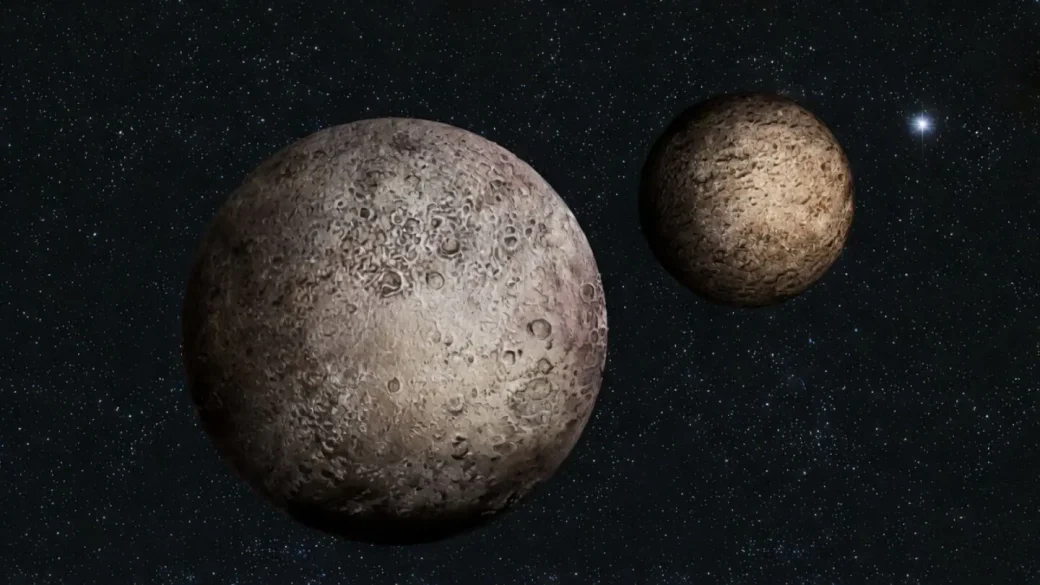
NASA’s James Webb Space Telescope (JWST) has detected a previously unidentified infrared spectral signature on both Titan, Saturn’s largest moon, and the dwarf planet Pluto, raising new questions about the chemistry of icy worlds in the outer Solar System. The mysterious signal, observed during Webb’s high-resolution infrared studies, does not match any known compounds currently catalogued by scientists, suggesting it could represent an unknown molecular mixture, a new chemical process, or an exotic surface material. Researchers stress that the discovery is preliminary and that the substance has not yet been identified. (newscientist.com)
The finding is particularly intriguing because Titan and Pluto are very different worlds that nevertheless share extremely cold environments and complex organic chemistry. Detecting the same unexplained spectral feature on both bodies suggests the material may form through similar chemical processes driven by sunlight, radiation, or interactions between atmospheric gases and icy surfaces.
James Webb Detects an Unknown Spectral Signature
Rather than directly identifying a new substance, the James Webb Space Telescope detected an unexplained infrared absorption feature that scientists have not yet been able to match with known molecules.
| Discovery | Details |
|---|---|
| Observatory | James Webb Space Telescope |
| Locations | Titan and Pluto |
| Detection | Unknown infrared spectral signature |
| Current status | Substance remains unidentified |
Researchers are now comparing the observations with laboratory measurements to determine what chemical compound or mixture could be responsible. (newscientist.com)
Why Titan and Pluto Are Important
Although separated by billions of kilometers, Titan and Pluto have several characteristics that make them valuable laboratories for studying complex chemistry.
Both worlds feature:
- Extremely cold temperatures.
- Nitrogen-rich environments.
- Organic molecules.
- Ice-covered surfaces.
- Atmospheric chemistry influenced by sunlight.
These conditions can produce complex compounds that are difficult to recreate on Earth.
A Clue to Outer Solar System Chemistry
Scientists believe the unidentified signature could originate from:
- A previously unknown organic compound.
- A mixture of frozen chemicals.
- Radiation-driven chemical reactions.
- Complex hydrocarbons.
- Nitrogen-containing molecules.
At this stage, researchers have not confirmed which explanation is correct.
James Webb’s Infrared Capabilities
The discovery was made possible by JWST’s highly sensitive infrared instruments, which can detect the chemical fingerprints of molecules across distant planetary bodies.
Unlike visible-light telescopes, Webb can:
- Identify molecular compositions.
- Analyze planetary atmospheres.
- Study icy surfaces.
- Detect faint chemical signatures.
- Observe distant Solar System objects in unprecedented detail.
These capabilities have already transformed studies of exoplanets, galaxies, and Solar System bodies.
Why the Discovery Matters
Finding the same unexplained signal on two different worlds could point to shared chemical processes occurring throughout the outer Solar System.
Potential implications include:
- Better understanding of planetary chemistry.
- Insights into complex organic molecules.
- Improved models of icy worlds.
- Guidance for future laboratory experiments.
- New targets for future space missions.
Scientists emphasize that additional observations will be needed before any conclusions can be drawn.
More Research Is Needed
Researchers are now working to determine the source of the mysterious signature through:
- Laboratory simulations.
- Computer modeling.
- Additional JWST observations.
- Comparisons with previous spacecraft data.
- Future planetary studies.
The unidentified signal remains an active area of investigation rather than a confirmed discovery of a new material.
James Webb Continues Expanding Planetary Science
Since beginning scientific operations, the James Webb Space Telescope has made numerous breakthroughs, including studies of:
- Exoplanet atmospheres.
- Early galaxies.
- Star formation.
- Asteroids.
- Giant planets.
- Icy moons.
Its observations are providing scientists with unprecedented detail about objects across the Solar System and beyond.
Outlook
Future observations by the James Webb Space Telescope and laboratory studies are expected to help researchers determine the nature of the mysterious spectral signature detected on Titan and Pluto. Identifying the compound—or compounds—could improve our understanding of how complex chemistry develops on icy worlds and how similar processes may occur elsewhere in the Solar System.
Until then, scientists caution that the material remains unidentified, and further evidence will be required before assigning it to any specific chemical substance.
What It Means for Planetary Science
The detection of the same unexplained infrared signature on Titan and Pluto demonstrates the James Webb Space Telescope’s extraordinary ability to uncover subtle chemical details that were previously beyond the reach of astronomers. While the mysterious material has not yet been identified, the finding suggests that distant icy worlds may share chemical processes that scientists do not yet fully understand. (newscientist.com)
For planetary science, the discovery opens a new avenue of research into the chemistry of the outer Solar System. If future studies identify the source of the spectral signature, it could reshape our understanding of how complex molecules form on frozen worlds and provide valuable clues about the evolution of planetary surfaces and atmospheres in some of the coldest regions of our cosmic neighborhood.
Get the day’s top stories in your inbox
One concise email. No spam, unsubscribe anytime.