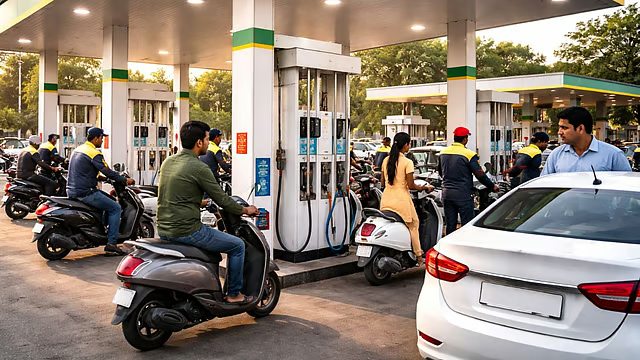
In a dramatic financial swing for India’s energy sector, public-sector Oil Marketing Companies (OMCs) are reportedly turning a corner, with gross marketing margins recovering to positive territory.
Recent brokerage analyses, including sector reports from JP Morgan and institutional trackers, reveal that composite margins on petrol and diesel have officially climbed back above pre-conflict levels, with some tracking segments approaching positive margins of ₹8 per litre on petrol in the current pricing window.
This sharp rebound marks a complete reversal from late spring (May 2026), when OMCs were bleeding nearly ₹550 crore per day to shield consumers from a global oil shock triggered by West Asia geopolitical friction.
1. The Dynamic Behind the Rebound
The sudden swing from steep daily under-recoveries back to positive profitability is being driven by a highly favorable macro crossover:
- Crude De-escalation: Following breakthroughs in regional ceasefire discussions, global benchmark Brent crude has retreated sharply from its $95+ peak, settling comfortably below the $80 per barrel threshold.
- The Government Tax Cushion: In March, the central government slashed excise duties on petrol and diesel by ₹10 per litre to absorb the initial price shock. Because the government has chosen to keep these duties low for now—and because retail pump prices were steadily increased by a cumulative ₹7.50 per litre in May—OMCs are now capturing the spread as cheaper crude reaches Indian refiners.
[Crude Spikes past $95] ──► Govt Cuts Excise by ₹10 ──► Pump Prices Raised by ₹7.50 (May)
                                                                 │
                                                                 ▼ (Late June 2026 Crossover)
[Crude Drops below $80] ──► Input Costs Plummet    ──► OMCs Retain Spread (~₹8/L Petrol Margin)
2. The Catch: Debt Burden and Q1 Drag
While the current daily run-rate is incredibly lucrative, market analysts caution that this margin expansion won’t instantly translate into flawless full-year balance sheets:
- The Debt Overhang: Over the last few months of peak energy friction, OMCs accumulated massive structural borrowings to finance crude imports while absorbing heavy retail subsidy losses.
- The Inventory Loss Trap: Because OMCs purchased massive volumes of crude when oil was near its $95 ceiling, the sudden drop below $80 means they will log heavy inventory losses in their Q1 (April–June 2026) earnings report, keeping immediate profitability under severe pressure.
- The LPG Multiplier: While auto fuels have returned to profitability, liquefied petroleum gas (LPG) under-recoveries remain an active burn, with state retailers still taking hits on domestic cooking gas cylinders.
3. Industry Split: Who Wins Most?
According to brokerage dashboards, the current pricing setup favors integrated refiner-retailers over standalone marketers:
| Oil Marketing Company | Structural Exposure & Preferred Tracking Status | Expected Recovery Timeline |
| BPCL & IOCL | Top Industry Picks: Benefit heavily from integrated operations; stronger combined refining and fuel marketing economics. | Projected to post highly resilient, robust earnings expansions starting in Q2 (July–September). |
| HPCL | Pure Retailer Risk: Highly exposed to pure marketing margins; carries a lighter refining footprint to hedge wild crude swings. | Margins have fully crossed pre-conflict levels, but debt-clearing timeline remains slightly extended. |
4. Will Pump Prices Drop?
With margins looking healthy, the focus shifts directly to the consumer. Union Petroleum Minister Hardeep Singh Puri recently indicated that retail petrol and diesel price cuts are actively under consideration, but will only be actioned once the current wave of lower-priced crude is fully processed through domestic refineries.
Furthermore, because the government is currently absorbing a ₹1.8 lakh crore annual revenue hit from the emergency excise duty cuts, the state may allow OMCs to maintain these elevated ₹8/L margins for a few more weeks to completely wipe out their crisis-era debt before passing relief down to the retail pump.