Moonshot AI, one of China’s leading artificial intelligence startups, has officially launched Kimi K3, its most advanced open-weight large language model (LLM) to date. With 2.8 trillion total parameters and a 1 million-token context window, Moonshot says K3 is the world’s largest open-weight AI model and is designed to compete directly with frontier AI systems from companies such as OpenAI and Anthropic.
Kimi K3 is built using a Mixture-of-Experts (MoE) architecture, activating only a subset of its parameters during inference to improve efficiency while maintaining high performance. According to Moonshot, the model delivers state-of-the-art capabilities in coding, reasoning, AI agents, and long-context tasks, with benchmark results that rival or exceed several leading proprietary models on selected evaluations.
Moonshot AI Launches Kimi K3
The release marks a significant milestone for China’s open AI ecosystem.
| Key Highlights | Details |
|---|---|
| Company | Moonshot AI |
| Model | Kimi K3 |
| Total parameters | 2.8 trillion |
| Context window | 1 million tokens |
| Architecture | Mixture-of-Experts (MoE) |
| Availability | Open-weight |
Moonshot positions K3 as its flagship model for enterprise AI, software development, and autonomous AI agents.
Key Features of Kimi K3
The model introduces several major upgrades over previous Kimi releases.
Key capabilities include:
- 2.8 trillion-parameter MoE architecture.
- 1 million-token context window.
- Advanced reasoning and planning.
- Strong coding and software engineering performance.
- Improved AI agent capabilities.
- Open-weight release for researchers and enterprises.
- Optimized GPU efficiency for large-scale deployment.
The long context window enables K3 to analyze entire codebases, lengthy documents, books, or extensive datasets within a single prompt.
Benchmark Performance
| Area | Kimi K3 Performance |
|---|---|
| Coding | Competitive with frontier AI models |
| Long-context reasoning | 1 million-token support |
| AI agents | Enhanced autonomous task execution |
| Enterprise workloads | Optimized for large-scale deployments |
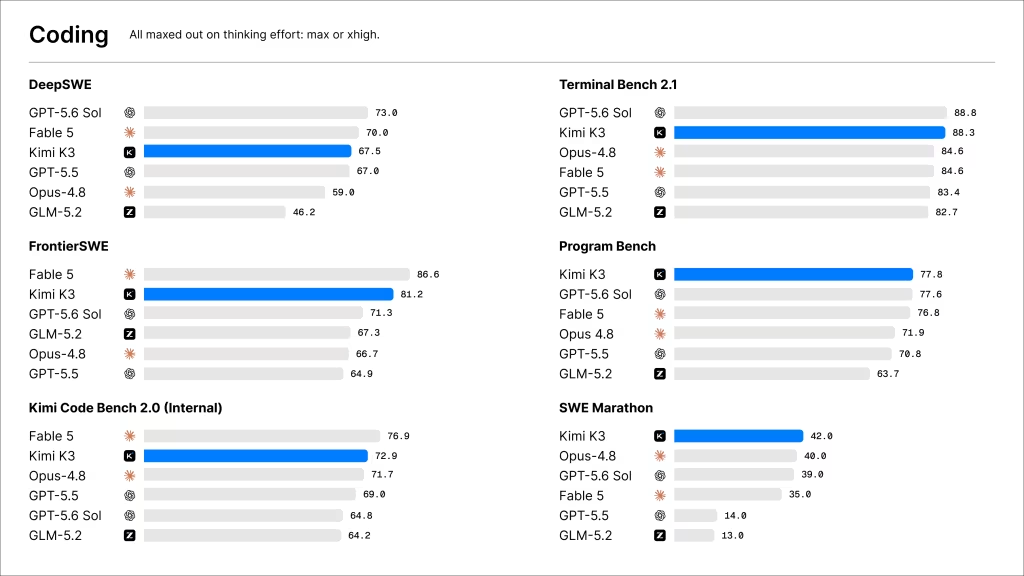
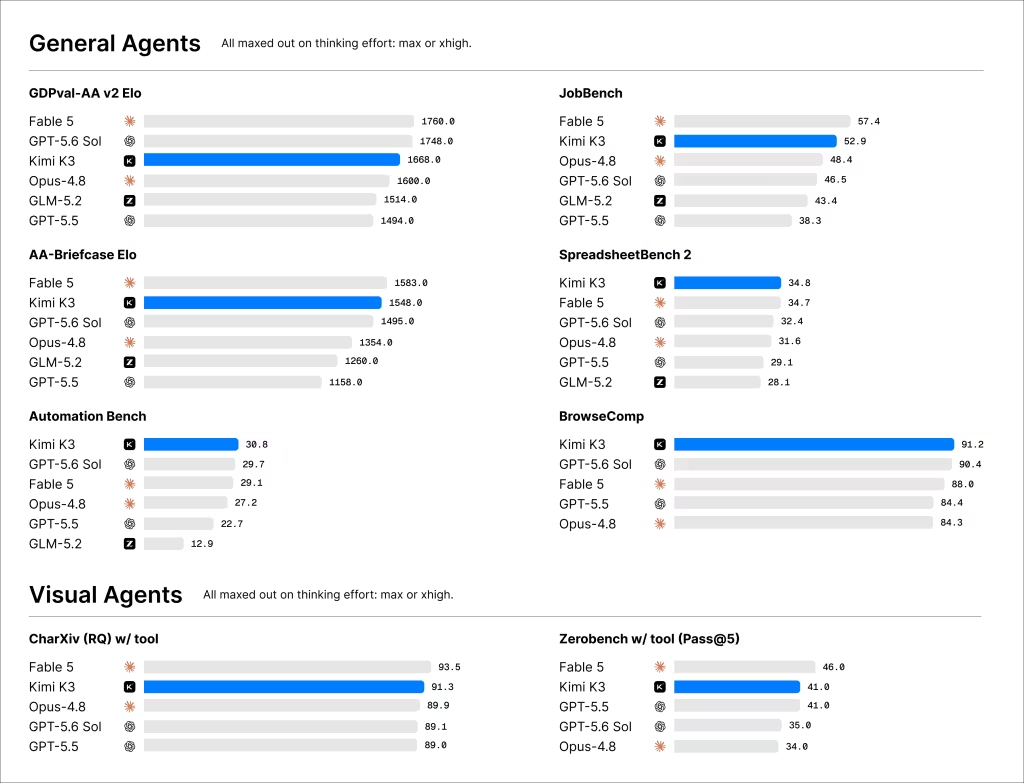
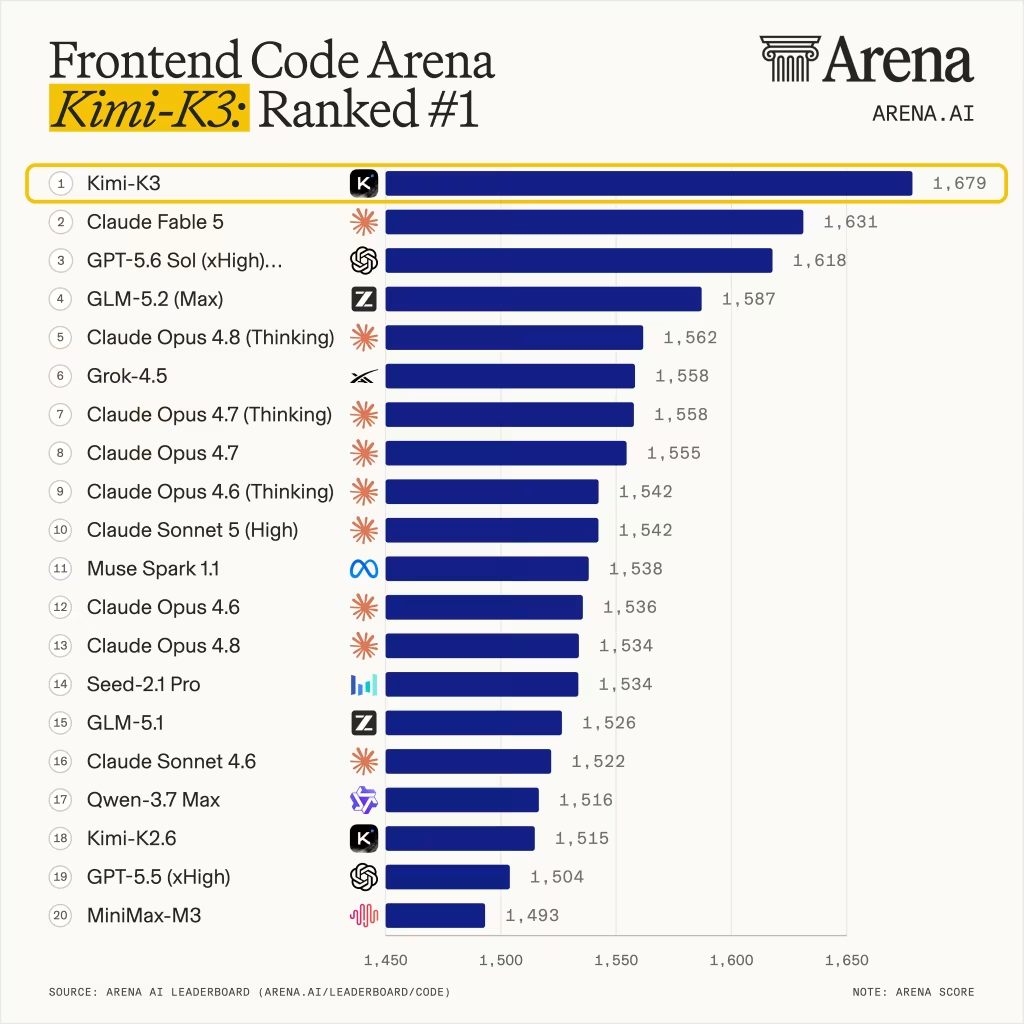
Moonshot claims K3 matches or surpasses several leading proprietary models on selected coding and agentic AI benchmarks, though independent validation is still ongoing.
Why Kimi K3 Matters
The launch reflects China’s accelerating progress in frontier AI.
Major implications include:
- Narrows the technology gap with U.S. AI labs.
- Expands access to powerful open-weight models.
- Supports enterprise AI adoption.
- Strengthens China’s open-source AI ecosystem.
- Increases competition in the global AI market.
The release comes amid intense competition between Chinese AI companies such as Moonshot, MiniMax, Alibaba, Z.ai, and DeepSeek.
Open-Weight Strategy
Unlike many frontier proprietary models, Kimi K3 is released as an open-weight model, allowing developers and enterprises to deploy and fine-tune it within the terms of its license.
Potential benefits include:
- Greater customization.
- Lower deployment costs.
- Increased transparency.
- Faster research and innovation.
- Wider enterprise adoption.
The approach continues the recent trend of Chinese AI companies releasing increasingly capable open-weight foundation models.
Challenges Ahead
Despite its impressive specifications, Kimi K3 faces several challenges.
These include:
- Independent verification of benchmark claims.
- High infrastructure requirements for deployment.
- Growing competition from U.S. and Chinese AI labs.
- Enterprise adoption outside China.
- Evolving AI regulations across global markets.
Real-world performance and developer adoption will ultimately determine the model’s long-term success.
Outlook
The launch of Kimi K3 represents one of the most significant AI releases of the year and highlights how quickly Chinese AI companies are advancing frontier model development. By combining a 2.8 trillion-parameter architecture with a 1 million-token context window and releasing the model as open weight, Moonshot AI is challenging the traditional dominance of closed proprietary AI systems while giving enterprises and developers access to one of the most capable publicly available models.
As competition intensifies between Chinese and U.S. AI developers, Kimi K3 is likely to accelerate innovation in coding assistants, AI agents, and enterprise automation. The release also reinforces the growing importance of open-weight foundation models, which are increasingly becoming viable alternatives to proprietary systems for organizations seeking greater flexibility and lower deployment costs.
What It Means for the Global AI Industry
Kimi K3 signals that the race for frontier AI is no longer defined solely by proprietary models. Open-weight systems are rapidly improving in capability, enabling enterprises, researchers, and developers to build advanced AI applications without depending entirely on closed commercial platforms.
For the broader AI ecosystem, the launch increases competitive pressure on leading U.S. AI companies while reinforcing the trend toward larger context windows, stronger agentic capabilities, and more efficient large-scale model architectures. As more frontier models become openly available, innovation across AI infrastructure, software development, and enterprise applications is expected to accelerate.
Get the day’s top stories in your inbox
One concise email. No spam, unsubscribe anytime.