Shaking up the open-source artificial intelligence landscape, tech pioneer MiniMax has officially launched its next-generation foundation model, MiniMax M3.
The new model achieves generational breakthroughs across software engineering and autonomous agent design. It uniquely combines a massive context window with native multimodality, allowing it to process text, image, and video inputs, and even actively operate a computer desktop.
1. Architectural Breakthrough: MiniMax Sparse Attention (MSA)
The core technical achievement powering M3 is a newly designed sparse attention mechanism dubbed MiniMax Sparse Attention (MSA).
Standard full-attention mechanisms suffer from “quadratic scaling,” meaning the computational memory requirements explode exponentially when reading massive documents. MSA solves this hardware bottleneck by introducing a clean, hardware-friendly “pick before you compute” block selection technique:
- Efficiency Gains: At a massive context window of 1 million tokens, M3’s per-token computational requirement is just 1/20th that of previous-generation models.
- Speed Velocity: This architecture delivers a 9x speedup in the prefilling stage and a 15x speedup during the decoding stage.
- Quality Retention: Despite the sparse pre-filtering, MSA matches full-attention quality across the vast majority of evaluation benchmarks.
2. Frontier Coding and Autonomous Agentic Capabilities
MiniMax M3 is oriented away from passive single-turn execution, leaning heavily into complex, multi-step autonomous collaboration. It simulates workflows like requirement elaboration, solution discussion, continuous task switching, and project iteration.
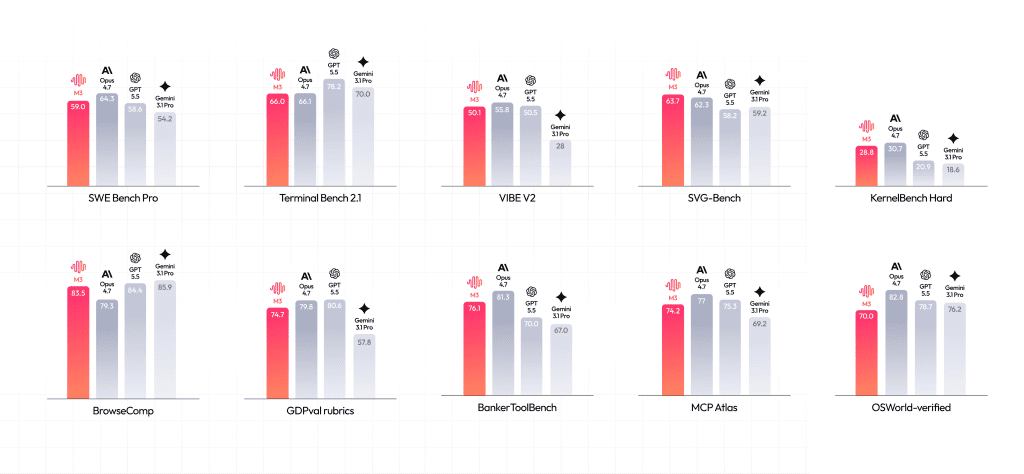
Across highly rigorous software engineering and execution benchmarks, M3 hits elite frontier-level accuracy:
- SWE-Bench Pro: 59.0%
- Terminal-Bench 2.1: 66.0%
- MCP Atlas: 74.2%
During internal developer testing, the model successfully ran autonomously for nearly 12 hours, completing complex code tasks by independently writing 18 commits and 23 experimental figures. In another testing pipeline, M3 autonomously managed a production-grade CUDA kernel optimization, diagnostic profiling, autotune configuration generation, and host-side scheduling modifications completely from scratch.
3. Native Multimodality from “Step 0”
Unlike many models that bolt an image-processing layer onto a pre-existing text network after the fact, M3 was trained using mixed-modality interleaved data from the start.
This native multimodal approach allows it to merge video, image, and text spaces deeply and naturally. Because it understands complex desktop layouts, tables, and visual UI structures, it can interact directly with computer operating systems, making it highly suitable for long-horizon digital work.
4. Availability and API Pricing
MiniMax has updated its token deployment plans and opened immediate access to developers via OpenRouter and its own API services.
The model enters the market with highly competitive, deflationary API pricing structures:
- Input Tokens: $0.30 per million tokens
- Output Tokens: $1.20 per million tokens
Concurrently, a consumer companion application called MiniMax Code has been launched alongside the model. The specialized agent app is natively trained alongside M3 to maximize the model’s ultra-long context and multi-turn project iteration capabilities, establishing it as a highly capable assistant for modern software engineering teams.
Get the day’s top stories in your inbox
One concise email. No spam, unsubscribe anytime.