Meta has officially launched Muse Image, its first in-house image generation model developed by the newly formed Meta Superintelligence Labs (MSL), led by Chief AI Officer Alexandr Wang.
Rather than just mapping text prompts directly to pixels like older generators, Muse Image operates as a reasoning and agentic engine. It currently sits at the number two spot on the independent Arena image generation leaderboard, trailing only OpenAI’s GPT Image 2.
1. What Makes Muse Image Architecturally Different?
Instead of generating an image instantly from a single text string, Muse Image loops in a reasoning phase before and during the generation process. It utilizes three core autonomous behaviors:
- Autonomous Web Search: If a prompt requires real-world context or knowledge of current events, the model independently calls web search to pull factual visual references before it begins drawing.
- Code Execution: During reinforcement learning, the model learned to write and execute Python code to solve precision issues. If asked for mathematical shapes, perfect fractals, or functional QR codes, it writes code to render the base element accurately first.
- Emergent Self-Refinement: Based on test-time compute, Muse Image evaluates its own generated drafts. If a detail is incorrect, it applies a local edit or completely regenerates the piece before displaying the final product to the user.
2. Platform Integrations and Key Features
The model is rolling out across Meta’s major consumer and enterprise ecosystems:
- Social App Deployment: It is actively live for free users in the US via the Meta AI app, WhatsApp direct messages, and Instagram Stories, where it powers over 30 new customizable AI filters and effects.
- The “Instagram Account” Tagging Prompt: In a highly viral feature, users can
@ mentiona friend’s public Instagram account within a prompt, and Muse Image will securely use their likeness and social context to blend them seamlessly into a new generated scene. - Advantage+ for Advertisers: The model is being embedded into Meta’s business suite, enabling brands to generate photorealistic product variations and marketing materials automatically.
3. Privacy Controls and Monetization
The instant rollout has triggered sudden online privacy discussions regarding the public account tagging feature. Meta has clarified that users can completely opt out of having their public likeness used in AI generations via their account settings, or by simply flipping their profile to private.
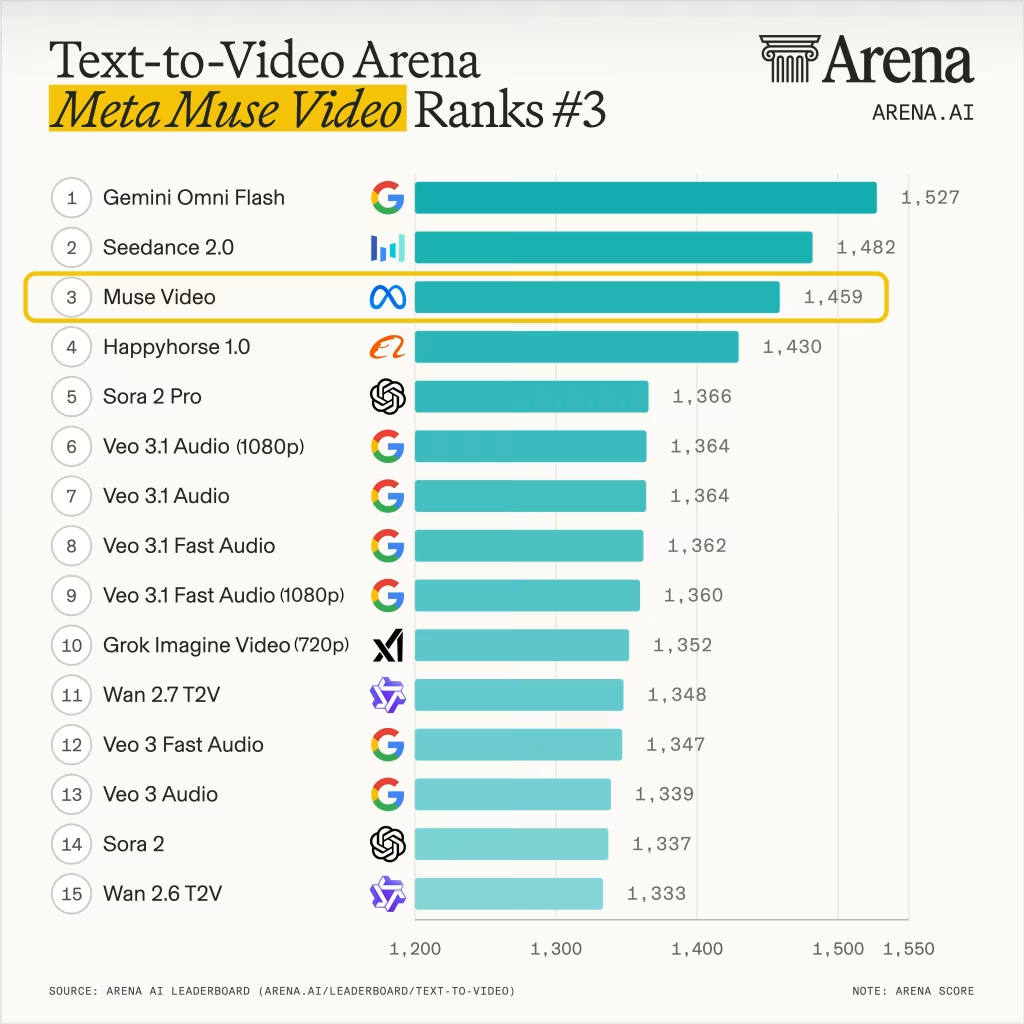
While everyday usage of Muse Image remains free, heavy power users who cross daily generation thresholds will eventually be prompted to subscribe to Meta’s premium Meta One subscription tier. Furthermore, the model has a companion pipeline called Muse Spark (Meta’s reasoning LLM) which can turn these images directly into interactive websites, and Meta is previewing a native audio-supported Muse Video engine built on the same architecture.
Get the day’s top stories in your inbox
One concise email. No spam, unsubscribe anytime.