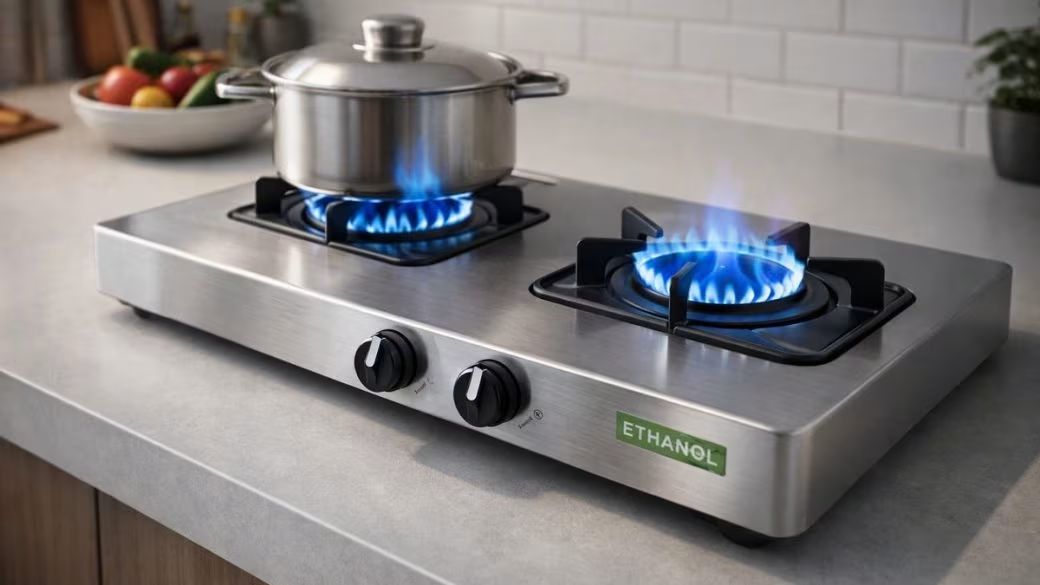
India is preparing to expand the use of ethanol beyond transportation, with the Ministry of Petroleum and Natural Gas working on a policy framework to introduce ethanol as a mainstream cooking fuel for households. If implemented, the initiative would mark a significant shift in the country’s clean energy strategy by positioning ethanol as an alternative to liquefied petroleum gas (LPG), helping reduce import dependence while creating a new market for domestically produced biofuel.
The proposal builds on India’s successful ethanol blending programme in petrol and comes at a time when the country has surplus ethanol production capacity. Industry stakeholders believe ethanol-powered cookstoves could improve energy security, diversify household fuel options, and support the government’s long-term decarbonisation goals.
Government Developing Policy for Ethanol Cooking Fuel
According to industry executives, the petroleum ministry is drafting a policy that would enable ethanol to be used as a mainstream domestic cooking fuel.
The proposed framework aims to:
- Introduce ethanol-powered cooking stoves for households.
- Reduce dependence on imported LPG.
- Expand domestic demand for ethanol.
- Strengthen India’s biofuel ecosystem.
- Improve long-term energy security.
Proposed Initiative at a Glance
| Aspect | Details |
|---|---|
| Fuel | Ethanol |
| Proposed use | Household cooking fuel |
| Policy status | Under development |
| Lead ministry | Ministry of Petroleum and Natural Gas |
| Primary objective | Reduce LPG dependence and expand clean cooking options |
Why India Is Exploring Ethanol for Cooking
India imports a substantial portion of its LPG requirements, making household cooking fuel vulnerable to global energy price fluctuations and geopolitical disruptions.
Using domestically produced ethanol could provide several advantages:
- Lower dependence on imported LPG.
- Better utilization of surplus ethanol production.
- Support for farmers supplying sugarcane, maize, and other feedstocks.
- Reduced greenhouse gas emissions compared with conventional fossil fuels.
- Greater resilience during fuel supply disruptions.
Potential Benefits
| Benefit | Expected Impact |
|---|---|
| Reduced LPG imports | Improved energy security |
| Higher ethanol demand | Stronger domestic biofuel industry |
| Additional farm income | Increased demand for feedstocks |
| Cleaner combustion | Lower emissions than traditional fuels |
Built on India’s Expanding Ethanol Programme
The proposal follows India’s rapid expansion of ethanol use in transportation.
Key milestones include:
- Nationwide rollout of E20 petrol.
- Significant growth in ethanol production capacity.
- Investment in grain- and sugar-based ethanol plants.
- Development of flex-fuel vehicles.
- Exploration of higher ethanol blends and new applications.
The government and industry have increasingly emphasized that ethanol should become part of a broader bioenergy ecosystem rather than being limited to fuel blending for vehicles.
India’s Expanding Ethanol Applications
| Existing Uses | Emerging Uses |
|---|---|
| Petrol blending (E20) | Household cooking |
| Industrial fuel | Diesel blends |
| Chemical feedstock | Generator fuel |
| Flex-fuel vehicles | Additional clean energy applications |
Challenges Before Large-Scale Adoption
Despite the potential benefits, several issues must be addressed before ethanol can become a mainstream cooking fuel.
These include:
- Developing affordable ethanol cookstoves.
- Building nationwide fuel distribution infrastructure.
- Establishing safety and storage standards.
- Ensuring competitive fuel pricing.
- Educating consumers about safe handling and usage.
Industry experts also note that successful adoption will depend on consistent fuel availability and policy support comparable to India’s LPG distribution network.
Key Challenges
| Challenge | Importance |
|---|---|
| Distribution network | Reliable household fuel supply |
| Stove availability | Consumer adoption |
| Pricing | Competitiveness with LPG |
| Safety regulations | Public confidence |
| Consumer awareness | Smooth transition |
Impact on India’s Energy Transition
If implemented, ethanol cooking fuel would represent another major step in India’s strategy to diversify its energy mix using domestically produced renewable fuels.
Beyond reducing import dependence, the move could:
- Expand the domestic biofuel market.
- Support rural incomes through higher agricultural demand.
- Encourage investment in ethanol production.
- Complement India’s broader clean energy and decarbonisation objectives.
Looking Ahead
India’s proposal to introduce ethanol as a household cooking fuel signals an expansion of its biofuel strategy beyond transportation into the domestic energy sector. By leveraging surplus ethanol production and reducing reliance on imported LPG, the initiative could strengthen energy security while creating new opportunities for farmers, biofuel producers, and equipment manufacturers.
However, the success of the programme will depend on supportive regulations, competitive pricing, safe and affordable cooking appliances, and a reliable nationwide distribution network. If these challenges are addressed, ethanol could become an important addition to India’s clean cooking fuel portfolio, complementing LPG rather than immediately replacing it and further advancing the country’s renewable energy ambitions.
Get the day’s top stories in your inbox
One concise email. No spam, unsubscribe anytime.