This joint development marks a massive geostrategic milestone for both nations, aligning maritime security with economic integration in the Indo-Pacific. Announced on July 7, 2026, during Prime Minister Narendra Modi’s state visit to Jakarta for talks with Indonesian President Prabowo Subianto, the project signals a new phase in their Comprehensive Strategic Partnership.
The broader operational and strategic implications of the deal include:
1. The Strategic Geometry of 100 Miles
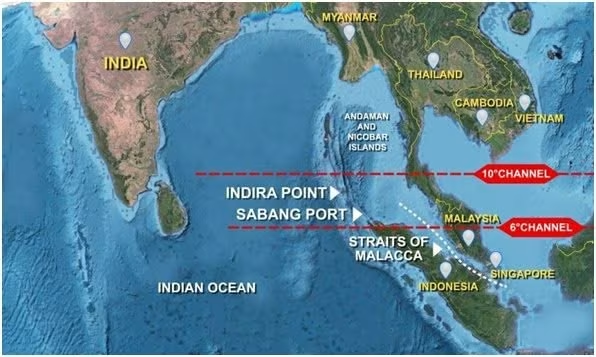
The Sabang port project is located at the northern tip of Sumatra, Indonesia. Its positioning creates a powerful maritime pincer when paired with India’s ongoing infrastructure push:
- The Malacca Gateway: Sabang directly overlooks the Strait of Malacca, one of the world’s most critical maritime chokepoints through which nearly 40% of India’s maritime trade passes.
- The Great Nicobar Link: Situated roughly 100 miles away from India’s proposed International Transshipment Port at Galathea Bay in Great Nicobar Island, the joint development allows both hubs to complement each other.
- The Security Umbrella: This geographic proximity drastically cuts reaction times for humanitarian assistance, disaster relief, and coordinated maritime patrols, establishing a robust security network at the mouth of the Indian Ocean.
2. Part of a Broader Strategic Pack
The Sabang agreement was not signed in isolation; it was part of nearly a dozen sweeping agreements aimed at deepening defense, technology, and mineral supply chains between New Delhi and Jakarta:
Plaintext
[ INDIA - INDONESIA STRATEGIC CORRIDOR ]

├── Defense Hardware ──► Indonesia to import India's Astra BVR air-to-air missiles
│                         & expand its existing BrahMos missile inventory.
├── Critical Minerals ─► Indian investments in Indonesian steel, nickel, and rare-earth
│                         permanent magnet manufacturing.
└── Tech & Education ──► Digital payment integration (UPI) and the setup of an
                          IIM-Bangalore campus in Indonesia.
- Defense Integration: Capitalizing on the missile’s performance during Operation Sindoor, Indonesia has officially agreed to import India’s Astra beyond-visual-range (BVR) air-to-air missiles and purchase additional batteries to beef up its existing BrahMos missile inventory.
- Critical Mineral Security: Given that Indonesia holds the world’s largest nickel reserves, India is securing its technology supply chains by directly investing in localized manufacturing facilities for steel, nickel, and rare-earth permanent magnets.
- Institutional Export: In an endorsement of India’s domestic tech and educational systems, India will assist Jakarta in creating customized Electronic Voting Machines (EVMs), integrate India’s UPI with Indonesia’s payment network, and establish an IIM-Bangalore campus in Indonesia.
3. Economic and Blue Economy Integration
Historically, Sabang has been an underutilized deep-sea port. By bringing in Indian engineering and infrastructure capital, the joint venture aims to transform the location into a highly viable commercial transshipment and seafood processing hub. It locks both nations into a shared “Blue Economy” framework, facilitating seamless, direct shipping lanes between India’s Andaman and Nicobar Islands and Southeast Asia, bypassing longer, traditional shipping loops.
Get the day’s top stories in your inbox
One concise email. No spam, unsubscribe anytime.