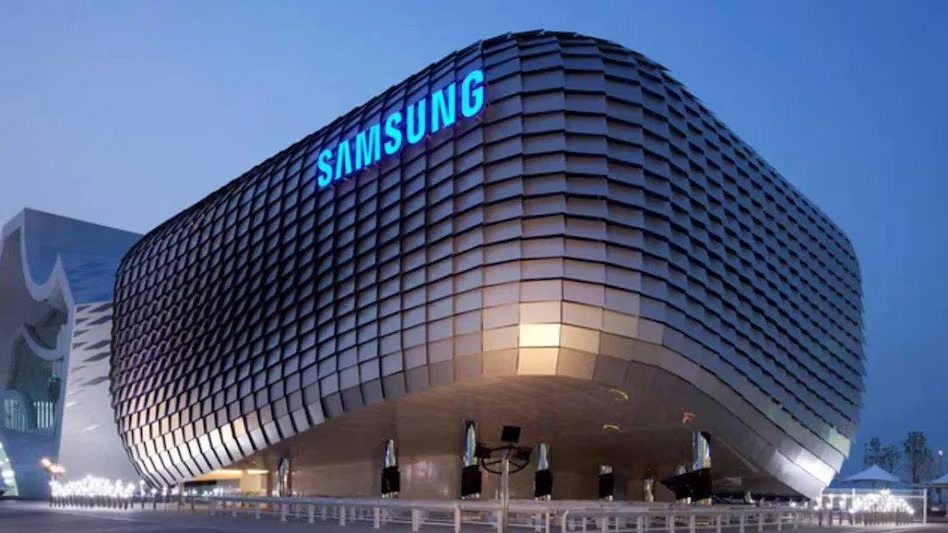
It is official. Samsung Electronics has just shattered corporate records, dethroning NVIDIA and Apple to claim the highest quarterly operating profit of any technology company globally.
In its preliminary earnings report released on July 7, 2026, the South Korean tech giant posted a jaw-dropping quarterly profit driven by an explosive artificial intelligence memory supercycle.
Here is how the historic numbers stack up and the market dynamics behind the monumental shift:
1. The Global Quarterly Profit Leaderboard
Samsung didn’t just beat its competitors; it cleared the field. In the ranking of quarterly operating profits for the most recent corporate reporting cycle, Samsung claimed the global #1 spot:
Plaintext
[ TECH GIANTS: QUARTERLY OPERATING PROFIT ]

  SAMSUNG ELECTRONICS ──────────────────► $58.4 Billion (KRW 89.4T)
  NVIDIA              ────────────► $53.5 Billion
  Alphabet (Google)   ──────► $39.7 Billion
  Microsoft           ──────► $38.4 Billion
  Apple               ──────► $35.9 Billion
2. Breaking Down Samsung’s Monster Quarter
Samsung’s financial turnaround from previous years has been nothing short of meteoric:
- Operating Profit: Expected to reach KRW 89.4 trillion (~$58.4 billion) for the April–June period. This is a staggering 19-fold (1,810%) increase compared to the same period last year.
- Revenue: Projected at KRW 171 trillion (~$111.7 billion), representing a 129% year-on-year explosion that outpaced consensus market estimates.
- The Hidden Metric: What makes this record even crazier is that Samsung achieved it after setting aside a massive 15 trillion to 19 trillion won provision for employee performance bonuses agreed upon during labor negotiations in May. Without this deduction, Samsung’s quarterly operating profit would have cleared 100 trillion won.
3. What Triggered the Reversal?
For the past two years, NVIDIA reaped the lion’s share of the AI gold rush by selling the GPUs (like the H100 and Blackwell architectures) that train massive AI models. However, the hardware bottleneck has structurally shifted into a Memory Supercycle.
To run NVIDIA’s chips at peak efficiency, big tech cloud providers require massive amounts of High-Bandwidth Memory (HBM) and enterprise server DRAM. Because Samsung and SK Hynix heavily prioritized high-margin AI memory production, the supply of conventional consumer DRAM and NAND flash memory dried up globally.
As a result, average selling prices for DRAM jumped 44% and NAND surged 53% in just three months. Samsung effectively became the house that wins no matter which AI developer is playing the game.
4. The Market Paradox: The 10% Stock Crash
In a classic case of “buy the rumor, sell the news,” Samsung’s stock actually tumbled nearly 9% to 10% immediately following the blockbuster announcement, dragging South Korea’s KOSPI index down with it.
Plaintext
       UNPRECEDENTED EARNINGS                        INVESTOR SENTIMENT
┌───────────────────────────────────┐       ┌───────────────────────────────────┐
│ • $58.4 Billion operating profit  │  vs   │ • Peak memory pricing fears       │
│ • 19x year-over-year growth       │       │ • Meta cloud-capacity resale rumors│
│ • Smashed institutional estimates │       │ • High profit already priced in   │
└───────────────────────────────────┘       └───────────────────────────────────┘
Wall Street and institutional investors are increasingly jittery about the absolute peak sustainability of Big Tech’s AI infrastructure spending. Rumors that companies like Meta might begin leveraging excess computing resources for cloud resale triggered a broader, sector-wide correction among chipmakers (with SK Hynix and Japan’s Kioxia also seeing steep declines).
While day traders argue over the durability of the AI boom, Samsung’s underlying balance sheet has asserted total dominance. The company is on track to potentially print an annual operating profit of 380 trillion won (~$248 billion) for the full year of 2026. Samsung will release its finalized, segment-by-segment financial breakdown on July 30.
Get the day’s top stories in your inbox
One concise email. No spam, unsubscribe anytime.