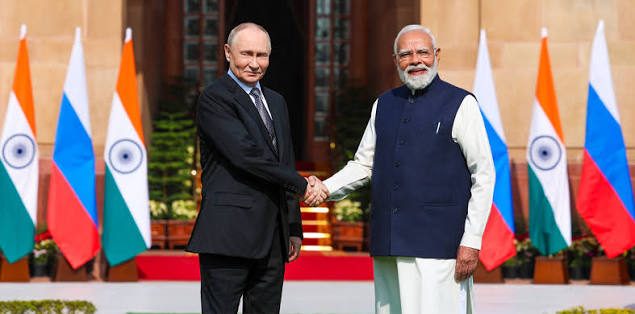
India and Russia have formally set an ambitious target of achieving $50 billion (approx. ₹4.42 lakh crore) in mutual investments by 2030.
The benchmark was established during a high-level meeting of the India-Russia Joint Working Group on Priority Investment Projects in Moscow. Co-chaired by India’s Department for Promotion of Industry and Internal Trade (DPIIT) Secretary Amardeep Singh Bhatia and Russian Deputy Minister of Economic Development Vladimir Iliychev, the move signals a deliberate push to expand their bilateral relationship past traditional commodity trade and into deep industrial and technological partnerships.
This investment roadmap operates alongside a parallel goal set by Prime Minister Narendra Modi and President Vladimir Putin to scale annual bilateral trade to $100 billion by the end of the decade.
1. Core Priority Sectors
The Joint Working Group outlined specific, high-barrier industries intended to anchor these future joint ventures and private sector collaborations:
- Emerging Technologies & Energy: Focus is heavily placed on green hydrogen, energy storage systems, and new-age tech integration.
- Critical Minerals & Mining: Securing long-term supply chains for semiconductor manufacturing and electronic infrastructure.
- Advanced Manufacturing & Metallurgy: Upgrading heavy industrial processes, chemicals, and core infrastructure development.
2. The “Making in Russia for India” Framework
To balance the currently skewed trade dynamics—which heavily lean in Russia’s favor due to India’s massive intake of discounted Russian crude oil—the diplomatic framework is leaning into localized co-production.
The Structural Strategy: Championed by India’s Ambassador to Russia, Vinay Kumar, the “Making in Russia for India” model intends to establish manufacturing joint ventures on Russian soil. This structure will look to combine Russian raw material access with Indian manufacturing execution, specifically targeting sectors like complex fertilizers, advanced mining equipment, and critical mineral processing.
3. Private Sector Mobilization
While the targets are set at the government level, execution relies heavily on corporate buy-in. To facilitate this, premier Indian industry bodies—including the Confederation of Indian Industry (CII) and the Federation of Indian Chambers of Commerce and Industry (FICCI)—participated concurrently in the Russia-India Investment Forum in Moscow.
The Indian delegation showcased recent domestic policy reforms, the availability of cost-effective skilled engineering talent, and production-linked incentives (PLI) to act as a clear landing pad for reciprocal Russian corporate capital on Indian soil.
Get the day’s top stories in your inbox
One concise email. No spam, unsubscribe anytime.