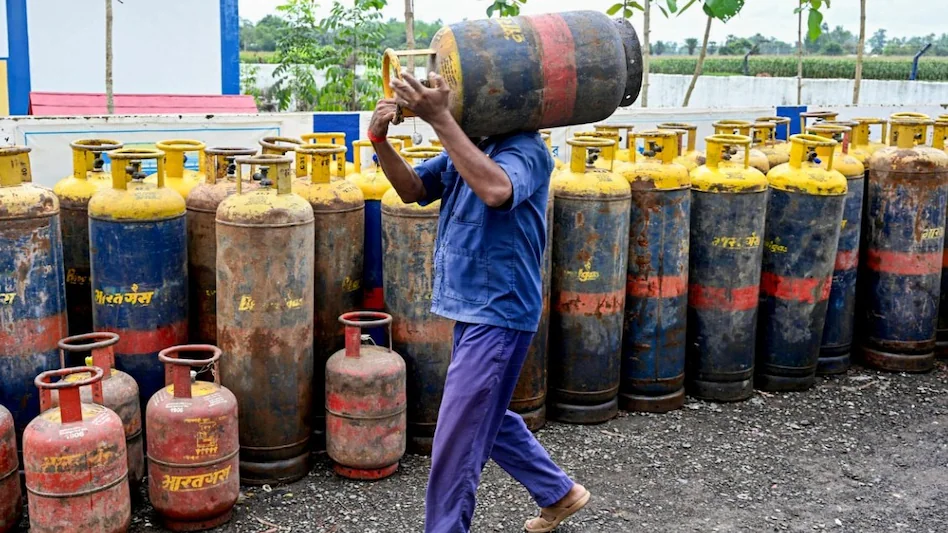
Adding fresh financial strain onto the commercial hospitality and catering sectors, state-run oil marketing companies (OMCs) have officially hiked the price of 19-kg commercial liquefied petroleum gas (LPG) cylinders by ₹42 in the national capital.
The price calibration, which took effect on Monday morning, reflects rising international energy benchmark costs and continuous supply-chain friction across the Gulf region. The revision applies exclusively to commercial cylinders utilized by hotels, restaurants, and manufacturing entities, while domestic cooking gas rates for households remain completely unchanged.
1. The New Retail Pricing Layer Across Major Metros
The June 1 pricing adjustment by the OMCs—Indian Oil Corporation (IOC), Bharat Petroleum Corporation (BPCL), and Hindustan Petroleum Corporation (HPCL)—varies across regions due to local state taxes and shipping costs.
- Delhi: A 19-kg commercial cylinder now retails at ₹3,113.50, up from the previous rate of ₹3,071.50.
- Kolkata: The eastern metro witnessed the steepest price increase, climbing by ₹53.50 to settle at a retail baseline of ₹3,255.50.
- Mumbai: Commercial rates scaled up to ₹3,067.50 per cylinder.
- Chennai: Prices shifted upward to land at ₹3,283.00.
- 5-kg FTL Cylinders: Smaller 5-kg Free Trade LPG (FTL) cylinders frequently used by street vendors also rose by ₹11, reaching ₹821.50 in Delhi.
2. The 2026 Price Trajectory: Fuel Costs Nearly Double
The June price hike continues a relentless inflationary cycle that has driven commercial cooking gas costs to near-historic highs over the first half of 2026.
At the start of January, a 19-kg commercial cylinder in Delhi cost just ₹1,691.50. Since then, a barrage of monthly adjustments—including a minor ₹49 bump in February, a ₹115 tick in March, and a massive ₹993 price surge in April—has effectively doubled the operating fuel overheads for commercial establishments in a span of just five months.
3. The Structural Backdrop: Strategic Buffers and Anti-Hoarding Filters
The pricing pressure runs parallel to a wider national push toward energy security. Just days prior to the rate hike, Petroleum Ministry Joint Secretary Sujata Sharma instructed OMCs to formulate blueprints to hold a minimum 30-day strategic LPG reserve stock to protect the country from volatile trade bottlenecks in West Asia.
The country depends heavily on the Persian Gulf for roughly 90% of its overall LPG intake. While domestic refineries are operating at peak output to produce between 50,000 and 52,000 metric tonnes of LPG daily, the output still leaves a persistent deficit against the national daily demand baseline of 72,000 metric tonnes, making external pricing shocks highly visible at the commercial counter.
To prevent commercial buyers from buying subsidized household cylinders or illegally hoarding stocks during the supply squeeze, enforcement authorities have scaled up a nationwide crackdown. Over a rapid four-day enforcement window, agencies conducted over 6,500 raids targeting regional LPG operations, resulting in multiple criminal FIRs, asset seizures, and arrests to ensure fair distribution metrics across the retail fuel chain.