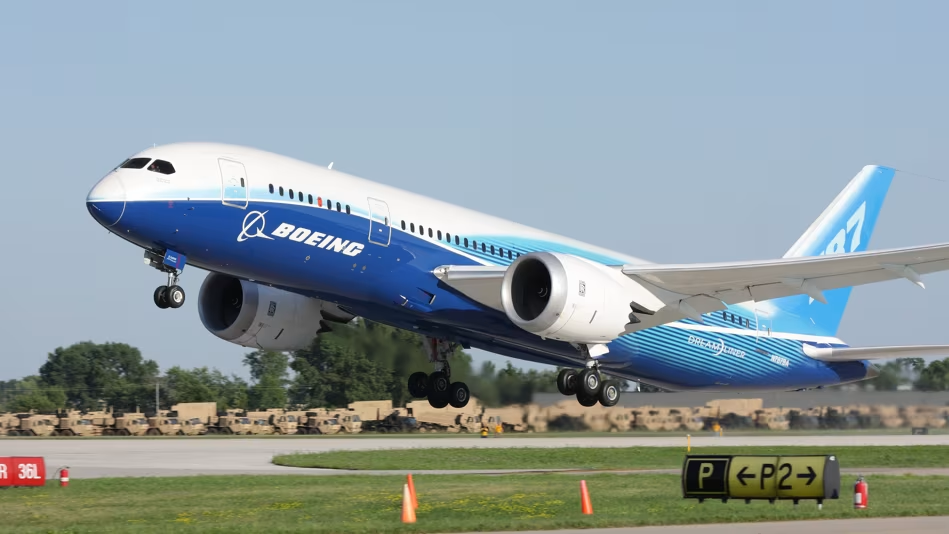
Boeing deliveries rose to their best first-half total since 2018. Boeing deliveries means how many finished planes the company handed to customers. That matters because airlines pay most of the money at delivery, so more handovers usually mean more cash for Boeing.
Key takeaways
- Boeing handed over 280 planes in the first six months of 2026.
- That is the company’s strongest first half since 2018.
- June deliveries reached 60 jets, helped by the 737 program.
- More Boeing deliveries can improve cash flow, but production risks still remain.
Why are Boeing deliveries rising now?
Boeing has spent years trying to recover from a brutal stretch. It faced safety crises, factory slowdowns, supply snags, and regulator pressure. A regulator is a government watchdog. It checks if planes and factories follow safety rules.
Now the company is moving more jets out the door. Reuters reported Boeing delivered 280 aircraft in the first half of 2026. That compares with 175 in the same period a year earlier. In June alone, Boeing delivered 60 planes, which was one of its stronger recent months.
The biggest driver was the 737 family, especially the 737 MAX. The 737 MAX is Boeing’s best-selling narrow-body jet. Narrow-body means a smaller single-aisle plane, like the ones many people take for short and medium trips.
That jump matters because Boeing gets a large chunk of payment at the end. So, more Boeing deliveries can help the company bring in cash faster. Cash flow means money coming in and going out of a business.
How do Boeing deliveries compare with past years?
The new total is important because it is Boeing’s best first half since 2018. That was the last year before the 737 MAX crisis turned into a deep and costly setback. Since then, Boeing has struggled to match older delivery levels.
Here is a quick look at the key numbers reported so far.
| Period | Planes delivered | What it shows |
|---|---|---|
| H1 2026 | 280 | Best first half since 2018 |
| H1 2025 | 175 | Much weaker pace |
| June 2026 | 60 | Strong monthly finish |
That means Boeing delivered 105 more planes than a year earlier. In percentage terms, that is about 60% growth. For a giant factory business, that is a big move in just one year.
Boeing deliveriesH1 2025H1 2026175280
The simple chart shows the gap clearly. The 2026 bar is much taller than 2025. In real life, that gap means more planes for airlines and more money for Boeing.
What does this mean for Boeing’s money and recovery?
For Boeing, deliveries are not just a scoreboard. They are closely tied to cash, debt, and investor confidence. Debt means money a company owes and must pay back.
When Boeing hands over a plane, it usually collects a large final payment. As a result, rising Boeing deliveries can ease pressure on the balance sheet. A balance sheet is a snapshot of what a company owns and owes.
This does not mean Boeing is suddenly out of danger. The company still has to prove it can build planes at a steady rate and keep quality high. Quality problems can stop deliveries fast, and even one issue can ripple through the whole factory line.
That is also why airlines and investors watch monthly data so closely. A missed part, engine issue, or paperwork delay can slow handovers. Meanwhile, each extra jet delivered can help the recovery story look more real.
How is Boeing doing against Airbus?
Boeing does not build planes alone in this market. Its main rival is Airbus, the European aircraft giant. Airbus and Boeing have fought for years to win airline orders and dominate global jet sales.
Deliveries matter because they show who is turning orders into real aircraft. An order is a customer promise to buy. A delivery is the moment the customer actually gets the plane.
Airbus has often stayed ahead in recent years, partly because Boeing had more disruption. But stronger Boeing deliveries suggest the U.S. plane maker is regaining some ground. That does not erase the gap overnight, but it gives Boeing a better shot in the race.
If you want a simple picture, think of two pizza shops. One can have lots of orders on paper. But the shop that actually gets hot pizzas out the door wins the night.
What could still slow Boeing deliveries?
Several things could get in the way. Supply chains are still fragile, and jet makers depend on thousands of parts from many suppliers. A supply chain is the long path parts take from factories to the final product.
Safety checks are another big factor. After past problems, Boeing faces intense oversight from the U.S. Federal Aviation Administration. The FAA is the main U.S. aviation safety regulator.
Labor issues can also hurt output. If workers strike or training falls behind, factories can slow down. Then airlines wait longer, and Boeing deliveries can miss targets.
There is also the wider economy to watch. Airlines want new jets because travel demand is strong in many regions. But if growth slows sharply, some buyers could delay aircraft plans.
Why should regular readers care about Boeing deliveries?
It may sound like a niche business story, but it reaches far beyond Wall Street. Planes connect holidays, cargo, jobs, and trade. If big manufacturers stumble, airlines can struggle to add routes or replace older aircraft.
That can affect ticket prices, delivery times for goods, and even airport growth. So Boeing deliveries are a useful clue about the health of the travel system. They also show whether one of America’s biggest industrial companies is finally finding its feet again.
The story fits a wider trend across industries. Companies need output, not just promises, to rebuild momentum. We have seen similar pressure in other sectors, from banking to trade and manufacturing, including our coverage of Bank of America profit and Iran oil exports continue.
For investors, airlines, and workers, the message is simple. Boeing deliveries are improving in a way we have not seen since 2018. But the real test is whether Boeing can keep this pace through the rest of 2026.
Reuters was first to report the half-year total, and Boeing posts monthly order and delivery updates on its official website. Those updates are watched closely because they offer one of the clearest signs of Boeing’s health.
FAQs
What are Boeing deliveries?
Boeing deliveries are the number of finished planes Boeing hands to customers. This matters because the company usually gets most of its money then.
Why do Boeing deliveries matter so much?
They show whether Boeing is turning factory work into cash. They also tell airlines and investors if production is moving smoothly.
How many planes did Boeing deliver in the first half of 2026?
Boeing delivered 280 planes in the first six months of 2026. That was its best first-half result since 2018.
Why is 2018 the key comparison year?
2018 was the last full strong year before the 737 MAX crisis hit hard. Since then, Boeing has faced years of setbacks and slower output.
Get the day’s top stories in your inbox
One concise email. No spam, unsubscribe anytime.