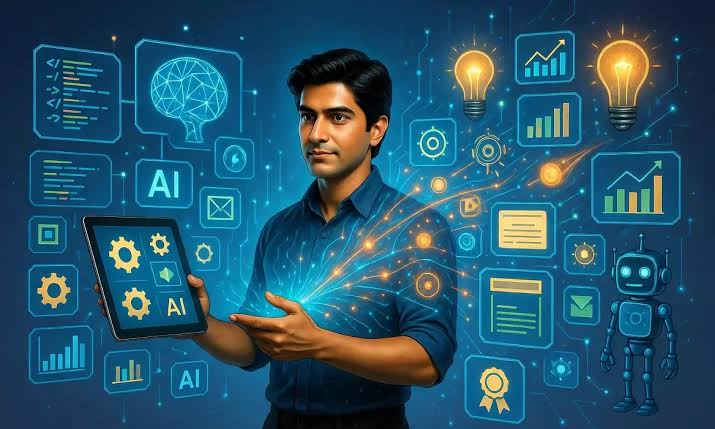
India AI talent is the pool of workers in India who can use, build, or work with artificial intelligence tools. Nasscom says that pool is getting very young, very fast. More than 90% of India’s early-career tech workers are now either AI-proficient or AI-native, which means they already know AI well or grew up learning it.
Key takeaways
- Nasscom says over 90% of India’s early-career tech workers have usable AI skills.
- The industry groups them as AI-proficient or AI-native.
- This matters because companies now expect AI skills even for junior roles.
- India AI talent could get a boost from more AI courses, startup funding, and company training.
- The gap is shifting from “who knows AI” to “who can use it well at work.”
What did Nasscom say about India AI talent?
Nasscom’s new message is simple. India’s youngest tech workers are arriving with AI skills already in hand. That changes hiring, training, and even what a “beginner” job looks like.
Nasscom is India’s main tech industry body. It tracks software firms, digital jobs, and skill trends. In this case, it says more than 9 out of 10 early-career tech workers in India are comfortable with AI tools or can work with AI systems in a deeper way.
That 90% figure is striking because it shows how fast classrooms and workplaces have changed. Just a few years ago, AI was a niche skill. That means only a small group used it. Now it is moving into the basic toolkit, like spreadsheets, coding, or cloud software.
For readers who want the short answer, here it is:
India AI talent is no longer limited to a few experts. For many young tech workers, AI skills are becoming a starting requirement, not a special bonus.
What do AI-proficient and AI-native mean?
These two labels sound fancy, but the idea is easy. AI-proficient workers can use AI tools well at work. They may write prompts, test models, automate tasks, or build features with help from AI systems.
AI-native workers go a step further. They learned in a world where AI was already normal, so they use it naturally from the start. Think of the difference between someone who learned email later and someone who grew up sending messages every day.
That does not mean every young worker is building giant AI models. A model is the system that learns patterns from data. Many will simply use AI to write code faster, summarize reports, check bugs, or help customers.
So the real shift is not just technical. It is cultural too, because young workers expect AI to sit inside the tools they already use.
Why is India AI talent growing so quickly?
One reason is simple demand. Companies want AI skills, so colleges, boot camps, and online platforms now teach them much earlier. A boot camp is a short, intensive training course. Students also get hands-on practice through free tools and open-source software.
India’s huge tech base helps too. The country has millions of software workers, a large engineering pipeline, and a strong services industry. Services firms build or manage tech for other companies. Once big employers adopt AI, training spreads fast across the workforce.
Startup activity also matters. Startups often move faster than large firms, so they test new AI tools quickly. As a result, young workers who join startups may learn prompt design, model testing, and workflow automation in their first jobs.
Government and academic efforts add another push. India has backed digital public infrastructure and local AI efforts, while colleges are adding AI tracks to regular courses. We recently covered how Karnataka plans India’s first government-run AI university, which shows how formal training is expanding too.
What do the numbers look like?
The headline number is over 90%. That means if you lined up 100 early-career tech workers, more than 90 would have meaningful AI ability. Not all at the same level, of course, but enough to work with AI in real jobs.
Here is a simple visual of the split Nasscom highlights most clearly. It compares workers with AI ability and those without it.
Early-career tech workers in India90%+<10%AI-skilledOthers
The numbers matter because hiring teams use them to set expectations. If 90% of beginners already know AI basics, companies may stop treating those skills as optional. They may test them in interviews the way they test coding, logic, or communication now.
| Measure | What it shows |
|---|---|
| 90%+ | Early-career tech workers with AI proficiency or AI-native skills |
| <10% | Share without those AI skill labels |
| 2 groups | AI-proficient and AI-native talent categories |
What does this mean for jobs and pay?
It means entry-level tech jobs are changing. A junior developer may still need coding basics, but employers now also want AI-assisted coding, data handling, and tool fluency. Fluency means being able to use a tool smoothly and correctly.
That could help some workers stand out less by merely “knowing AI.” Instead, the edge may come from using AI to solve real work problems faster. For example, a support engineer who cuts ticket time by 30% with AI may be more valuable than someone who only knows the buzzwords.
Pay may not jump for everyone right away. But roles that mix core tech skills with strong AI use could earn more over time, since companies care about output. Output means how much useful work someone gets done.
It also means constant learning. AI tools change fast, so a skill learned this year may need updating next year. That is why firms keep investing in internal training, just as they did with cloud and cyber tools before.
Are companies and schools ready for this shift?
They are moving, but not at the same speed. Some companies already train workers on safe AI use, model limits, and data rules. Data rules matter because employees should not paste private company information into public tools.
Schools are trying to catch up. Many now offer AI electives, coding labs, and certifications. A certification is proof that you completed a course or test. But quality still varies, so students may leave with very different skill levels.
That is why real practice matters more than labels. Building a chatbot, fixing bugs with AI help, or cleaning data for a project tells an employer much more than a flashy certificate alone.
There is also a wider policy debate. India wants to grow its own AI capacity while staying globally competitive. We covered that from another angle in our report on how the government is working with Sarvam and BharatGen for local AI models.
Why this matters beyond the tech sector
India AI talent will not stay inside software companies. Banks, hospitals, retailers, factories, and logistics firms now use AI too. Logistics means moving goods from one place to another. So AI-ready workers can spread into many industries.
That could make India more attractive to global companies looking for skilled teams. It may also help homegrown firms build products faster. In fact, a strong young talent base can matter as much as funding, because tools are easier to buy than skilled people are to develop.
This does not mean the job market gets easy. Competition may grow because more workers now bring similar AI basics. But it does mean the floor is rising. The floor means the minimum skill level employers expect.
For primary-source readers, Nasscom’s update was reported by The Hindu BusinessLine, while broader industry context can also be tracked through the Nasscom website and policy updates from the Ministry of Electronics and IT.
What should students and young workers do now?
Start with the basics, then build proof. Learn one AI tool for writing, one for coding, and one for data work. Then use them on real tasks, because employers trust examples more than claims.
Keep your core skills strong too. AI can help with code, but it cannot replace clear thinking, teamwork, and subject knowledge. The best young workers will likely be the ones who can check AI’s answers, not just copy them.
That is the big lesson in this India AI talent story. The crowd is getting smarter, so the next advantage is judgment. Judgment means knowing what to use, when to trust it, and when to say the tool is wrong.
FAQs
What is India AI talent?
India AI talent means workers in India who can use or build with artificial intelligence tools. In this story, it mainly refers to young tech workers starting their careers.
Why does the 90% figure matter?
It matters because it shows AI is becoming a basic job skill. Companies may now expect it even in junior tech roles.
How can students build AI skills?
They can learn simple AI tools, practice on real projects, and keep improving coding and problem-solving. Real work samples often matter more than certificates.
Get the day’s top stories in your inbox
One concise email. No spam, unsubscribe anytime.