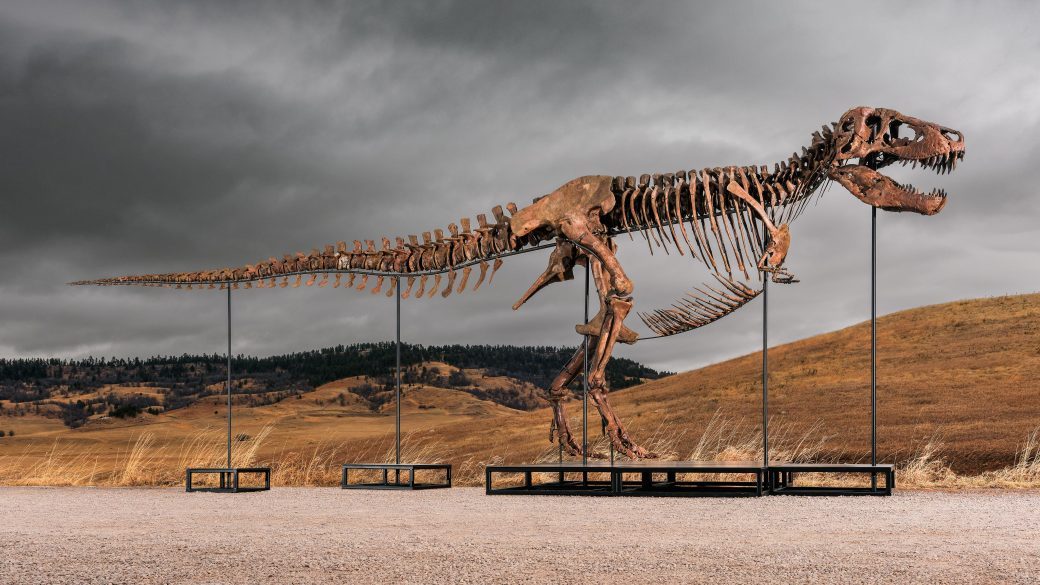
A 67-million-year-old Tyrannosaurus rex skeleton nicknamed “Gus” has been sold for a record-breaking $50.1 million at a Sotheby’s auction in New York, making it the most expensive dinosaur fossil ever sold at auction. The sale surpassed the previous record of $44.6 million set by the Stegosaurus fossil “Apex” in 2024, underscoring the growing demand for rare natural history specimens among wealthy collectors.
The anonymous buyer secured the fossil after a competitive 10-minute bidding battle involving multiple participants. “Gus” is regarded as one of the largest and most complete T. rex specimens ever discovered, standing 12.5 feet (3.8 meters) tall, stretching 38 feet (11.6 meters) long, and consisting of 183 fossil bones, representing roughly 61% of the dinosaur’s skeleton by bone count.
“Gus” Sets New Auction Record
The sale establishes a new benchmark for dinosaur fossils sold at auction.
| Key Highlights | Details |
|---|---|
| Fossil | Tyrannosaurus rex “Gus” |
| Auction house | Sotheby’s |
| Sale price | $50.1 million |
| Previous record | $44.6 million (Stegosaurus “Apex”) |
| Buyer | Anonymous |
The final price far exceeded Sotheby’s pre-sale estimate of $20 million to $30 million.
About the Fossil
“Gus” is among the most scientifically significant T. rex specimens discovered.
Key facts include:
- Approximately 67 million years old.
- Discovered in Harding County, South Dakota.
- Excavated between 2021 and 2023.
- Includes 183 fossil bones.
- Exceptionally well-preserved skull.
- Evidence of healed injuries from its lifetime.
Researchers believe the fossil provides valuable insights into the biology and behavior of Tyrannosaurus rex.
Auction Highlights
| Auction Detail | Information |
|---|---|
| Bidding duration | Around 10 minutes |
| Number of bidders | Seven |
| Estimated value | $20–30 million |
| Final price | $50.1 million |
The sale reflects growing global demand for museum-quality dinosaur fossils.
New Record for Fossil Sales
The auction surpassed several previous landmark sales.
Recent record sales include:
- Gus (T. rex) – $50.1 million (2026)
- Apex (Stegosaurus) – $44.6 million (2024)
- Stan (T. rex) – $31.8 million (2020)
- Sue (T. rex) – $8.36 million (1997)
The rapid increase in auction values reflects rising interest from private collectors and institutions alike.
Scientific Debate Continues
The record sale has renewed discussion within the paleontology community.
Concerns include:
- Reduced access for scientific research.
- Difficulty for museums to compete with private buyers.
- Commercialization of scientifically important fossils.
- Preservation of rare specimens for public education.
The Society of Vertebrate Paleontology has urged that significant fossils like “Gus” be made publicly accessible through museums or research institutions whenever possible.
Why Collectors Value Dinosaur Fossils
High-end fossils have become increasingly attractive collectibles.
Factors driving demand include:
- Extreme rarity.
- Scientific significance.
- Museum-quality preservation.
- Cultural appeal of dinosaurs.
- Growing alternative asset market.
Some buyers have previously loaned major fossils to museums, allowing continued public display and research.
Outlook
The sale of “Gus” for $50.1 million marks a milestone in both the natural history and collectibles markets. As one of the largest and most complete Tyrannosaurus rex skeletons ever discovered, the fossil attracted extraordinary interest, demonstrating that museum-grade specimens have become highly sought-after assets among wealthy collectors.
At the same time, the record-breaking auction has reignited debate over the balance between private ownership and scientific access. While private investment can help fund excavation and preservation, many researchers argue that fossils of exceptional scientific importance should remain accessible for research and public education. Where “Gus” will ultimately be displayed remains unknown, as Sotheby’s has not disclosed the identity of the buyer.
What It Means for Paleontology and the Collectibles Market
The sale underscores the rapid growth of the global fossil market, where rare dinosaur specimens are increasingly viewed alongside fine art and luxury collectibles. Record-breaking prices may encourage additional fossil discoveries and private investment in excavation, but they also raise concerns that museums could be priced out of acquiring scientifically valuable specimens.
For the scientific community, the long-term impact will depend on whether private owners choose to loan or donate important fossils for research and public exhibition. Such collaborations could help balance commercial interests with the preservation of Earth’s prehistoric heritage.
Get the day’s top stories in your inbox
One concise email. No spam, unsubscribe anytime.