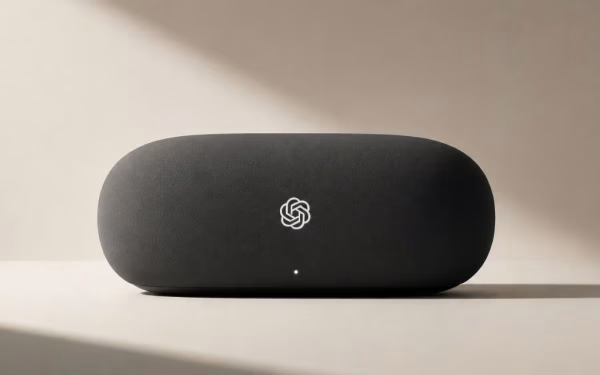
OpenAI has formally pushed back against Apple’s trade secret lawsuit, saying it is “not aware of any evidence” supporting Apple’s allegations that the AI company misappropriated confidential hardware information. The statement marks OpenAI’s strongest response yet after Apple sued the company, its hardware unit io, and two former Apple executives, alleging a coordinated effort to obtain proprietary information to accelerate OpenAI’s consumer hardware ambitions.
In its latest response, OpenAI said it takes the allegations seriously but believes the complaint lacks merit. The company added that it supports fair competition and employees’ freedom to change employers, while remaining focused on building innovative AI technology. The lawsuit has emerged just weeks after OpenAI completed its $6.5 billion acquisition of io, the AI hardware startup founded by former Apple design chief Jony Ive.
OpenAI Responds to Apple’s Lawsuit
The legal dispute centers on Apple’s claims that former employees improperly transferred confidential information to OpenAI.
| Key Highlights | Details |
|---|---|
| Plaintiff | Apple |
| Defendant | OpenAI, io Products, and former Apple employees |
| Allegation | Trade secret misappropriation |
| OpenAI’s response | “Not aware of any evidence” supporting the claims |
| Status | Litigation ongoing |
OpenAI said it believes in fair competition and is focused on developing its own technologies rather than relying on competitors’ intellectual property.
What Apple Alleges
According to Apple’s complaint, the company believes confidential hardware information was used to benefit OpenAI’s emerging hardware division.
Apple’s allegations include:
- Theft of confidential product information.
- Misappropriation of trade secrets.
- Recruitment of former Apple employees.
- Improper access to internal hardware knowledge.
- Use of confidential information in developing AI hardware.
These are allegations made in Apple’s lawsuit and have not been proven in court.
OpenAI’s Defense
OpenAI has rejected the allegations.
The company stated:
- It takes the lawsuit seriously.
- It has seen no evidence supporting Apple’s claims.
- It supports fair competition.
- Employees should be free to change jobs.
- Its focus remains on building innovative AI technology.
Earlier, OpenAI had also said it had “no interest in other companies’ trade secrets.”
Why the Case Matters
| Issue | Potential Impact |
|---|---|
| AI hardware development | Could affect OpenAI’s device roadmap |
| Intellectual property | Major test for trade secret protection |
| Talent mobility | Questions around employee movement between tech firms |
| AI competition | Intensifies rivalry between Apple and OpenAI |
The dispute comes as OpenAI expands beyond software into consumer hardware.
Connection to OpenAI’s Hardware Plans
The lawsuit coincides with OpenAI’s ambitious hardware strategy.
Recent developments include:
- Acquisition of io for $6.5 billion.
- Partnership with former Apple designer Jony Ive.
- Development of AI-native consumer devices.
- Expansion beyond ChatGPT software.
- Entry into consumer electronics.
Apple argues that some of its proprietary hardware expertise was improperly used in these efforts, while OpenAI denies the accusation.
Legal Challenges Ahead
The case is expected to focus on several issues.
These include:
- Whether trade secrets were actually misappropriated.
- Evidence supporting Apple’s allegations.
- Employee confidentiality obligations.
- Intellectual property protections.
- Potential impact on future AI hardware products.
The litigation could take months or years before reaching a final resolution.
Outlook
OpenAI’s latest statement represents a stronger legal defense against one of the most significant intellectual property lawsuits in the AI industry. While Apple alleges that confidential hardware knowledge was used to accelerate OpenAI’s consumer device ambitions, OpenAI maintains that it has seen no evidence supporting those claims and remains committed to fair competition.
The outcome of the lawsuit could have important implications for the future of AI hardware, employee mobility in Silicon Valley, and trade secret protection in an increasingly competitive technology landscape. As OpenAI prepares to expand beyond software into consumer devices, the case is likely to remain closely watched by investors, regulators, and the broader technology industry.
What It Means for the AI Industry
The legal battle underscores how competition in artificial intelligence is increasingly extending beyond software into hardware, design, and talent acquisition. As leading AI companies invest billions in new consumer devices, intellectual property disputes are becoming a central strategic risk.
For the broader AI ecosystem, the lawsuit could shape future hiring practices, confidentiality policies, and collaborations between AI developers and hardware companies. Regardless of the outcome, the case is likely to influence how technology firms protect proprietary information while competing for experienced engineering talent.
Get the day’s top stories in your inbox
One concise email. No spam, unsubscribe anytime.