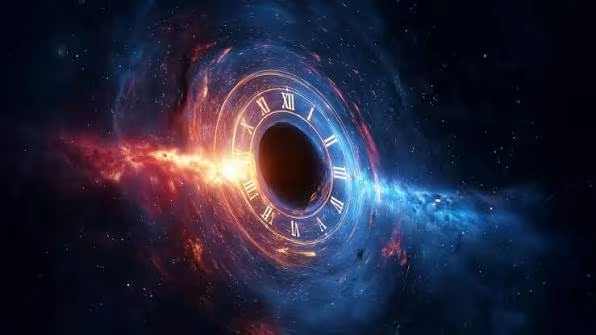
Scientists have recreated a tiny, expanding model of the early universe inside a quantum computer, leading to a breakthrough that could offer a new way to measure time in systems where conventional clocks do not exist. The research addresses one of physics’ deepest questions: how time emerges in the quantum universe, where the traditional concept of time used in everyday life and in Einstein’s relativity may no longer apply.
Using a simplified quantum simulation of the universe, researchers demonstrated that time can emerge from changes in quantum relationships rather than from an external ticking clock. The findings could help scientists better understand the earliest moments after the Big Bang and contribute to future theories that unify quantum mechanics and gravity.
Scientists Simulate a Tiny Universe
The study recreated a simplified model of the universe using quantum computing.
| Research Highlights | Details |
|---|---|
| Research focus | Quantum simulation of the universe |
| Technology used | Quantum computer |
| Main discovery | New method for measuring time |
| Scientific significance | Better understanding of quantum gravity and the early universe |
Instead of relying on a conventional clock, the researchers examined how time could arise naturally within a quantum system.
Why Measuring Time Is Difficult
In everyday life, time is measured using clocks.
However, at the quantum level:
- There may be no universal external clock.
- Space and time behave differently.
- Quantum systems evolve through probabilities.
- Traditional physics equations become insufficient.
- Time may emerge from interactions within the system itself.
This creates one of the biggest challenges in modern theoretical physics.
A New Way to Measure Time
The researchers found that time can be inferred from changes occurring inside the quantum system.
Rather than using an outside clock, the approach measures:
- Changes in quantum states.
- Relationships between particles.
- Evolution of quantum information.
- Internal correlations within the simulated universe.
- Observable physical changes.
This suggests that time may be an emergent property instead of a fundamental quantity.
Why Quantum Computers Were Needed
| Advantage | Benefit |
|---|---|
| Quantum simulation | Models complex quantum systems |
| High computational power | Handles interactions impossible for classical computers |
| Accurate particle behavior | Mimics quantum evolution |
| Flexible experiments | Tests theoretical models of the universe |
Quantum computers allow researchers to study physical phenomena that cannot be recreated directly in laboratories.
Implications for Physics
The findings could influence several areas of research.
Potential applications include:
- Quantum gravity.
- Early universe cosmology.
- Black hole physics.
- Fundamental particle research.
- Quantum information science.
- Future quantum technologies.
Understanding how time emerges could help bridge the gap between quantum mechanics and Einstein’s theory of general relativity.
Understanding the Early Universe
The study provides new insights into conditions shortly after the Big Bang.
Scientists hope to better understand:
- How the universe evolved.
- The origin of space-time.
- The behavior of matter at extreme energies.
- The transition from quantum physics to classical physics.
- The fundamental structure of reality.
These questions remain among the biggest unsolved problems in physics.
Challenges Ahead
Although promising, the research remains at an early stage.
Scientists still need to:
- Validate the results with larger quantum systems.
- Improve quantum computing hardware.
- Extend simulations to more realistic universe models.
- Compare predictions with theoretical physics.
- Develop practical experimental tests.
Much more work is required before the approach becomes a standard tool in physics research.
Outlook
The successful simulation of a miniature quantum universe represents an important step toward understanding one of science’s most fundamental mysteries: the nature of time itself. By showing that time may emerge from quantum relationships rather than requiring an external clock, the research offers a fresh perspective on how the universe may have behaved during its earliest moments.
As quantum computing technology continues to advance, researchers expect increasingly sophisticated simulations of space, time, gravity, and the Big Bang. These developments could eventually help scientists build a unified framework connecting quantum mechanics with general relativity—one of the most ambitious goals in modern physics.
What It Means for Science
The discovery demonstrates how quantum computing is becoming a powerful tool for exploring questions that were once considered purely theoretical. Instead of simply performing faster calculations, quantum computers are beginning to recreate aspects of the universe itself, allowing scientists to test ideas about reality in entirely new ways.
If future studies confirm these findings, they could reshape our understanding of time, the evolution of the universe, and the laws governing nature. Beyond fundamental physics, the research may also accelerate advances in quantum technologies, leading to new computational methods and scientific discoveries across multiple disciplines.
Get the day’s top stories in your inbox
One concise email. No spam, unsubscribe anytime.