
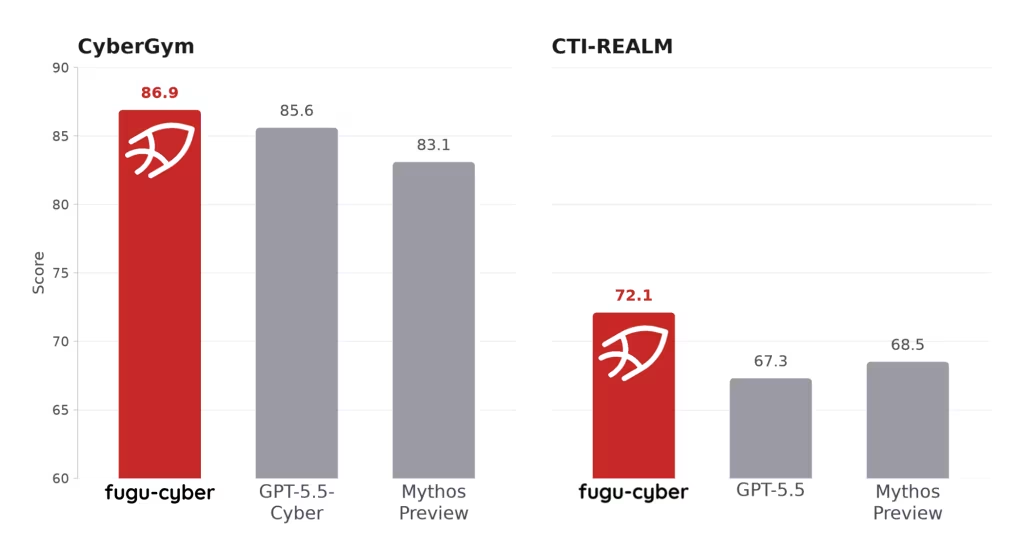
Japanese artificial intelligence startup Sakana AI has introduced Fugu-Cyber, a new AI orchestration model designed specifically for cybersecurity tasks. Rather than relying on a single large language model (LLM), Fugu-Cyber coordinates multiple specialized AI models to perform complex cyber defense workflows. According to the company, the system achieved an 86.9% score on the CyberGym benchmark, setting a new state-of-the-art performance for AI-driven cybersecurity orchestration. The launch reflects a growing trend toward multi-agent AI systems capable of handling sophisticated enterprise security operations. (sakana.ai)
Fugu-Cyber is built to assist security analysts with tasks such as vulnerability assessment, incident response, malware investigation, and penetration testing. Instead of treating AI as a standalone chatbot, Sakana AI’s approach orchestrates multiple specialized models, enabling them to collaborate and divide complex cybersecurity problems into manageable tasks before producing a final result. (sakana.ai)
What Is Fugu-Cyber?
Fugu-Cyber is an AI orchestration framework that coordinates several AI models, each optimized for different cybersecurity functions.
The platform is designed to:
- Automate complex cybersecurity workflows.
- Coordinate multiple AI agents.
- Improve vulnerability analysis.
- Assist with penetration testing.
- Support incident investigation and response.
Unlike traditional AI assistants, the system dynamically selects the most suitable model for each task, improving overall performance across complex security scenarios. (sakana.ai)
Fugu-Cyber at a Glance
| Feature | Details |
|---|---|
| Developer | Sakana AI |
| Model | Fugu-Cyber |
| Purpose | AI orchestration for cybersecurity |
| Architecture | Multi-model orchestration |
| Benchmark score | 86.9% on CyberGym |
Record CyberGym Benchmark Performance
Sakana AI reported that Fugu-Cyber achieved an 86.9% score on the CyberGym benchmark, a widely used evaluation framework for measuring AI performance across cybersecurity tasks.
Benchmark Highlights
| Metric | Result |
|---|---|
| Benchmark | CyberGym |
| Fugu-Cyber score | 86.9% |
| Focus areas | Security reasoning, vulnerability analysis, exploitation workflows |
According to the company, the score demonstrates improvements in coordinating AI agents across multi-step cyber operations rather than optimizing a single language model for isolated tasks. (sakana.ai)
Multi-Agent AI Instead of One Large Model
A key differentiator of Fugu-Cyber is its orchestration-based architecture.
Instead of depending on one foundation model, the platform:
- Routes tasks to specialized AI models.
- Combines outputs from multiple agents.
- Evaluates intermediate results.
- Iteratively refines solutions.
- Produces a coordinated final response.
This architecture is intended to improve reliability for security operations that require planning, verification, and multiple reasoning steps. (sakana.ai)
Traditional AI vs. Fugu-Cyber
| Traditional LLM | Fugu-Cyber |
|---|---|
| Single model handles all tasks | Multiple specialized AI models collaborate |
| Linear reasoning | Multi-agent orchestration |
| Limited task specialization | Dedicated models for different cyber tasks |
| One response pipeline | Coordinated workflow execution |
Enterprise Cybersecurity Applications
Sakana AI says Fugu-Cyber is designed to support security teams across several operational areas.
Potential use cases include:
- Vulnerability discovery.
- Penetration testing assistance.
- Malware investigation.
- Threat intelligence analysis.
- Incident response automation.
- Security operations center (SOC) workflows.
By automating repetitive and complex investigations, the platform aims to improve analyst productivity while helping organizations respond to cyber threats more efficiently. (sakana.ai)
Growing Trend Toward AI Orchestration
The launch highlights an emerging shift in enterprise AI from larger standalone models to coordinated AI systems composed of multiple specialized agents.
Major technology companies are increasingly investing in:
- AI agents.
- Workflow orchestration.
- Autonomous reasoning systems.
- Multi-model collaboration.
- Enterprise automation platforms.
Rather than building ever-larger language models, orchestration frameworks seek to improve performance by combining the strengths of multiple AI systems for specific business domains such as cybersecurity. (sakana.ai)
Why AI Orchestration Matters
| Advantage | Benefit |
|---|---|
| Specialized models | Higher task accuracy |
| Multi-step reasoning | Better handling of complex workflows |
| Scalable architecture | Easier integration of new models |
| Enterprise automation | Improved operational efficiency |
Looking Ahead
Sakana AI’s launch of Fugu-Cyber signals the growing importance of orchestration-based AI systems in enterprise cybersecurity. By coordinating multiple specialized AI models instead of relying on a single large language model, the platform aims to improve complex security workflows such as vulnerability assessment, incident response, and penetration testing. Its reported 86.9% CyberGym benchmark score suggests that multi-agent architectures may offer significant performance gains for real-world cybersecurity operations. (sakana.ai)
As cyber threats become more sophisticated and organizations face increasing pressure to automate security operations, AI orchestration platforms like Fugu-Cyber could become an important component of modern security infrastructure. The launch also reinforces a broader industry trend in which future AI systems are expected to rely less on individual frontier models and more on collaborative networks of specialized AI agents working together to solve complex enterprise challenges. (sakana.ai)
Get the day’s top stories in your inbox
One concise email. No spam, unsubscribe anytime.