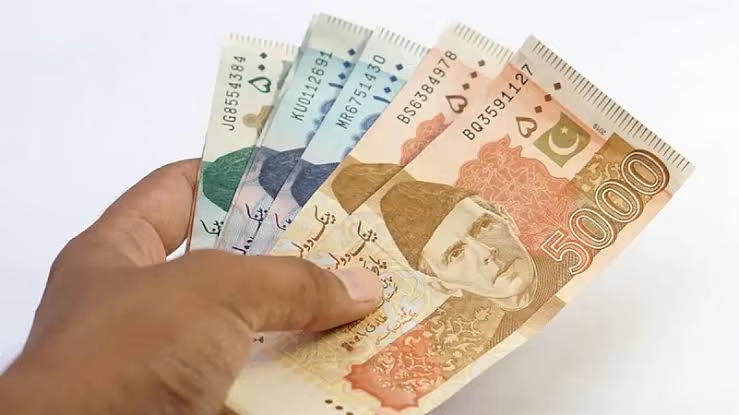
Pakistan received a record $41.6 billion in workers’ remittances during fiscal year 2025–26 (FY26), marking the highest annual inflow in the country’s history and surpassing its total merchandise exports for the year. According to data released by the State Bank of Pakistan (SBP), remittances increased 8.6% year over year from $38.3 billion in FY25, underscoring the growing importance of overseas Pakistanis in supporting the country’s economy, foreign exchange reserves, and balance of payments.
The milestone highlights a structural shift in Pakistan’s external sector. While exports remain a key source of foreign exchange, remittances have become the country’s single largest external inflow, helping finance imports, stabilize the Pakistani rupee, and meet external debt obligations at a time of ongoing economic reforms under the International Monetary Fund (IMF) program.
Pakistan Records Historic $41.6 Billion in Remittances
The State Bank of Pakistan reported that overseas Pakistanis sent $41.6 billion home during FY26, an increase of 8.6% from the previous fiscal year.
Key highlights include:
- Total FY26 remittances: $41.6 billion.
- Growth over FY25: 8.6%.
- June 2026 remittances: $3.5 billion.
- Year-on-year growth in June: 2%.
- Month-on-month decline in June: 18.3%.
Despite the monthly slowdown in June, cumulative inflows remained at record levels, reflecting the resilience of overseas income transfers.
Remittances Surpass Pakistan’s Merchandise Exports
For the first time, annual workers’ remittances exceeded Pakistan’s total goods exports, illustrating the increasing role of overseas workers in sustaining the country’s external finances.
The development has several implications:
- Remittances have become Pakistan’s largest source of foreign exchange.
- They provide a cushion against trade deficits.
- They help finance imports of energy, machinery, and essential goods.
- They support household consumption across the country.
- They reduce pressure on foreign exchange reserves.
- They strengthen the country’s balance of payments.
Economists note that while strong remittance inflows improve near-term macroeconomic stability, long-term growth still depends on expanding exports, manufacturing, and industrial competitiveness.
Saudi Arabia and UAE Continue to Lead
The Gulf region remained Pakistan’s largest remittance corridor.
During June 2026, the biggest contributors were:
- Saudi Arabia: $829.6 million.
- United Arab Emirates: $792.2 million.
- United Kingdom: $514.9 million.
- United States: $296.8 million.
For the full fiscal year, Saudi Arabia and the UAE together accounted for nearly half of total remittance inflows, highlighting the continued importance of Pakistani workers employed in Gulf economies.
Why Remittances Matter
Workers’ remittances are one of Pakistan’s most stable sources of foreign currency and play a vital role in the economy.
They help:
- Support millions of households.
- Finance education and healthcare expenses.
- Boost domestic consumption.
- Improve foreign exchange liquidity.
- Reduce external financing pressures.
- Strengthen financial sector stability.
The sustained rise in remittances has become particularly important as Pakistan continues implementing fiscal and structural reforms while managing debt repayments and import requirements.
Economic Outlook
State Bank of Pakistan Governor Jameel Ahmad recently said the central bank expects remittances to reach around $44 billion in FY27, driven by continued overseas employment and stronger formal banking channels. The central bank also expects foreign exchange reserves to improve further if external conditions remain stable.
However, economists caution that remittances alone cannot replace export-led growth. Sustained improvements in manufacturing, technology exports, industrial productivity, and foreign direct investment will remain essential for long-term economic resilience.
What Investors Will Watch
Market participants will closely monitor:
- Growth in workers’ remittances.
- Export performance.
- Foreign exchange reserves.
- Current account balance.
- IMF reform progress.
- Pakistani rupee stability.
- Overseas employment trends.
These indicators will help determine whether Pakistan can sustain macroeconomic stability while reducing its dependence on external financing.
Outlook
Pakistan’s record $41.6 billion in workers’ remittances marks a significant milestone for the country’s economy, with inflows now exceeding annual merchandise exports. The achievement reflects the growing contribution of overseas Pakistanis to economic stability and provides valuable support for foreign exchange reserves, household incomes, and the balance of payments.
While the record inflows strengthen Pakistan’s short-term economic position, policymakers and economists agree that long-term prosperity will depend on increasing exports, attracting investment, and improving industrial competitiveness. As the country targets $44 billion in remittances for FY27, balancing diaspora-driven inflows with stronger export growth will remain a key policy priority.
Get the day’s top stories in your inbox
One concise email. No spam, unsubscribe anytime.