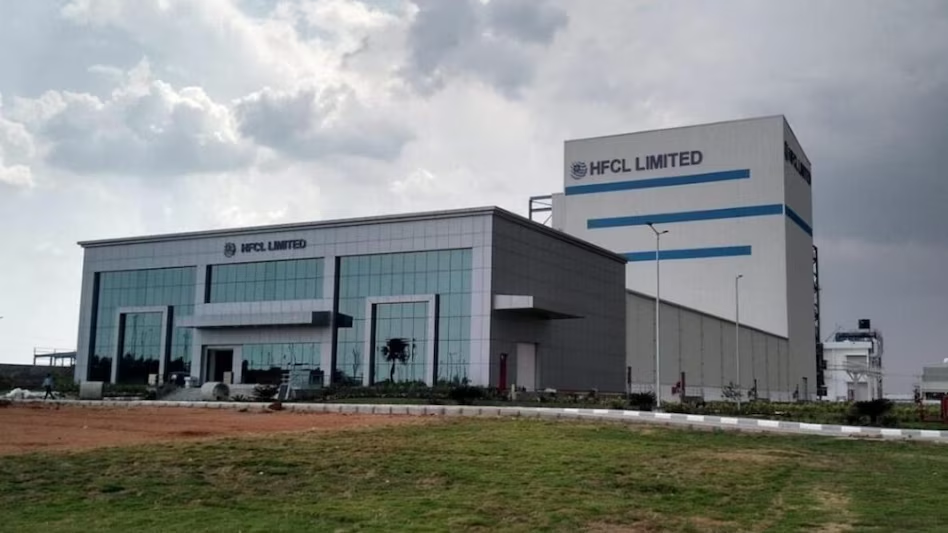
HFCL export order news means the Indian telecom gear maker has won a big overseas deal worth ₹495 crore. An export order is a sale to a buyer in another country. In this case, HFCL will supply optical fibre cables to an international data centre company. That matters because data centres need fast links to move huge amounts of data.
Key takeaways
- HFCL has won a ₹495 crore export contract from an international data centre company.
- The company will supply optical fibre cables, which carry internet data as light signals.
- The deal points to strong demand from data centres, cloud firms, and AI services.
- For India, it shows local telecom manufacturers can win large global orders.
What is the HFCL export order about?
The HFCL export order is for optical fibre cables, often called OFC. Optical fibre cable carries data using pulses of light. That makes it very fast, and it helps move internet traffic across long distances.
HFCL said the order value is about ₹495 crore. That is close to ₹5 billion, or roughly $59 million at an exchange rate near ₹84 to the dollar. The buyer was described as an international data centre company, but its name was not shared.
Data centres are giant buildings full of computers. They store websites, apps, videos, and AI tools. Because people stream, shop, game, and use chatbots all day, these buildings need dense fibre networks inside and outside the site.
Why do data centres need so much fibre cable?
Think of a data centre like a huge railway station. Data is the train, and fibre is the track. If there are too few tracks, trains slow down. So operators keep adding more fibre to prevent jams.
This is one reason the HFCL export order stands out. AI services are pushing traffic higher, and cloud firms are expanding server capacity. A server is a powerful computer that stores and sends data. More servers usually mean more cables.
Even small delays matter. A delay of milliseconds means tiny parts of a second. For video calls, cloud gaming, and AI tools, speed matters because users expect answers almost right away.
Key numbers behind the HFCL export orderOrder₹495 cr$ value~$59m₹/$ rate~84
Why is this order important for HFCL?
First, size matters. A ₹495 crore deal is large enough to grab attention in the telecom manufacturing space. It gives investors a clue that HFCL is not only chasing Indian contracts. It is also building business overseas.
Second, the buyer type matters. Data centre spending can be steadier than some telecom spending, because digital traffic keeps growing. That does not make it risk-free, but it can open repeat business if the first project goes well.
The HFCL export order also shows how Indian firms fit into a wider tech buildout. Chips, servers, switches, and fibre all work together. We recently covered how Micron plans a huge U.S. chip manufacturing expansion, while software demand is also rising with tools like OpenAI’s newer GPT-5.6 models.
What does optical fibre cable actually do?
Optical fibre cable is made from very thin strands of glass. Yes, glass. Light travels through those strands and carries data much faster than old copper cables in many use cases.
Fibre is the backbone of the internet. A backbone is the main route that heavy traffic uses. Without enough backbone capacity, networks get crowded, so speeds can drop when lots of people log on at once.
That is why the HFCL export order is not just about one company’s sales number. It is also about the hidden plumbing of the internet. Most people never see these cables, but they use them every time they watch a reel, back up photos, or ask an AI bot a question.
How does this fit into the bigger India tech story?
India wants to grow as a manufacturing and digital hub. That includes everything from semiconductors to telecom gear to support services. Big network projects can help local companies build a global track record.
There is also a strong data angle. More global firms are building in India and serving India from abroad. Our earlier report on India’s potential to support 5,000 global capability centres by 2030 shows how fast digital infrastructure needs could rise.
The link is simple. More offices, more apps, and more AI use mean more data. As a result, more fibre is needed between cities, under campuses, and inside data centres.
What numbers stand out in the HFCL export order?
The headline figure is ₹495 crore. That equals 495 x 10 million rupees, which is ₹4.95 billion. For many readers, that is easier to picture as nearly ₹500 crore, or just under $60 million.
Here is a simple snapshot of the key figures:
| Item | Figure | What it means |
|---|---|---|
| Order value | ₹495 crore | Large overseas contract for HFCL |
| Rupee value | ₹4.95 billion | Same amount in billions |
| Approx. dollar value | ~$59 million | Rough conversion at ₹84 per $1 |
| Buyer type | International data centre company | A global operator of server facilities |
If you compare it with a ₹100 crore deal, this one is almost five times larger. That is why markets often watch such announcements closely. Big orders can improve revenue visibility, which means investors get a clearer idea of future sales.
What should readers watch next?
Watch for three things. First, look for the delivery timeline if the company shares it later. Second, see whether HFCL wins more data-centre-linked deals. Third, track whether this order helps margins, which is the profit left after costs.
Readers should also watch the wider buildout of AI and cloud infrastructure. More demand for computing often means more demand for network equipment too. For primary details on the company, readers can check HFCL’s official site and market disclosures on BSE.
Here is the plain takeaway: the HFCL export order shows that the internet’s hidden pipes are becoming a hot business again. As AI, cloud tools, and streaming grow, companies that make the cables and gear behind them could see more chances to win large global deals.
FAQs
What is the HFCL export order?
It is a ₹495 crore overseas contract for optical fibre cables. HFCL will supply the cables to an international data centre company.
Why are fibre cables important?
They move data as light, so they are very fast. Data centres need lots of fibre because apps, videos, and AI tools use huge amounts of data.
Why does this matter for India?
It shows an Indian company can win a major global tech infrastructure deal. That helps India’s image as a maker of telecom and digital equipment.
How big is ₹495 crore in dollars?
It is roughly $59 million at an exchange rate near ₹84 per dollar. The exact figure changes if the rupee moves.
Get the day’s top stories in your inbox
One concise email. No spam, unsubscribe anytime.