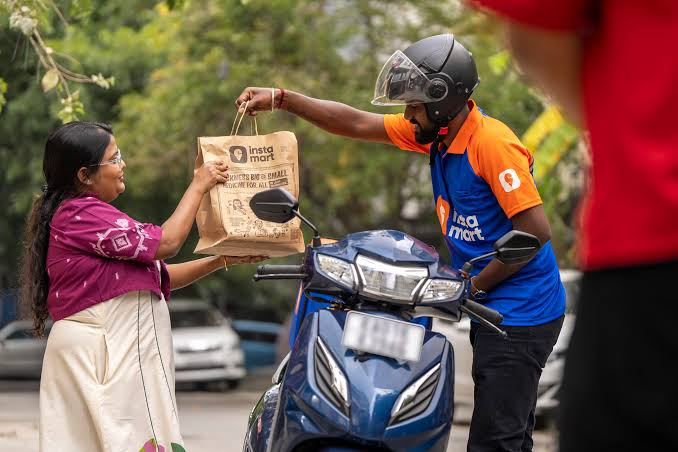
India’s leading fast-moving consumer goods (FMCG) companies are witnessing a sharp acceleration in quick commerce (q-commerce) sales, with Hindustan Unilever (HUL), Dabur, Marico, and Tata Consumer Products reporting growth of up to 62% through ultra-fast delivery platforms such as Blinkit, Zepto, Swiggy Instamart, Flipkart Minutes, and BigBasket Now. The surge highlights how consumer shopping habits are shifting toward instant delivery for everyday essentials, making quick commerce one of the fastest-growing sales channels for the FMCG industry.
The rapid expansion has prompted FMCG companies to launch channel-specific products, smaller stock-keeping units (SKUs), and premium offerings tailored for quick commerce. As urban consumers increasingly rely on 10–30 minute deliveries, the channel is evolving from an emergency shopping option into a mainstream retail format that is reshaping India’s consumer goods market.
Quick Commerce Emerges as a Major Growth Driver
Recent quarterly updates from major FMCG companies show that quick commerce continues to outpace traditional retail and even conventional e-commerce.
According to company disclosures:
- Hindustan Unilever (HUL) reported approximately 62% year-on-year growth in quick commerce.
- Dabur recorded strong double-digit growth across quick commerce and e-commerce channels.
- Marico highlighted robust momentum across its domestic and digital businesses.
- Tata Consumer Products continued to strengthen its presence on quick commerce platforms as part of its omnichannel strategy.
Quick Commerce Performance
| Company | Quick Commerce Trend |
|---|---|
| Hindustan Unilever | Up to 62% growth |
| Dabur | Strong double-digit growth |
| Marico | Continued robust expansion |
| Tata Consumer Products | Rapid channel growth and wider availability |
Why Quick Commerce Is Growing So Rapidly
Several structural changes are fueling the rapid adoption of quick commerce across India’s FMCG sector.
Key growth drivers include:
- Rising demand for deliveries within 10–30 minutes.
- Higher purchases of groceries and daily essentials.
- Increasing urban smartphone penetration.
- Expansion of dark store networks.
- Greater availability of premium and impulse-buy products.
What initially served as a convenience channel for emergency purchases has expanded into a preferred shopping destination for routine household needs.
Growth Drivers
| Factor | Impact |
|---|---|
| Faster deliveries | Improved customer convenience |
| Dark store expansion | Wider product availability |
| Urban demand | Higher order frequency |
| Premium assortment | Increased basket values |
FMCG Companies Adapt Their Strategies
Consumer goods manufacturers are increasingly designing products specifically for quick commerce platforms.
Strategic initiatives include:
- Launching platform-exclusive product packs.
- Offering smaller and trial-sized SKUs.
- Increasing premium product availability.
- Improving inventory planning with platform partners.
- Investing in digital merchandising and targeted promotions.
These efforts help brands capture impulse purchases while ensuring products remain consistently available on fast-delivery platforms.
Business Benefits
| Strategy | Expected Outcome |
|---|---|
| Exclusive SKUs | Better consumer engagement |
| Smaller pack sizes | Higher purchase frequency |
| Premium products | Improved margins |
| Digital promotions | Greater visibility on apps |
Quick Commerce Is Becoming Material for FMCG Sales
Industry estimates indicate that quick commerce is no longer a niche sales channel.
According to Kotak Institutional Equities, quick commerce now contributes around 6% of total FMCG sales, roughly double its share a year earlier, underscoring its growing importance in companies’ distribution strategies.
For leading FMCG companies, the channel complements traditional kirana stores, supermarkets, and e-commerce marketplaces while providing direct access to high-frequency urban consumers.
Distribution Evolution
| Channel | Current Trend |
|---|---|
| Traditional retail | Stable growth |
| Modern trade | Continued expansion |
| E-commerce | Healthy growth |
| Quick commerce | Fastest-growing channel |
Looking Ahead
The rapid growth reported by HUL, Dabur, Marico, and Tata Consumer Products underscores how quick commerce has become a strategic pillar for India’s FMCG industry. With consumers increasingly expecting groceries and household essentials within minutes, companies are redesigning product portfolios, packaging, and supply chains to meet evolving shopping preferences.
As platforms continue expanding into new cities and improving delivery infrastructure, quick commerce is expected to capture a larger share of FMCG sales. Companies that successfully tailor their product mix and distribution strategies for this channel are likely to gain a competitive edge, making quick commerce one of the most influential trends shaping India’s consumer goods sector over the next few years.
Get the day’s top stories in your inbox
One concise email. No spam, unsubscribe anytime.