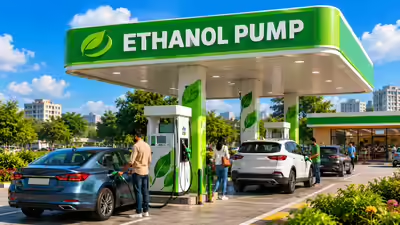
In a synchronized push to transition India toward sustainable mobility, the Ministry of Petroleum and Natural Gas has announced an aggressive infrastructure roadmap for alternative fuels. The central government plans to establish 500 ethanol dispensing stations across the country by the end of 2026.
The announcement, delivered by Union Minister Hardeep Singh Puri, marks the official launch of high-blend ethanol fuel infrastructure designed to support a new wave of Flex-Fuel Vehicles (FFVs).
The Phased Infrastructure Rollout Plan
To ensure fuel availability matches manufacturing pipelines, the government is executing the infrastructure expansion in distinct chronological phases:
- The Initial Corridor (Current Phase): The rollout begins with an initial cluster of 50 to 100 dispensing stations strategically located across high-density urban corridors, specifically Delhi-NCR, Mumbai, Pune, and Nagpur.
- The 2026 Milestone: This foundational network will expand rapidly to touch 500 functional pumps by December 2026. These stations will primarily focus on distributing the newly commercialized E85 fuel (a blend of 85% ethanol and 15% petrol) along with E100 (nearly pure ethanol).
- The 2027 Long-Term Target: Looking further ahead, the Ministry aims to scale the network exponentially to over 5,000 operational outlets across major Indian cities by the close of 2027.
Syncing Infrastructure with Automotive Rollouts
The expansion plan directly addresses a historic “chicken-and-egg” problem in the biofuel sector: fuel retailers wouldn’t install pumps without vehicles on the road, and automakers wouldn’t build flex-fuel engines without pump infrastructure.
The policy shift is heavily supported by major automotive milestones in the mass-market transport sector:
- Passenger Vehicles: Maruti Suzuki recently unveiled India’s first passenger flex-fuel car—the WagonR Flex Fuel prototype—engineered to handle high-blend ethanol lines beyond the standard E20 threshold.
- Two-Wheelers: Hero MotoCorp has launched mass-market, flex-fuel variants for its highly popular Splendor+ and HF Deluxe motorcycles. These commuter bikes are fully calibrated to operate seamlessly on any blend ranging from E20 up to E85, with consumer deliveries scheduled to begin in July 2026.
Macro Economic and Agricultural Projections
The aggressive target to hit 500 stations is backed by significant fiscal and environmental incentives:
1. Consumer Economics: The ₹20 Discount
To compensate for the fact that ethanol carries roughly one-third lower energy density than pure petrol, the government has mandated that state-run oil marketing companies (OMCs) retail E85 at a steep discount of ₹20 per litre compared to standard E20 petrol. At ₹82.12 per litre in Delhi, this deep pricing discount is intended to guarantee immediate running-cost parity for early adopters.
2. Multi-feedstock Sourcing and Forex Savings
The Ministry noted that India’s overarching ethanol blending program has already achieved a 20% baseline blend nationwide, moving up from just 1.5% in 2014. By substituting 302 lakh metric tonnes of crude oil, the program has insulated the economy against global energy shocks to the tune of ₹1.84 lakh crore in foreign exchange savings.
Furthermore, production capabilities have diversified beyond sugarcane to utilize multiple domestic feedstocks, including broken food grains, agricultural waste, bamboo, and seaweed.
3. Boosting Rural Income
According to government assessments, if just 50% of new two-wheelers and passenger vehicles sold in the country transition to flex-fuel technology, it will trigger an additional ethanol demand of over 311 crore litres. This scale of adoption is projected to generate an estimated ₹12,403 crore in extra income for Indian farmers supplying the necessary biomass.
Regulatory Backing
To smooth out the legal integration of the 500-station network, the Ministry of Road Transport and Highways has formally proposed sweeping amendments to the Central Motor Vehicles Rules, 1989. The new draft framework will legally establish standardized emission compliance and fuel safety definitions for high-level alternative fuels—including E85, E100, B100 biodiesel, and hydrogen-CNG combinations—laying a transparent foundation for automakers and fuel station operators alike.
Get the day’s top stories in your inbox
One concise email. No spam, unsubscribe anytime.